Lieutenant Carl E. Decklar of Dubuque, Indiana, was a fighter pilot of the United States Army Air Forces, serving with the 354th Fighter Squadron, part of the 355th Fighter Group. In the final period of the war, the unit was based at Steeple Morden in the United Kingdom. His combat career coincided with the most intense phase of fighter operations over Western Europe, during the turn of 1944 and 1945.

Lieutenant Carl E. Decklar and the ground crew of his Mustang, S/Sgt. Virgil McAfee and an unidentified mechanic. January–March 1945. Photo: Mark Decklar, 355th Fighter Group
Combat record
Second Lieutenant Carl Decklar scored his first two confirmed aerial victories on January 14, 1945, during an aggressive fighter sweep over the Münster area. This was the group’s third combat mission of the day. American pilots engaged successive formations of Bf 109s and Fw 190Ds. After a short but extremely intense fight, pilots of the 355th Fighter Group claimed 11 victories, with two Messerschmitt Bf 109s credited to Decklar.
On March 22, 1945, Lieutenant Decklar took part in a large-scale attack on the airfields at Memmingen, Würzburg, and Kitzingen. During this operation, he destroyed one enemy aircraft on the ground, shared with Lieutenant Paul Vineyard. On that day, the 355th Fighter Group inflicted heavy losses on the Luftwaffe, destroying a total of 12 aircraft—including Me 262s, He 111s, Fw 190s, and Bf 109s—and damaging a further nine machines.

Another significant episode followed on April 4, 1945, during an armed reconnaissance mission over the Parchim, Perleberg, and Kaltenkirchen areas, combined with systematic attacks on airfields. During this action, the 355th Fighter Group destroyed seven aircraft on the ground. Notably, pilot Cooper damaged an unusual aircraft identified as a Dornier Do 335, while Riffle damaged a jet-powered Arado Ar 234—among the most advanced Luftwaffe aircraft of the final phase of the war.
Decklar scored his third—and final—confirmed aerial victory as a First Lieutenant on April 8, 1945, over the Oberpfaffenhofen area in southern Germany. The type of enemy aircraft shot down remains unknown.
Summary of Carl Decklar’s combat achievements: 3 confirmed aerial victories and 1.5 aircraft destroyed on the ground (five total claims: four individual and one shared).

The aircraft – the P-51K in frontline service
Decklar’s aircraft was a P-51K-1-NT Mustang, serial number 44-11360. The P-51K version was very similar to the early P-51D-5, differing mainly in the factory installation of the Aeroproducts propeller and the standard dorsal fin fillet.
Propeller from the P-51D
In operational service in the European Theater of Operations, many P-51K Mustangs were modified by replacing the Aeroproducts propeller with the Hamilton Standard propeller used on the P-51D. The reason was the inferior operational characteristics of the Aeroproducts propeller. This modification was common and also applied to Decklar’s aircraft.
Gunsight and mirror
Another change was the installation of the K-14 computing gunsight, replacing the earlier N-9. At the same time, the pilot opted to fit a Spitfire-type rear-view mirror on top of the windscreen—a popular solution among Mustang pilots that significantly improved rearward visibility. These features are included in the P-51K Mustang model straight from the box.

 Tail warning radar
Later in its service life, the Mustang “Dot Darlin’” (after five victories, photo above) was fitted with the AN/APS-13 tail warning radar, which alerted the pilot to an enemy approaching from behind. The characteristic antennae of the system are visible on the tail surfaces. Modelers can replicate them using thin wire and foil or thin sheet metal.
Read more about the radar here: link.
An example of the radar installed on another Mustang: photo below.

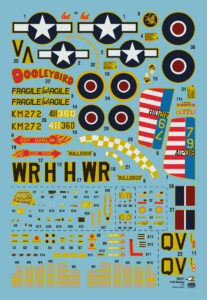
Markings and insignia – “Dot Darlin’ / Our Mom”
The name “Dot Darlin’” referred to the pilot’s wife, Dorothy. The second inscription, “Our Mom”, is less clear; it may have been added by another pilot or ground crew members, but there are no confirmed sources explaining its origin.
The squadron emblem—a bulldog—was painted on the tail, while the word “Bulldogs” appeared on the engine cowling, above the exhaust stacks, a distinctive marking of the unit.
The red band on the forward fuselage and the red vertical tail were not decorative elements—they indicated assignment to the 355th Fighter Group and its 354th Fighter Squadron. This is a typical example of functional yet visually striking USAAF unit markings from the final period of the war.
An example of how the P-51K changed during frontline service
The history of Carl Decklar’s P-51K shows how combat aircraft evolved at the front—from factory configuration, through local field modifications, to differences depending on the exact moment of the war. For the modeler, this is a particularly attractive subject, allowing a conscious choice of a specific “moment in time”, rather than just a generic paint scheme.
See also:
- P-51K Mustang model in the Arma Hobby store link

Modeller happy enough to work in his hobby. Seems to be a quiet Aspie but you were warned. Enjoys talking about modelling, conspiracy theories, Grand Duchy of Lithuania and internet marketing. Co-founder of Arma Hobby. Builds and paints figurines, aeroplane and armour kits, mostly Polish subject and naval aviation.
This post is also available in:
 polski