When Mustangs escorted bombers to Berlin in Europe, the situation in the Pacific looked completely different. Targets were farther away, the vastness of the ocean complicated navigation, and even a minor technical problem could easily mean the loss of both aircraft and pilot with little chance of rescue.
The challenge of distance
Since Summer 1944 Boeing B-29 Superfortress strategic bombers operated from the Mariana Islands and flew extremely long missions against Japan. Only after the capture of Iwo Jima in March 1945 could American forces deploy North American P-51D and P-51K Mustangs as escort fighters for these raids. The distance from Iwo Jima to Tokyo was roughly 1,200 km (750 miles) one way — comparable to the distance between southern England and Berlin. The difference was that over Europe pilots had land beneath them, emergency airfields and a developed rescue network. Over the Pacific, for most of the flight, they saw nothing but ocean.
At first, the Mustang was not the preferred fighter among local Pacific commanders. Many pilots placed greater trust in the Lockheed P-38 Lightning and Republic P-47 Thunderbolt. The twin-engine P-38 offered a better chance of returning home after losing one engine, while the rugged radial-engined P-47 was considered far more resistant to damage than the liquid-cooled Merlin-powered Mustang. Over ocean and jungle, this carried enormous psychological importance.
USAAF leadership ultimately selected the Mustang for a very simple reason — it offered the best balance of performance, range, production cost and large-scale operational capability. In Europe it had already proven capable of escorting bombers all the way to Berlin and back to England. After the capture of Iwo Jima, those same qualities made it the ideal fighter for Very Long Range operations against Japan.
VLR – Very Long Range standard
The Mustangs operating from Iwo Jima differed from their European counterparts. The VLR standard included not only additional fuel capacity, but also radio and navigation equipment needed for extremely long over-water missions.
Mustangs from Iwo Jima carried antennas for the AN/CPA-6 “Uncle Dog” radio-navigation system, helping pilots maintain course and find their way back to base across the open Pacific. Later in the war, some aircraft also received the AN/APS-13 rear-warning radar system, recognizable by its small antennas mounted near the rear fuselage.
The standard escort configuration used 110-gallon underwing drop tanks. These provided the range necessary for flights from Iwo Jima to Tokyo and back. Strike missions created a different problem: the hardpoints normally used for bombs were already occupied by fuel tanks. At the same time, HVAR rockets introduced on later P-51D variants increased aerodynamic drag, reducing range. To compensate, pilots often used larger and more streamlined 150-gallon tanks originally developed for the Lockheed P-38 Lightning.
The kit includes a separate VLR sprue containing these characteristic Pacific-war configurations — 110-gallon tanks, 150-gallon Lightning tanks and HVAR rockets used in attacks against airfields and ground targets.
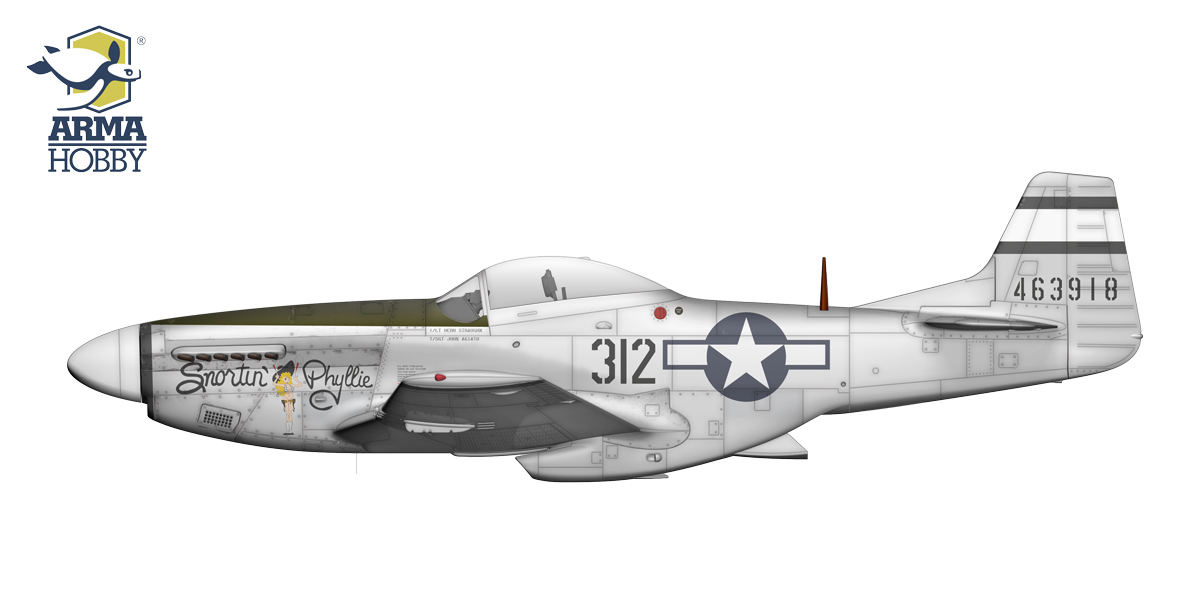
“Snortin’ Phyllie” – 21st Fighter Group
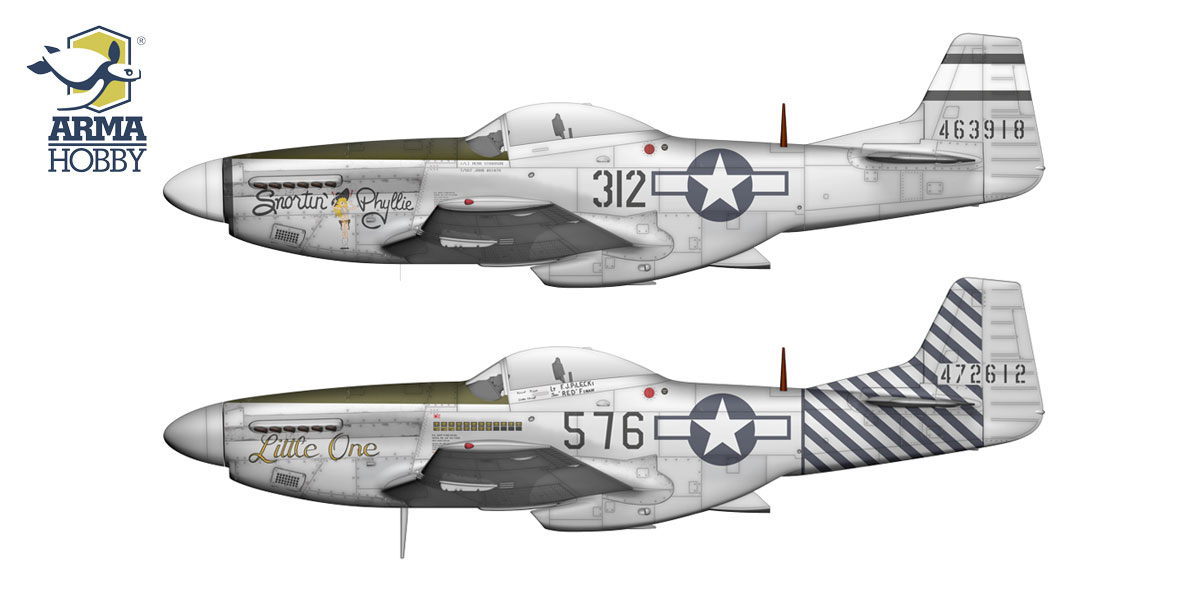
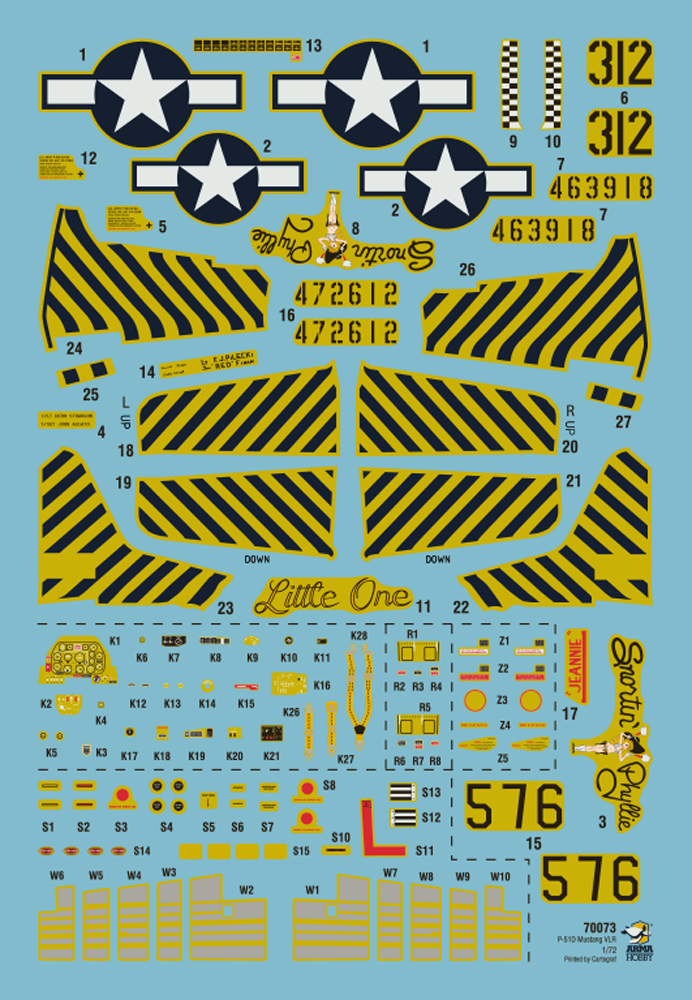
The first marking option in the kit is North American P-51D-20-NA, 44-63918/312, “Snortin’ Phyllie”, flown by 1st Lt. Herb Straughn of the 531st Fighter Squadron, 21st Fighter Group, Iwo Jima, spring-summer 1945.
This is a classic Iwo Jima Mustang — equipped for Very Long Range missions and carrying the characteristic markings of units operating over Japan. One of its most distinctive features was the white tail band with black borders, along with similarly marked wing and horizontal stabilizer tips.
The aircraft also featured a striking nose art painting of a lightly dressed cowgirl. The name “Snortin’ Phyllie” followed the typical style of wartime American nose art and likely referred to the temperamental young woman depicted on the aircraft.
More about reconstruction of aeroplane colors and configurations you can find here: Snorting Phyllie.
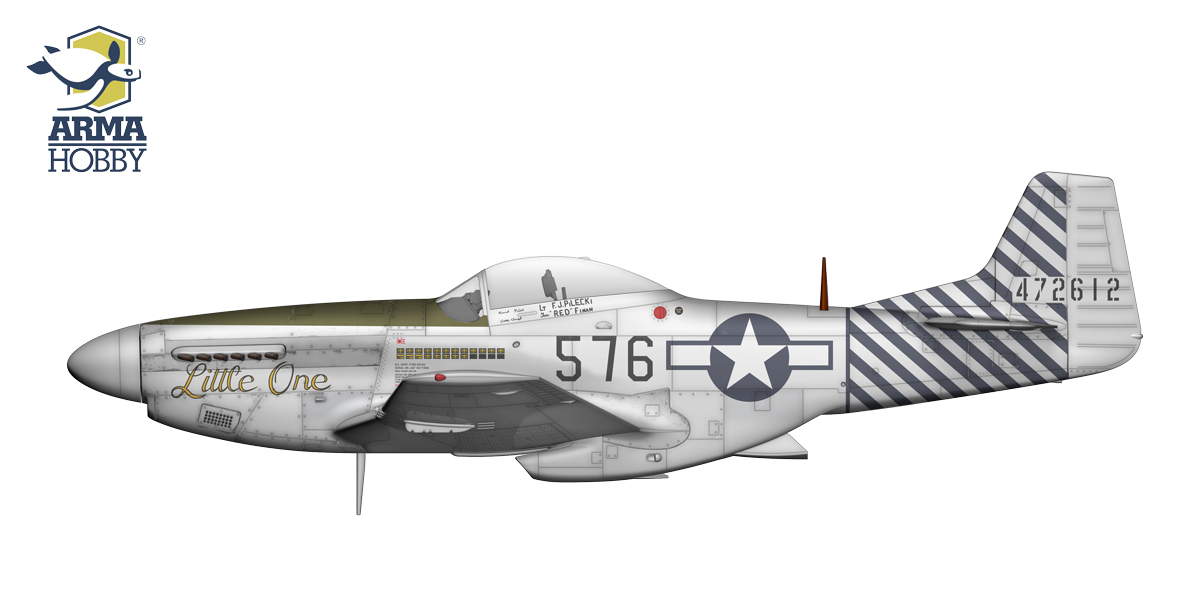
“Little One” – 506th Fighter Group
The second aircraft is P-51D-25-NA, 44-72612/576, “Little One”, flown by 1st Lt. Francis J. Pilecki of the 458th Fighter Squadron, 506th Fighter Group, Iwo Jima, spring 1945.
This is one of the most visually striking VLR Mustang schemes. The distinctive diagonal tail stripes immediately catch the eye. Combined with the additional fuel tanks and weapons load, the aircraft looks purpose-built for long-range flights over the Pacific and attacks against Japan.
Our kit is probably the first commercially available P-51D VLR model featuring tail stripes designed specifically to match the complex curves of the Mustang’s rear fuselage.
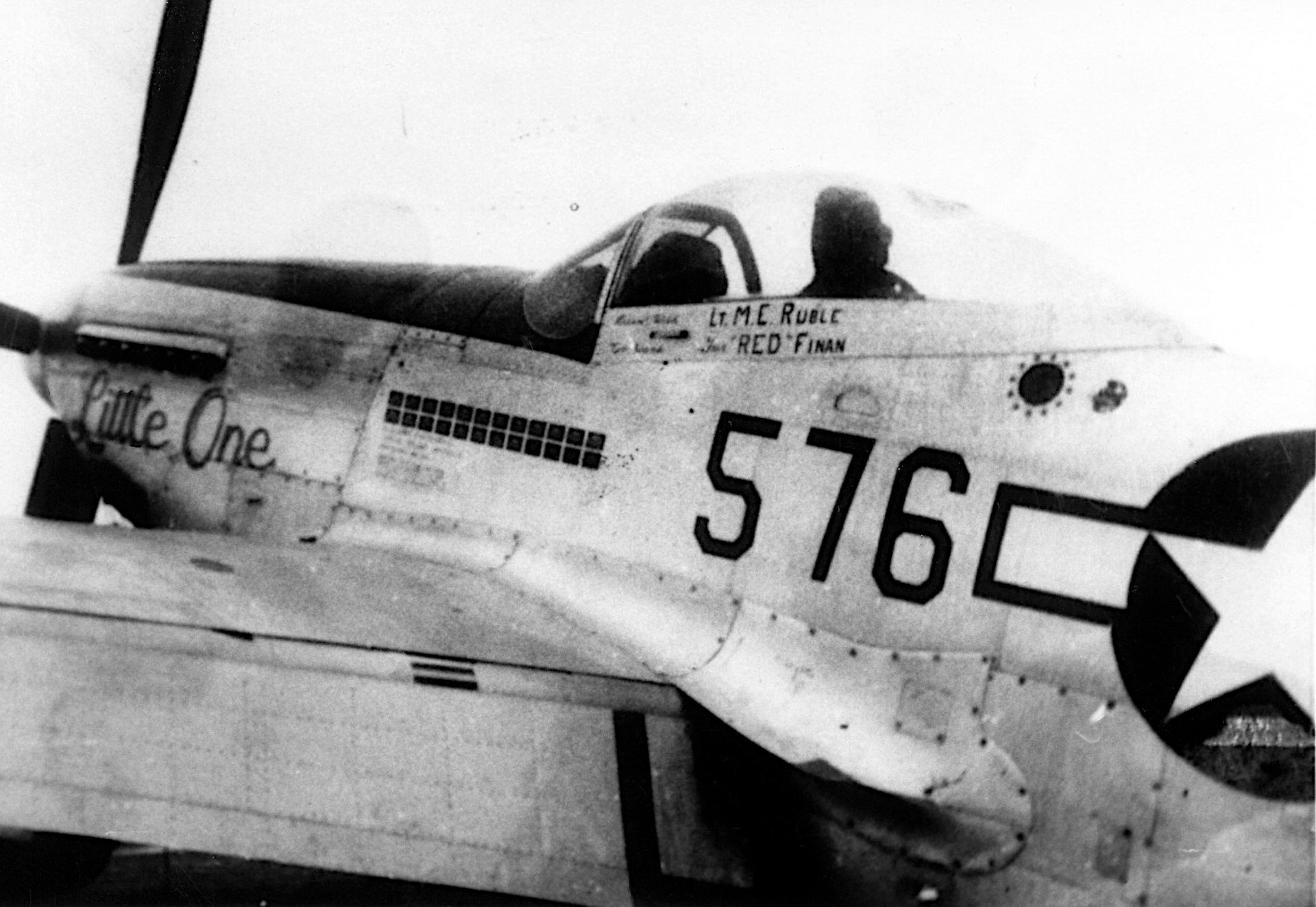
The pilot’s surname may also sound familiar to some readers because of its association with Witold Pilecki — a Polish resistance fighter who voluntarily entered Auschwitz in order to gather intelligence about the German concentration camp system. After escaping, he prepared some of the first reports describing the Holocaust for the Western Allies. After the war, Poland fell under Soviet-backed communist rule, and despite his wartime heroism, Pilecki was executed by the communist authorities in 1948 as an “enemy of the state. To the best of our knowledge, Lt. Francis J. Pilecki was not related to Witold Pilecki. However, as a Polish model company, we found the coincidence of the surname both interesting and worth mentioning alongside one of the most visually striking VLR Mustang schemes.
Mustangs over Japan
VLR missions were among the longest combat sorties ever flown by Allied single-engine fighters during World War II. The success of these operations depended on the Mustang’s extraordinary range, the capture of Iwo Jima and the immense logistical capabilities of American air power.
Our P-51D Mustang VLR kit represents this particular moment of the war — the point at which American fighters could routinely escort bombers over Japan and carry out direct attacks against targets on the Japanese Home Islands.
See also:
70090 F4F-3 Wildcat – trzy samoloty, które stanęły przeciw potędze Japonii

Modeller happy enough to work in his hobby. Seems to be a quiet Aspie but you were warned. Enjoys talking about modelling, conspiracy theories, Grand Duchy of Lithuania and internet marketing. Co-founder of Arma Hobby. Builds and paints figurines, aeroplane and armour kits, mostly Polish subject and naval aviation.
This post is also available in:
 polski