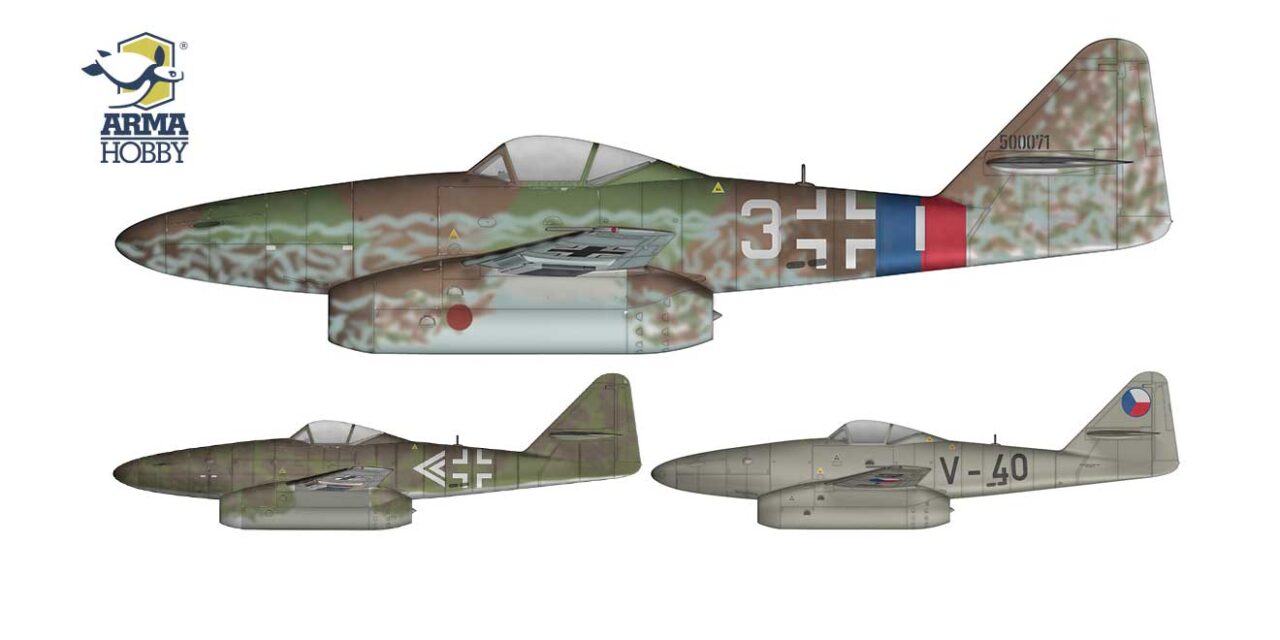
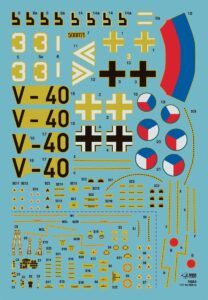
With the release of the new Messerschmitt Me 262 A-1a kit, we present the three marking options included in the box. Two depict German combat aircraft from the final months of World War II, while the third illustrates the post-war service of the type in Czechoslovakia.
Let’s take a closer look at each of them.
Messerschmitt Me 262 A-1a – the first operational jet fighter
The Messerschmitt Me 262 A-1a was the world’s first jet-powered fighter to enter front-line service. Its high top speed and heavy armament, consisting of four 30 mm MK 108 cannons, were intended to make it an effective bomber interceptor while allowing it to avoid prolonged turning combat with escort fighters.
Despite its remarkable combat potential, the Me 262 appeared too late and in insufficient numbers to influence the outcome of the war. Introduced into combat in late 1944 and early 1945, the type was unable to halt the Allied air offensive over Germany.
After the war, surviving Me 262 aircraft were extensively evaluated at Allied research establishments. At the same time, in Czechoslovakia, limited production was initiated using preserved technical documentation and production tooling. These aircraft were built as Avia S-92 single-seaters and CS-92 two-seat trainers, remaining in service until 1950 and performing, among other duties, air defence tasks around Prague.
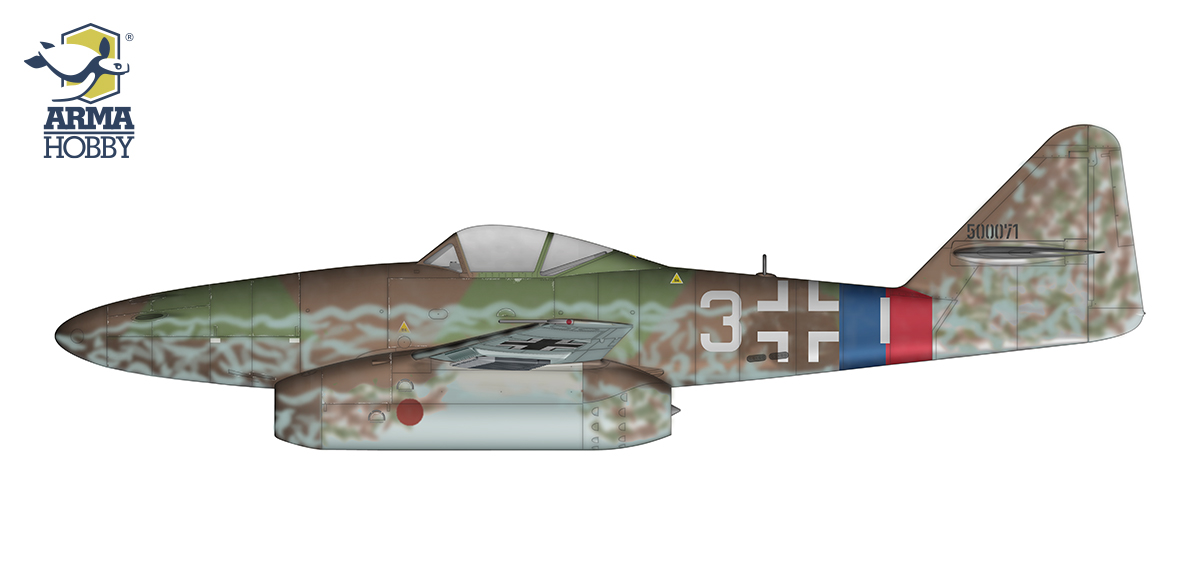
Messerschmitt Me 262 A-1a, W.Nr. 500071 “White 3”, Oberfähnrich (officer cadet) Hans Guido Mutke, 9./JG 7, Fürstenfeldbruck airfield, Germany, April 1945
The Messerschmitt Me 262 A-1a bearing factory number 500071 was assembled and test-flown in late March 1945, after which it was assigned to 9./JG 7. In April 1945 the aircraft was based at Fürstenfeldbruck airfield.
On 25 April 1945, pilot Oberfähnrich Hans Guido Mutke was tasked with ferrying the aircraft to Bad Aibling airfield due to the advance of American forces toward the Munich area. During the flight, either deliberately or as a result of navigational confusion, the aircraft entered Swiss airspace and landed at Zürich-Dübendorf, where it was interned until the autumn of 1945. The aircraft was returned to Germany only in 1957 and today is preserved in the collection of the Deutsches Museum in Munich.
Mutke is also associated with an earlier flight on 9 April 1945, during which, in a very steep dive, he may have briefly approached the speed of sound. Similar incidents may have occurred to other Me 262 pilots; however, if Mutke’s account is accurate, he would have been the first pilot to survive such an episode.
Although the event remains a subject of historical debate, it is sometimes regarded as one of the earliest encounters of a pilot with transonic flight regimes.
The kit provides tactical markings for “White 3” in two variants – with and without a yellow outline – allowing the modeller to choose the interpretation that best matches the available photographic evidence.
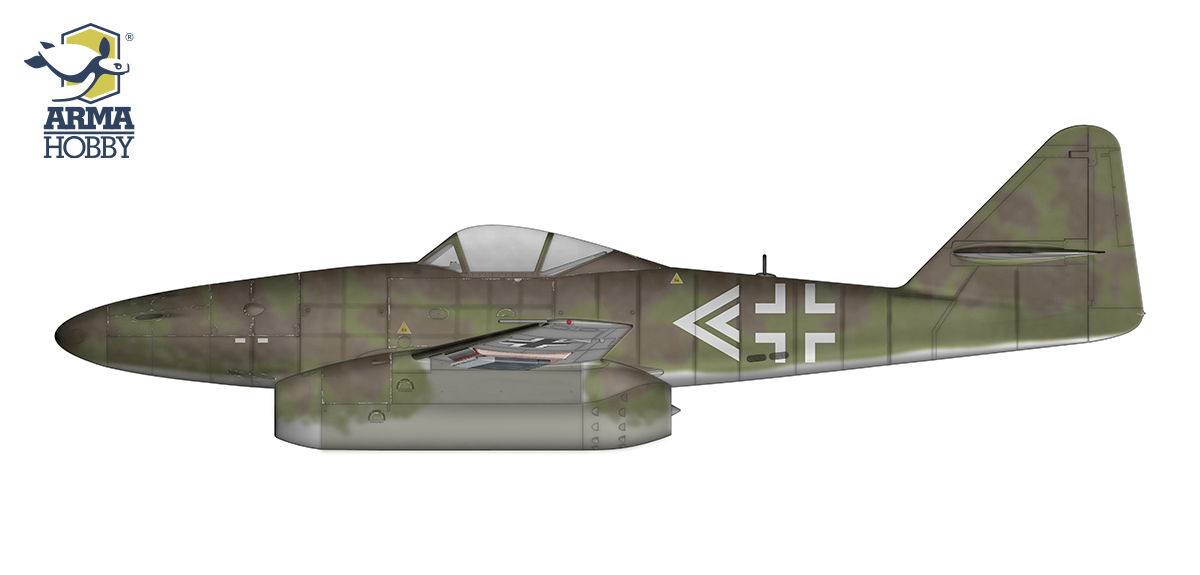
Messerschmitt Me 262 A-1a, Jagdverband 44, pilot: Generalmajor (brigadier general) Adolf Galland, unit commander, München-Riem airfield, Germany, February–April 1945
After being removed in January 1945 from his post as General der Jagdflieger (Inspector General of Fighter Aviation), Adolf Galland assumed command of the newly formed Jagdverband 44, equipped with Me 262 jet fighters. From February to April 1945, the unit conducted combat operations from München-Riem airfield.
The marking option included in the kit represents one of the Me 262 aircraft flown by Galland during his time with JV 44. It should be noted that pilots at this stage of the war were not permanently assigned to specific aircraft, instead flying whichever machines were available at the time, although the aircraft depicted carries full commander’s markings.
The profile included in the kit is a reconstruction based on fragmentary photographic evidence, consistent with the current state of research.
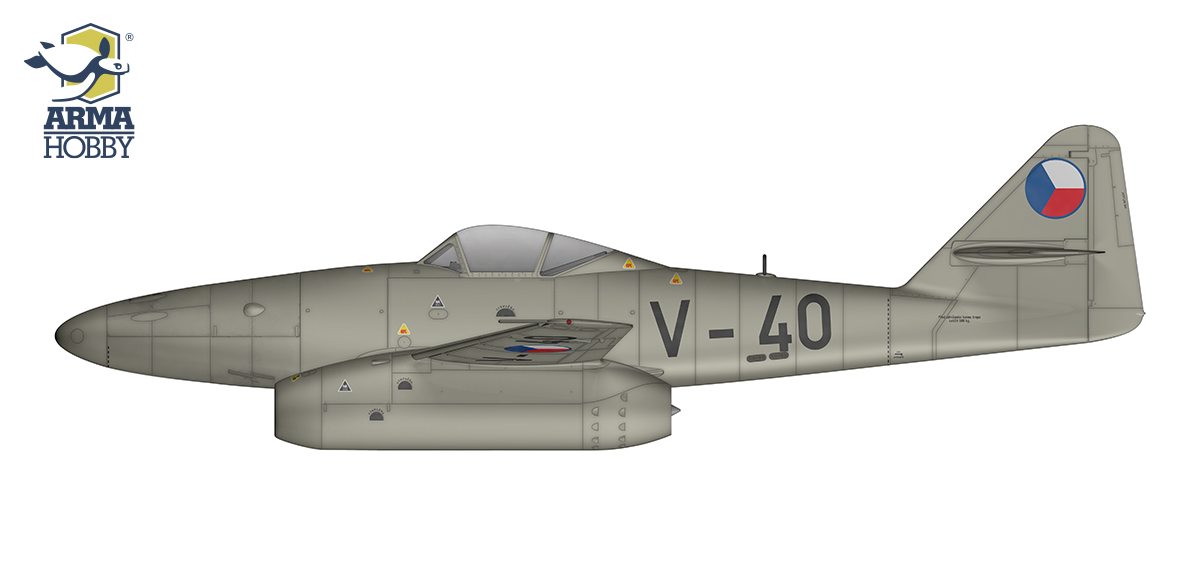
Avia S-92 “Turbina”, Czechoslovak Air Force, 5th Fighter Flight (5. stíhací letka), Žatec airfield, 1947–1950
Following the end of World War II, Czechoslovakia began production of jet fighters based on Messerschmitt Me 262 documentation. Single-seat aircraft were designated Avia S-92, while two-seat trainers were designated CS-92. Production commenced in 1946.
These aircraft were painted in shades close to the German RLM 02, using both post-war paint stocks and locally produced equivalents. They carried Czechoslovak national insignia and individual markings, including aircraft number V-40 applied to the fuselage and under the wings.
Although the Avia S-92 was still a capable fighter, like its German predecessor it suffered from limited technical reliability. In 1950 the type was withdrawn from front-line service, with some aircraft preserved in museums or used for display purposes.
See also:
Me 262 A-1a model in the Arma Hobby store link

Modeller happy enough to work in his hobby. Seems to be a quiet Aspie but you were warned. Enjoys talking about modelling, conspiracy theories, Grand Duchy of Lithuania and internet marketing. Co-founder of Arma Hobby. Builds and paints figurines, aeroplane and armour kits, mostly Polish subject and naval aviation.
This post is also available in:
 polski