

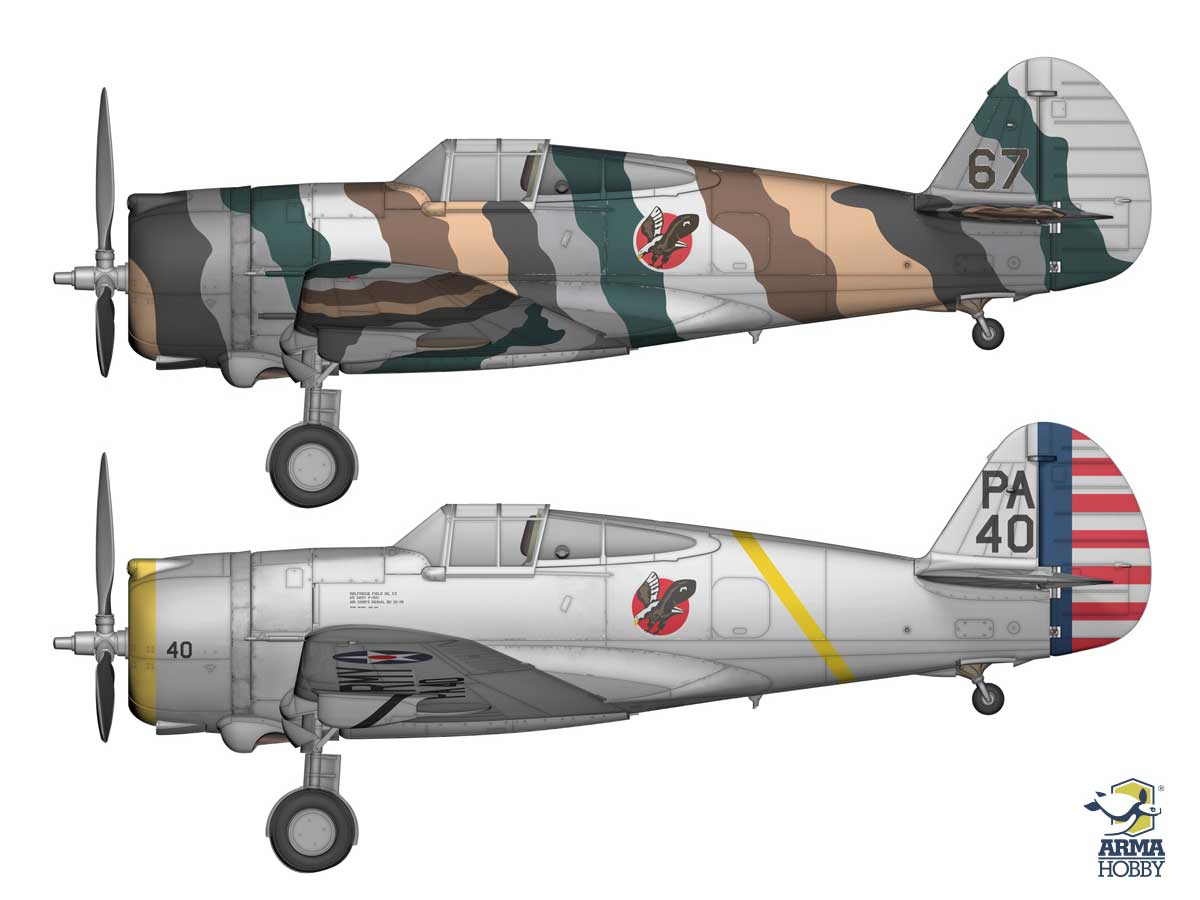
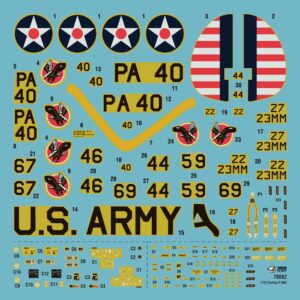
The new 70082 Curtiss P-36C boxing includes markings for aircraft of the 27th Pursuit Squadron — the unit whose machines were used to test some of the most striking experimental camouflage schemes applied by the U.S. Army Air Corps just before the war. We also added serial numbers on the decal sheet for several more aircraft from this unit that did not fit into the instruction booklet. So in this article, we show the camouflage schemes for each of them, while also putting the broader subject of USAAC aircraft finishes in the interwar period into context.
A colourful road to Olive Drab. The evolution of U.S. Army Air Corps aircraft finishes, 1918–1941
The evolution of U.S. Army Air Corps aircraft finishes between the end of the Great War and June 1941 — when the service became an independent branch under the name U.S. Army Air Force — is a remarkably colourful and adventurous story. It begins with specifications requiring aircraft to be painted in standard Army khaki and ends almost back where it started, with a only slightly less monotonous camouflage of Olive Drab 41 and Neutral Gray 43, so familiar from the Second World War.
Between that rather colourless beginning and equally unexciting end, however, a great deal happened. A surprisingly wide range of finishes appeared, including experimental and very short-lived ones, of which only a handful of surviving photographs document the search for an ideal form of camouflage.
From camouflage theory to military practice
Experiments with different methods of camouflage had already been carried out by armies and navies before the outbreak of the Great War. During the conflict, many armed forces established special units tasked with making military equipment and soldiers less visible to the enemy. Artists representing different styles and schools were often recruited for this creative work. It was in this period that the theoretical foundations of camouflage were developed.
The pioneer of military camouflage, artist and naturalist Abbott Handerson Thayer, described the protective coloration commonly found in animals, where the upper, most illuminated surfaces are darkest, while the shaded lower parts are lightest. Applying this principle, which he called countershading, he showed in his experiments how objects could visually blend into their background.
Alongside colour matching and tonal shading — the most intuitive form of camouflage, though effective only under specific conditions — experiments were also carried out with schemes whose purpose was not to hide an object within its surroundings, but to confuse the observer about its shape, size, distance or direction of movement. Drawing on knowledge of visual perception, designers tried to create camouflage patterns that made it difficult for the observer to focus on the object itself.
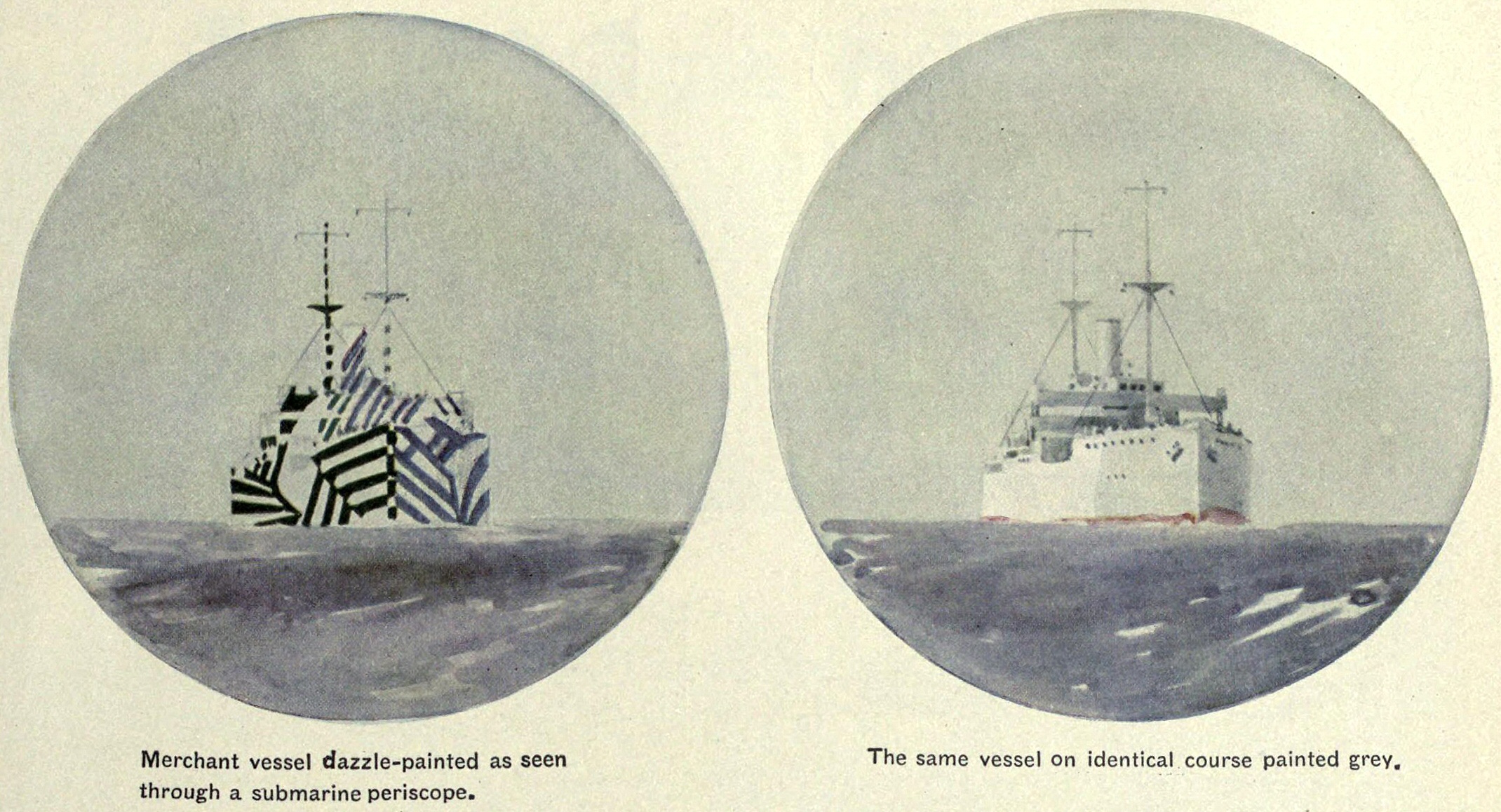
Claimed effectiveness of dazzle camouflage: a U-boat periscope view of a ship in camouflage (left) and without it (right), Encyclopædia Britannica, 1922. The patterns made it harder to judge the ship’s heading. Public domain via Wikipedia.
Large-scale practical use of this kind of disruptive camouflage, known as dazzle camouflage, took place at sea, on ships especially vulnerable to torpedo attack. The very fact that a ship was being observed through a periscope may have made this counterintuitive form of camouflage even more effective.
The anti-camouflage era: yellow wings and blue fuselages
All these advanced methods of concealment lost the interest of the U.S. Army Air Corps in peacetime. On the contrary, it was decided that good visibility increased safety. As a result, from 1925 aircraft received bright yellow paint on the upper surface of the upper wing, and from 1927 on both surfaces of both wings, while fuselages remained in Olive Drab.
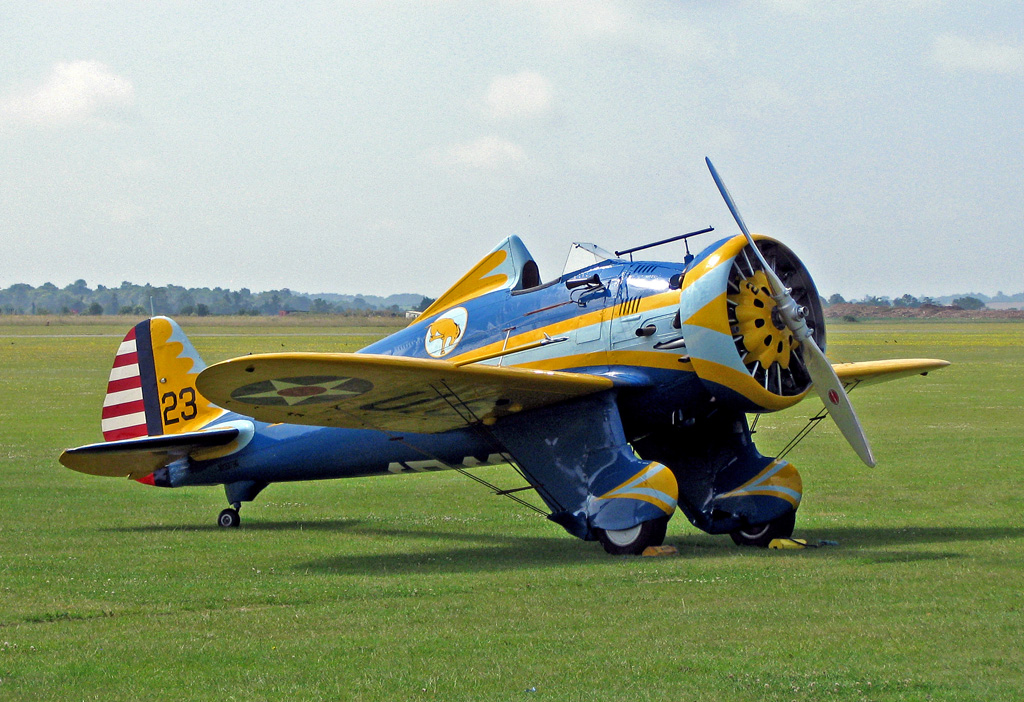
Yellow-and-blue Boeing P-26A 33-0123 NX3378G (c/n 1899) in 95th Pursuit Squadron markings, Duxford, Flying Legends 2014. Photo: RuthAS, own work, CC BY-SA, Wikimedia Commons.
Training aircraft soon received bright light blue fuselages. From May 1934 the finish was standardized, and both combat and training aircraft were painted in this second scheme with blue fuselages. After this anti-camouflage period of yellow wings, it was eventually decided to stop painting new aircraft altogether and leave them in natural aluminium finish.
First camouflage trials
Even during the period when these bright finishes were standard in the U.S. Army Air Corps, limited trials with different camouflage methods continued. In 1930, washable water-based paints were introduced. These could be applied for manoeuvres and also made it possible to experiment safely with different patterns and colours, since it was relatively easy to return to the official finish afterwards.
Research into new colours and patterns accelerated in the second half of 1937, after Brigadier General Henry Arnold, then responsible for procurement and production for the U.S. Army Air Corps, saw a photograph of a Fairey Battle painted in the newly developed RAF disruptive camouflage known as the Temperate Land Scheme.
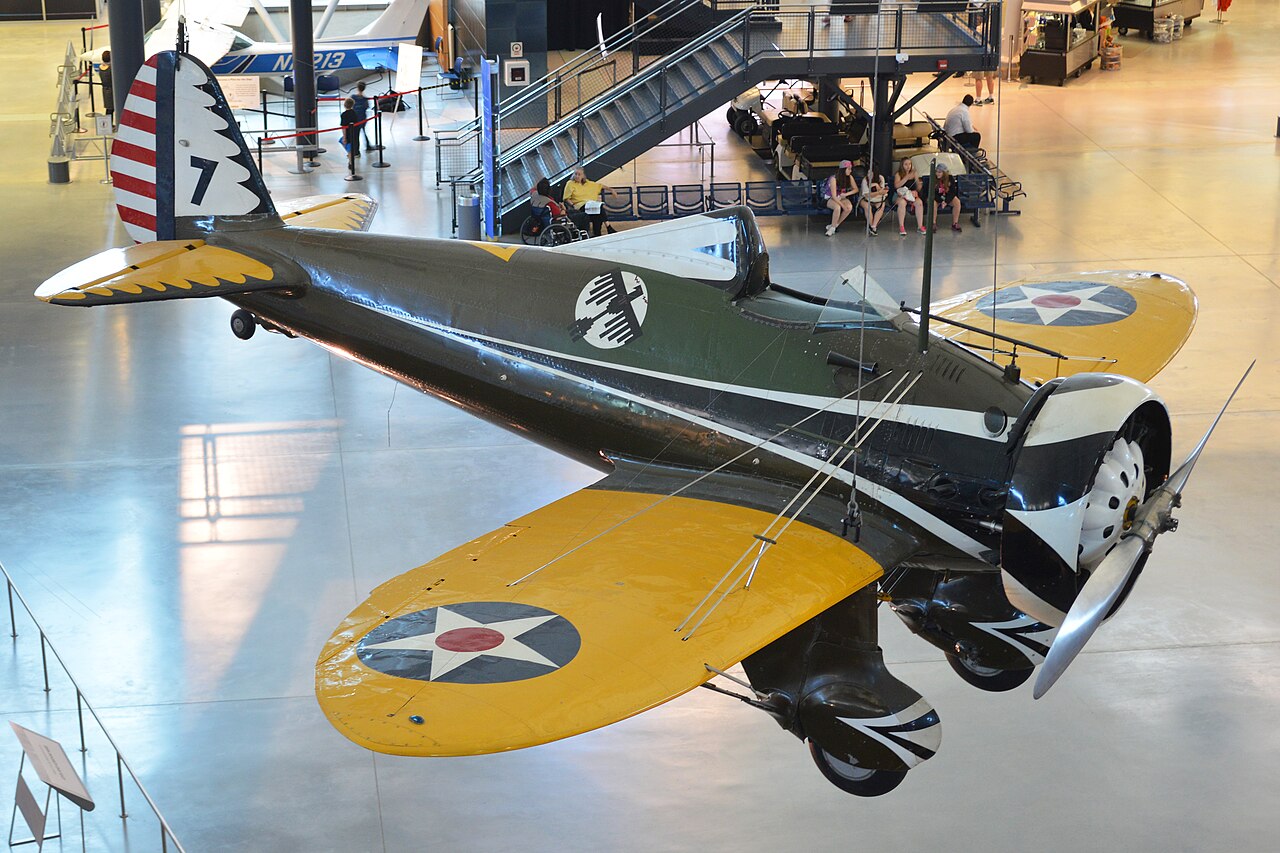
Yellow-and-olive Boeing P-26A 33-135 (c/n 1911), now displayed at the Steven F. Udvar-Hazy Center in 34th Pursuit Squadron markings. Photo: HawkeyeUK, Chantilly, Virginia, 2015, CC BY-SA 2.0.
Three directions of experimentation
The experiments followed three main directions. The first group of camouflage schemes was meant to be effective against the ground, the second against the sky, and the third was intended for night aircraft. The washable water-based paints developed earlier were used throughout.
It seems rather surprising that trials and experiments were needed to establish that green worked well over wooded terrain, blue over water, and sand over barren desert ground. It was also found that the second group of camouflage schemes, intended to hide an aircraft against the sky, was no more effective than leaving aircraft in natural metal finish.
Another conclusion was that propellers should be painted, because polished blades flashing in sunlight made aircraft easier to spot. It was also discovered that the rough, deeply matt finish of the water-based paints slightly reduced top speed. In the case of the P-36, the difference was about 3.5 mph.
“Camouflage Study No. 42”
By mid-1939, there was still an ongoing debate within the U.S. Air Corps over whether temporary camouflage, applied with washable paints, should remain the standard approach, or whether aircraft should instead receive camouflage finishes at the factory. Brig. Gen. Arnold supported the latter idea and directed the experiments toward creating an ideal aircraft finish that would be effective against both ground and sky, while also retaining usefulness in night operations.
In other words, he wanted to combine the three previously separate categories into one. On top of that came the demand that the camouflage should be effective in different geographical regions, and that its patterns should influence visibility and even the perceived size of a formation. The experiments intended to achieve these goals were designated “Camouflage Study No. 42”, and began in June 1939.
The bar was set very high, and as we know, such a universal and effective camouflage was never truly achieved. For us, however, this phase is important because its results — in the form of highly varied and colourful finishes — were shown to the civilian public, and were therefore captured in numerous colour photographs and films.
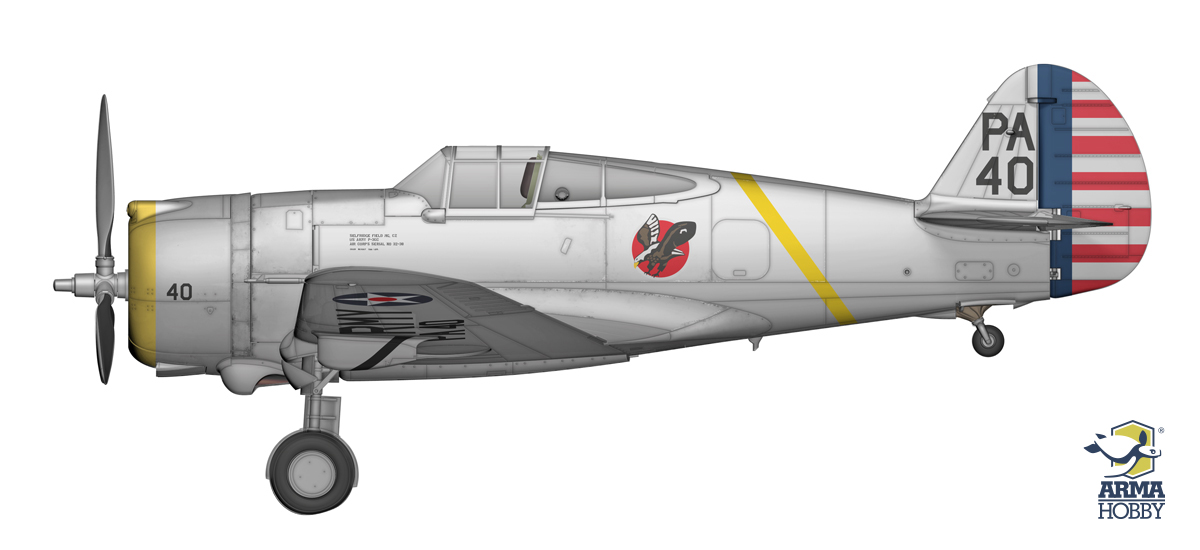
Curtiss P-36C, 27th Pursuit Squadron, USAAC, Selfridge Field, Michigan, 1939
This aircraft was photographed before the introduction of the display camouflage schemes, in the plain standard finish used by frontline units. It is a good example of the early appearance of the P-36C before the most intensive phase of camouflage testing began.
Cleveland 1939: camouflage as spectacle
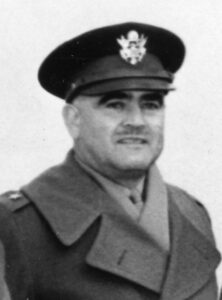
From 3 to 5 September 1939, the annual National Air Races took place in Cleveland. Eighteen P-36Cs of the 27th Pursuit Squadron attended, carrying unique and often highly eccentric camouflage and anti-camouflage schemes.
The finishes were divided into three groups. The first combined concealment against both ground and sky, with the familiar formula of dark upper surfaces and light undersides. The second used small bright disruptive patches against otherwise dark earth tones, with the same pattern applied to both upper and lower surfaces. The third and most interesting, called “Confusion and distortion”, was based on the same principle used in naval dazzle camouflage during the Great War.
In the case of aircraft, just as with ships, the goal was not to make them invisible, but to make their shape, size and direction of movement harder to judge. It was assumed that such labour-intensive, multi-colour finishes might offer advantages in air combat, although it was obvious that this came at the cost of concealment against either ground or sky.
The unit, commanded by Major Willis R. Taylor (pictured on the left), who flew aircraft number 69, arrived on Saturday, 3 September with 18 aircraft. Over the next three days, the pilots presented an approximately 25-minute tactical display, fragments of which can be seen in the colour film below:
The end of experimentation: Olive Drab and Neutral Gray
Further research continued throughout the year, and in conclusions issued in August 1940 it was recommended that aircraft should be painted in durable finishes using just two colours: Olive Drab on top and Neutral Gray underneath.
For a long time after that, U.S. Army Air Force aircraft were reasonably well camouflaged — and certainly in a way that was cheap and rather dull. Accountants must have been delighted by the choice of such a sparse and simple finish, especially with mass wartime production on the horizon. From an aesthetic and modelling point of view, however, this is a period of only moderate appeal — unless, of course, you happen to enjoy discussions about “50 shades of Olive Drab.”
Colours
It is still not entirely clear which water-based paints were actually used during these experiments. The surviving colour photographs do not make identification any easier. The same aircraft can look completely different in different exposures.
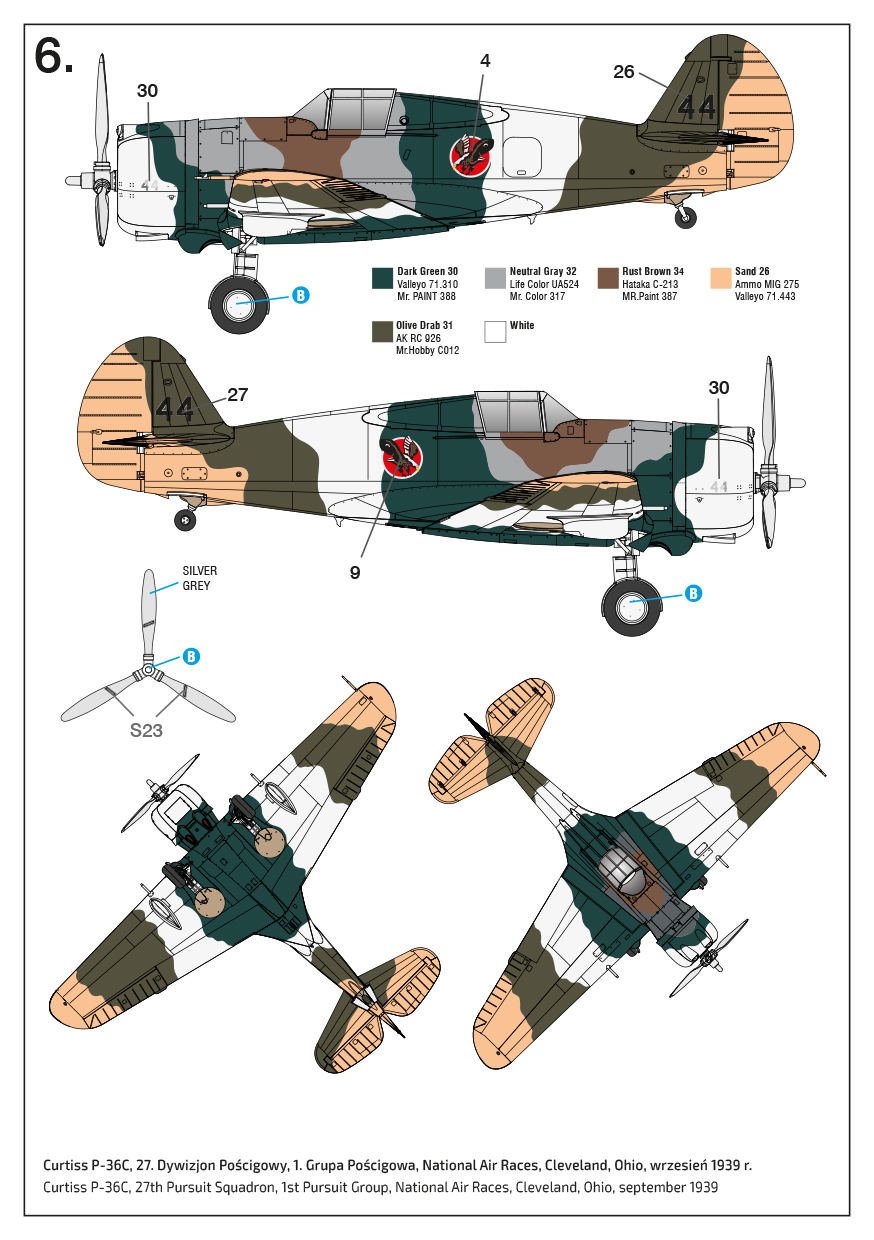
Robert Archer believed that the following colours were used on our Hawks: White 25, Sand 26, Sea Green 28, Dark Blue 29, Dark Green 30, Dark Olive Drab 31, and Neutral Gray 32. However, this selection does not stand up well against the photographs, and it seems necessary to add Black 33 and Rust Brown 34 as well. We have also been unable to identify any aircraft that clearly carried patches of Dark Blue 29 or Sea Green 28.
There is a great deal of uncertainty and contradictory information here, and even authorities in the field such as Dana Bell and Robert D. Archer were unable to find definitive documentation and resolve all of the ambiguities. We strongly believe that our interpretation of the colours and camouflage schemes, based on their work, avoids most of the obvious traps — but, as always, some room for alternative interpretations remains.
White 25 and Black 33
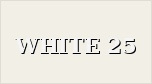

The easiest colours to interpret are, of course, White 25 and Black 33. Dana Bell gives their F.S. 595a equivalents as 37778 and 37038 respectively.
Sand 26

The least obvious of the colours is Sand 26. According to the author mentioned above, this appeared on 27th Pursuit Squadron aircraft in a form that was soon abandoned. Many errors of interpretation stem from the fact that the later sand colour had a distinctly pinkish hue, while the one seen in photographs and film appears yellow rather than pink.
Dana Bell himself refers to this colour as Orange Terra Cotta, and in my view it may have been close to FS 33434. In any case, eyewitnesses recalled it as having a vivid orange cast, which is worth bearing in mind when choosing a suitable modelling paint.
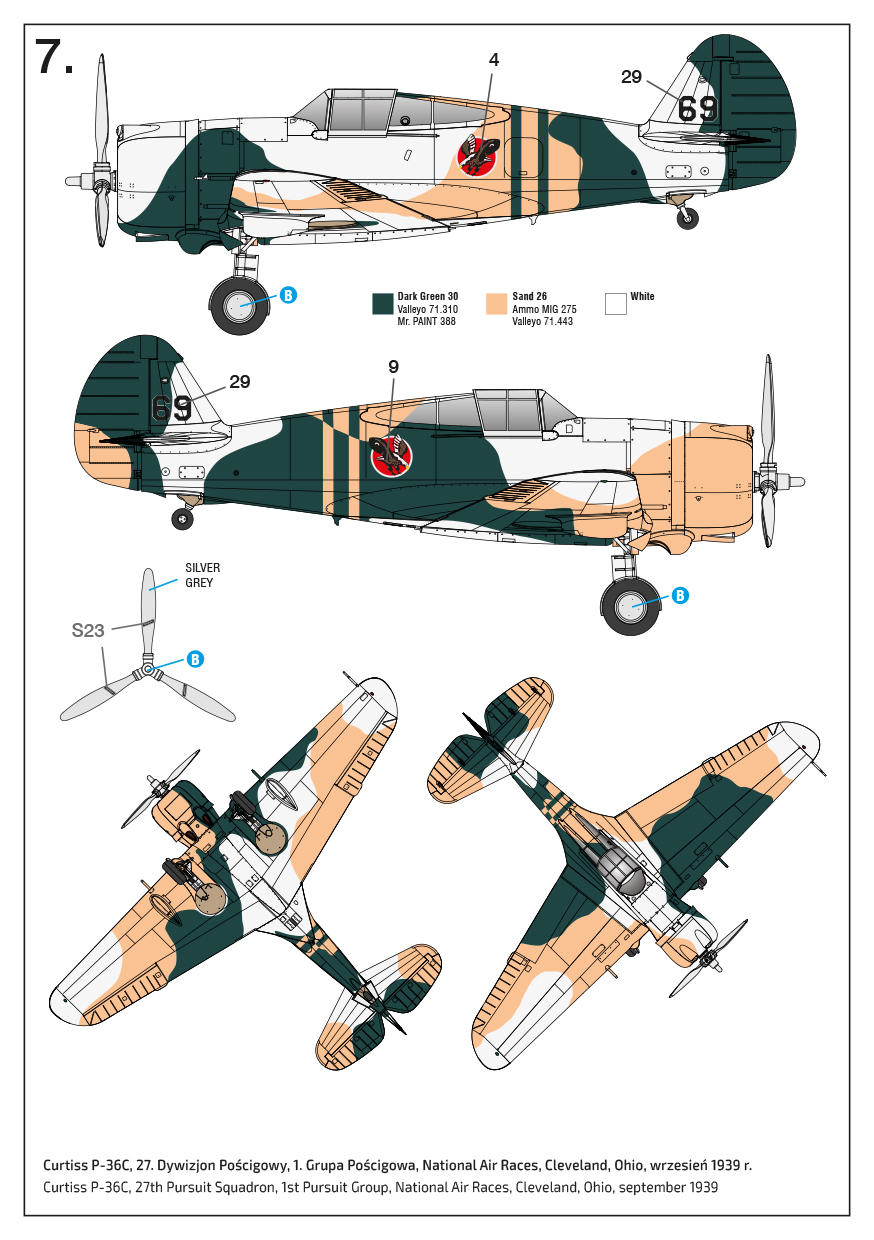
An interesting additional reference is also this Facebook post showing this colour on the glazing of aircraft “69” — the same machine also featured in the last colour scheme shown at the end of this article.
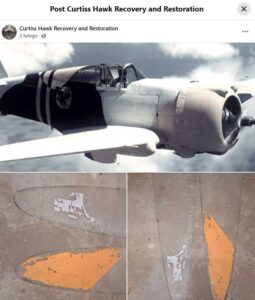
Source: Curtiss Hawk Recovery and Restoration / Facebook.
Dark Green 30

Dark Green 30 appears in photographs and film as a very dark black-green or bottle-green shade. Dana Bell identified it as a slightly darkened FS 34092. For my part, I would suggest a tone closer to FS 34058, which seems to match the photographic evidence very well.
Olive Drab 31
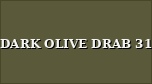
Olive Drab 31 has a good equivalent in FS 34087, although caution is needed, since paint manufacturers reproduce it differently. In any case, compared to the later and better-known Olive Drab 41, this earlier version was lighter and less brown in tone.
Neutral Gray 32

Neutral Gray 32 is close in tone to FS 36173, although it may have been slightly darker and more neutral.
Rust Brown 34

The last of the colours used, Rust Brown 34, is close to FS 30117, though slightly darker.
Examples of Curtiss P-36C camouflage schemes from the 27th Pursuit Squadron
Below we present a selection of Curtiss P-36C camouflage schemes from the period of camouflage experiments carried out by the 27th Pursuit Squadron. These very aircraft are what made Cleveland 1939 one of the most fascinating episodes in the history of American aviation camouflage — not only from a military point of view, but also from a modeller’s perspective.
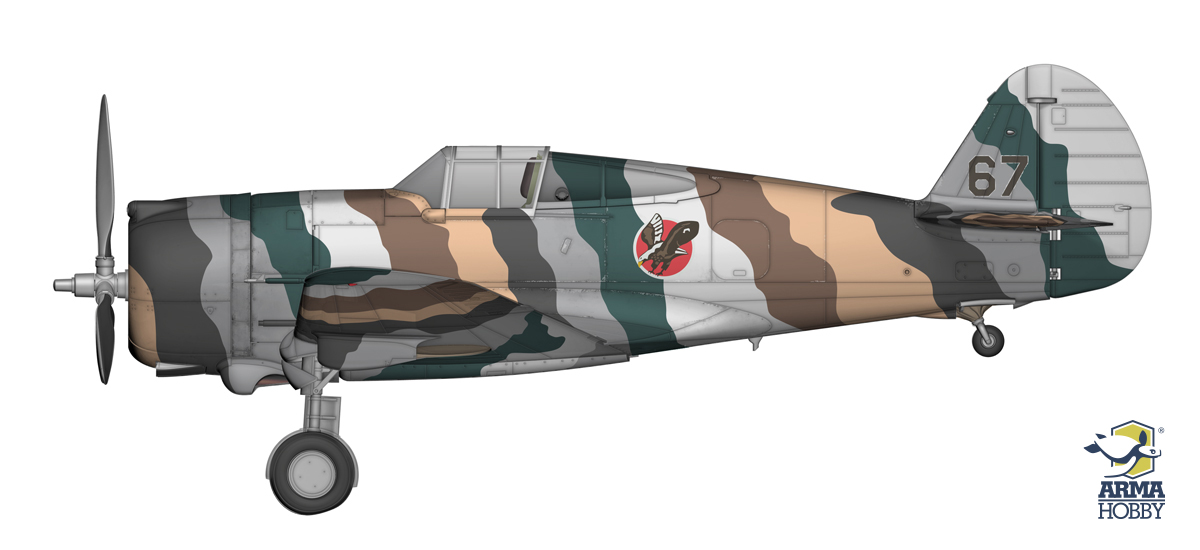
Curtiss P-36C, 27th Pursuit Squadron, 1st Pursuit Group, National Air Races, Cleveland, Ohio, September 1939
This aircraft wore one of the most distinctive experimental camouflage schemes used by the 27th Pursuit Squadron. The temporary, high-contrast finish was intended as a display scheme and formed part of the trials carried out before standard wartime camouflage patterns were introduced.
Bonus camouflage options for the Curtiss P-36C model
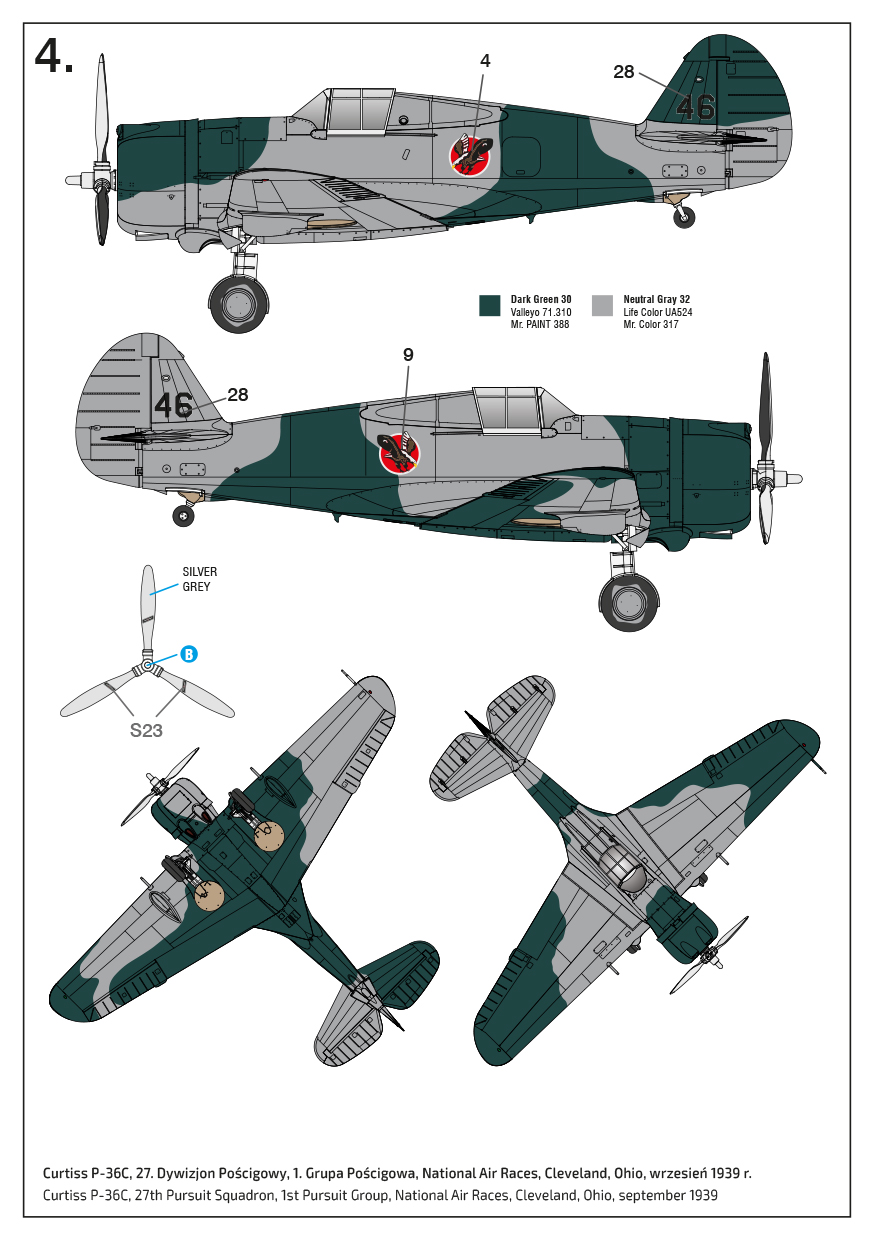
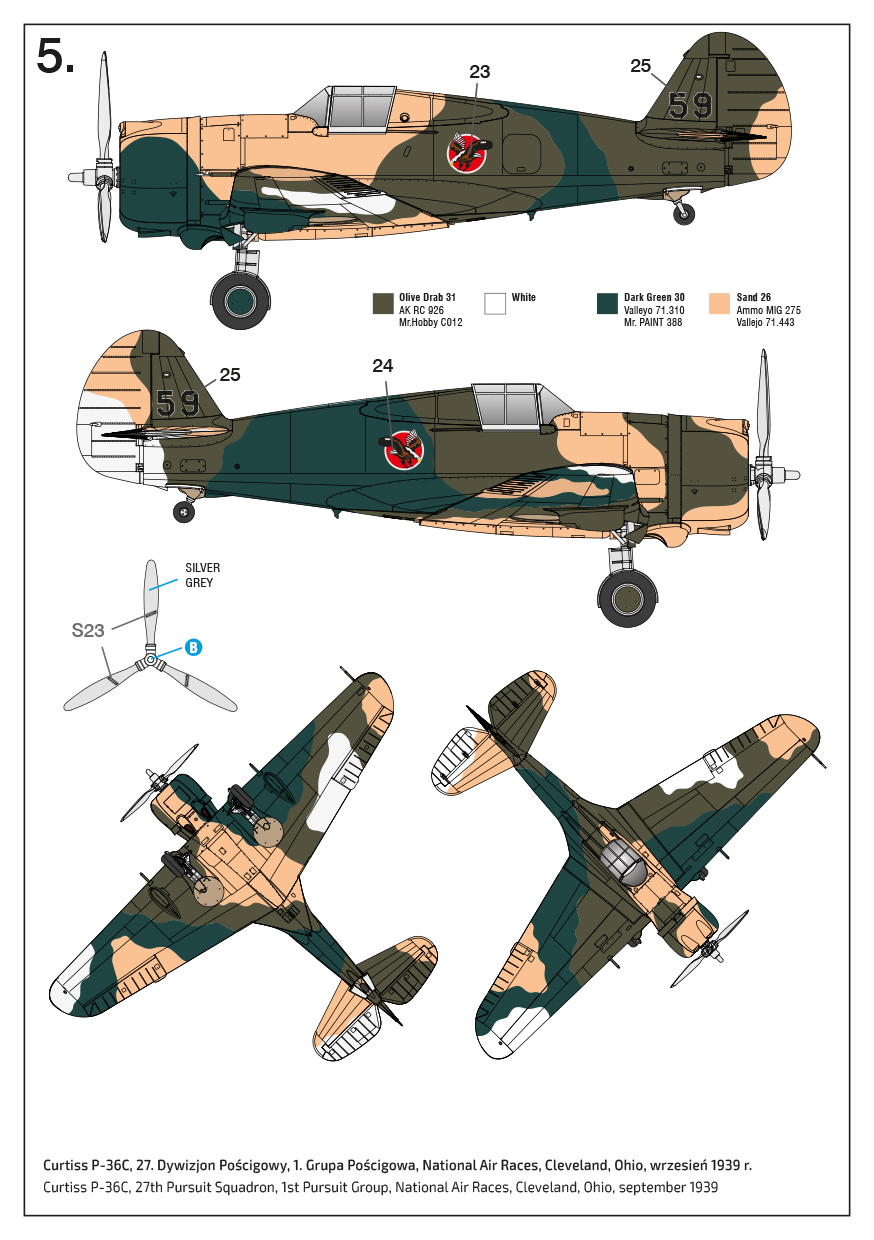
Below we present selected finishes developed on the basis of the film shown above and photographs of the aircraft available in printed sources and online. Markings for these machines are included on the kit decal sheet.
Selected references
- Dana Bell, US Air Force Colours 1926–1942, Arms & Armour Press, 1980, ISBN 0853684847 (AbeBooks).
- Robert D. Archer, The Official Monogram US Army Air Service & Air Corps Aircraft Color Guide, Vol. 1: 1908–1941, Monogram Aviation Publications, 1995, ISBN 0914144464 (Amazon).
See also:
- Curtiss P-36C in the Arma Hobby store
Model maker for 45 years, now rather a theoretician, collector and conceptual modeller. Brought up on Matchbox kits and reading "303 Squadron" book. An admirer of the works of Roy Huxley and Sydney Camm.
This post is also available in:
 polski


Great article on something I wasn’t aware of.