Me 262 was developed at a time when the German aviation industry was operating under enormous pressure. Before moving on to the specific aircraft featured in the first edition of the kit, it is worth first putting the subject of late-war RLM colours and the factory painting process of these aircraft into order.
Late-war RLM colours – a puzzle with missing pieces?
The painting guide for the Me 262 A model uses colour names based on the RLM standard. Developed by the Reich Air Ministry in 1933, this standard covered the range of paint colours used in the aviation industry. It assigned them names and, above all, regulated their use—not only in terms of camouflage pattern composition, but also in defining where a given paint was to be used in the production process.
The evolution of RLM camouflage colours has long been, and still remains, the subject of extensive research and analysis by aviation historians. Because the surviving archives are incomplete, much of the information published in the past may now be outdated or revised in light of newer research and newly discovered documents. This issue is especially apparent when it comes to the RLM colours used during the final year of the war.
During the period when the Me 262 was being produced, a number of instructions were issued describing the rules and recommendations for finishing the aircraft’s external surfaces. Over time, and in response to the worsening situation of the German industry, these instructions inevitably moved toward simplification and economy. At the same time, gaps in the documentation have made them increasingly difficult for modern researchers to interpret clearly.

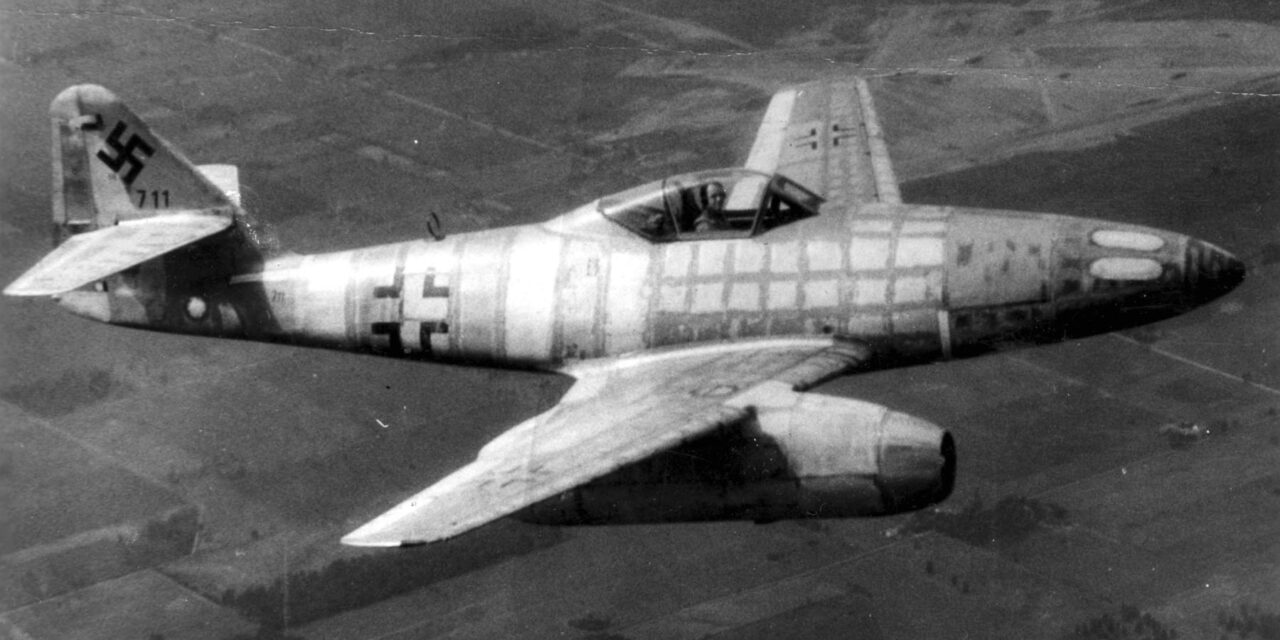
Me 262 WNr. 111711 was the first undamaged, fully operational aircraft of this type to fall into Allied hands. Factory test pilot Hans Fay, while ferrying the new aircraft from the assembly plant at Schwäbisch-Hall to its delivery point, diverted the Messerschmitt to the American-held Rhein-Main airfield near Frankfurt. The photograph shows the aircraft during testing at Wright Field in Dayton, Ohio. Completely devoid of camouflage paint, it illustrates the condition in which Me 262s left the assembly lines in the final weeks of the war. (U.S. Air Force photo).
Colours used on the Me 262
RLM 81
 A colour first mentioned in August 1943 as the intended replacement for the earlier RLM 70. At that stage its exact shade was not clearly defined, though it was described as the darker of the two greens in the new pair. It came into use from autumn 1944. Variants encountered range from chocolate brown and olive-brown through dark brown to a dark green sometimes close to Olive Drab. Messerschmitt identified RLM 81 as a brown with a violet tint, or simply as brown. Surviving Bf 109 and Me 262 components painted in this colour seem to confirm that paint suppliers for Messerschmitt’s main factories and subcontractors maintained a brown shade.
At the same time, several other dark green shades are encountered, provisionally identified as variants of RLM 81. Good paint manufacturers typically offer two or three versions of RLM 81: dark brown, lighter brown, and dark green. The challenge of defining RLM 81 can be compared to the American Olive Drab—one name, but a whole range of shades. An important point to consider when painting a model is to use several slightly different tones of RLM 81 on the same aircraft, reflecting the fact that the real machines were assembled from ready-made components supplied by different subcontractors, each with their own painting and finishing practices.
RLM 82
 A light green colour. The brightest of the greens used by the Luftwaffe, often described as a vivid green or fresh grass green. It appeared alongside RLM 81 as the second colour in the pair, and it seems that production of this paint was more standardised, with identified samples indicating a fairly consistent shade used both by Messerschmitt and by Focke-Wulf factories and their licensees. A characteristic feature of RLM 82 appears to be its relatively limited covering power, which means that surfaces painted with it often show traces of contrasting underlying layers, such as filled seams standing out against the colour of natural metal. Model paint manufacturers usually offer a single shade of RLM 82 as a light green.
RLM 76


 A light blue colour used for the lower and side surfaces of fighter aircraft and heavier destroyer/ground-attack types, introduced well before RLM 81 and 82, as early as 1940. It replaced RLM 65, which remained in use until the end of the war on bomber, transport, and training aircraft. Under late-war conditions, the appearance of RLM 76 also changed, and several different shades have been identified on the same aircraft types—from very pale grey through grey-blue to a distinctive yellowish-grey somewhat reminiscent of British Sky.
Several theories attempt to explain these differences in the appearance of RLM 76. The most common point to technological difficulties in maintaining consistent large-scale production, the use of old stocks including earlier RLM 65 in new paint batches, and experimentation with chemical composition and ingredient ratios. As with RLM 81, model paint manufacturers offer several shades of RLM 76. Trade names vary: sometimes they are labelled RLM 76 with suffixes such as 1, 2, or 3, or divided into “early”, “late”, and so on. As with RLM 81, it is worth trying to reproduce different tones of RLM 76 on a single aircraft, in keeping with the realities of decentralised production and assembly from ready-made subcomponents.
RLM 02

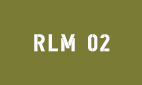 In the case of this and the next RLM number, we are no longer really talking about a single colour, but rather a paint defined by function. Its colour was secondary; its main purpose was corrosion protection for metal surfaces. Because of its composition, the paint could vary in shade. The most typical RLM 02 associated with the earlier period of the war is grey-green, whereas the RLM 02 that can still be found in original condition in a few less visible corners of the Munich Me 262 has a tone closer to mustard or even green. Interestingly, the use of RLM 02 was reportedly meant to be reduced in favour of RLM 66, which in this period offered similar protective properties.
RLM 66
 A dark grey paint, also described as black-grey, with a matt finish. From 1942 onwards its shade changed slightly due to alterations in chemical composition aimed at giving it protective qualities similar to those of RLM 02, and from then on RLM 66 had a noticeable dark greenish cast. This paint was used for cockpit interiors and their equipment. On the Me 262 it can be found on the landing gear legs and wheel hubs, and on post-war Czechoslovak-built S-92 aircraft also on the internal fuselage surfaces and main wheel wells.
Outdated information, revised interpretations, and popular myths:
- RLM 99 – there was never any officially recognised paint colour by this designation. Some older publications use the term when describing variants of RLM 76, focusing on its unusual yellowish tone. RLM 99 sometimes appears instead as a label for hard-to-classify colours of various protective coatings used on wood/plywood and fabric.
- The concept of “liquid putty” or “painting with thinned putty” appeared in very old literature on the subject, largely in attempts to explain the unusual appearance of the fuselage sides on Fw 190 and Bf 109 aircraft. The characteristic yellowish, beige, unevenly saturated colour was then explained as the use of substitute materials not intended for painting metal surfaces, assuming that concern for accurately maintaining the prescribed paint colour had been abandoned under wartime conditions.
In reality, during the period in question, German Fliegerlacke, developed by Warnecke und Böhm, were intended to be applied directly to the outer surfaces of the airframe without primers. The substance used in Me 262 production as both filler and seam-smoothing/sealing compound appears—judging from surviving wartime colour photographs—to have been grey, similar to shades such as Neutral Gray or Medium Sea Gray.
- Modelling literature often states that everything inside a German aircraft’s structure should be painted RLM 02. In reality, the use of this paint on internal components was reduced to an absolute minimum. Modern chemical methods of protecting metal were available, and protective paint was limited to selected components and materials such as steel, wood, or fabric. Under wartime production conditions, long-term durability was no longer the priority; availability and ease of mass production mattered more, and eliminating selected stages of the manufacturing process not only increased output but also made it possible to involve small local subcontractors outside the aviation industry.
- During the period when the Me 262 was built, most internal metal surfaces were left unpainted, with the exception of steel and wooden parts that required additional protection. One version of RLM 02 was used, among other places, in the nose wheel bay (steel), on the slats and flaps, engine cowlings, the skinning of the nose section, and a few other areas. The inside of the fuselage and the wing bays, however, were left unpainted.
- RLM 83 – what colour was it? For many years, up until the beginning of the 21st century, one of the most distinct shades associated with RLM 81—a dark green—was incorrectly identified as RLM 83. The number 83 appeared in the literature, but was never formally assigned to any specific paint. As a result, historians and modellers, guided by logic and tonal similarity, gave it a likely meaning by equating it with the dark green variant of RLM 81.
Only around 2010 did archival research begin to shed new light on the subject. Notes found in German aviation production documents and paint catalogues suggested that RLM 83 did indeed appear in the catalogue, but as a completely different paint intended for other purposes. Thanks to the rediscovered formula, RLM 83 was reconstructed and turned out to be a dark blue—navy blue—not green.
These findings were described in detail by M. Ullmann, who analysed Luftwaffe archival records and military paint catalogues, confirming that this paint was used mainly on aircraft operating over water, which rules it out as part of the standard RLM 81/82 combination used on land-based aircraft. This discovery makes it possible to correct earlier misinterpretations and reproduce Luftwaffe camouflage from the Second World War with greater historical accuracy.
Trzy Messerschmitty – przegląd malowań zestawu premierowego Me 262 A-1a 1/72
How did simplified painting processes affect the appearance of Me 262 aircraft?
Messerschmitt 262, like many German designs introduced into production during the war, was conceived for dispersed manufacturing. Its production was divided among a network of cooperating subcontractors, and the supply chain was organised to provide at least a theoretical degree of independence and continuity despite growing logistical difficulties and material shortages.
Aircraft components were often manufactured outside the aviation industry. Complete assemblies—such as nose sections fitted with undercarriage and armament, fuselage sections, cockpits, or wings—were transported to final assembly centres, where they were joined together and prepared for factory test flights. As the war progressed, assembly plants were even relocated to improvised sites in forests, while stretches of motorway served as runways for newly completed aircraft.
At the same time, efforts were made to simplify those production processes that did not directly affect the aircraft’s combat value. This practice is particularly visible in the evolution of Me 262 camouflage.
During the production period of the two aircraft that can be built using the decals from Arma Hobby’s first-edition kit, the factory scheme called for full coverage in RLM-approved colours: RLM 81 and RLM 82 on the upper and side surfaces, while reducing the use of RLM 76 to a minimum and concentrating it mainly on parts made of steel or wood.
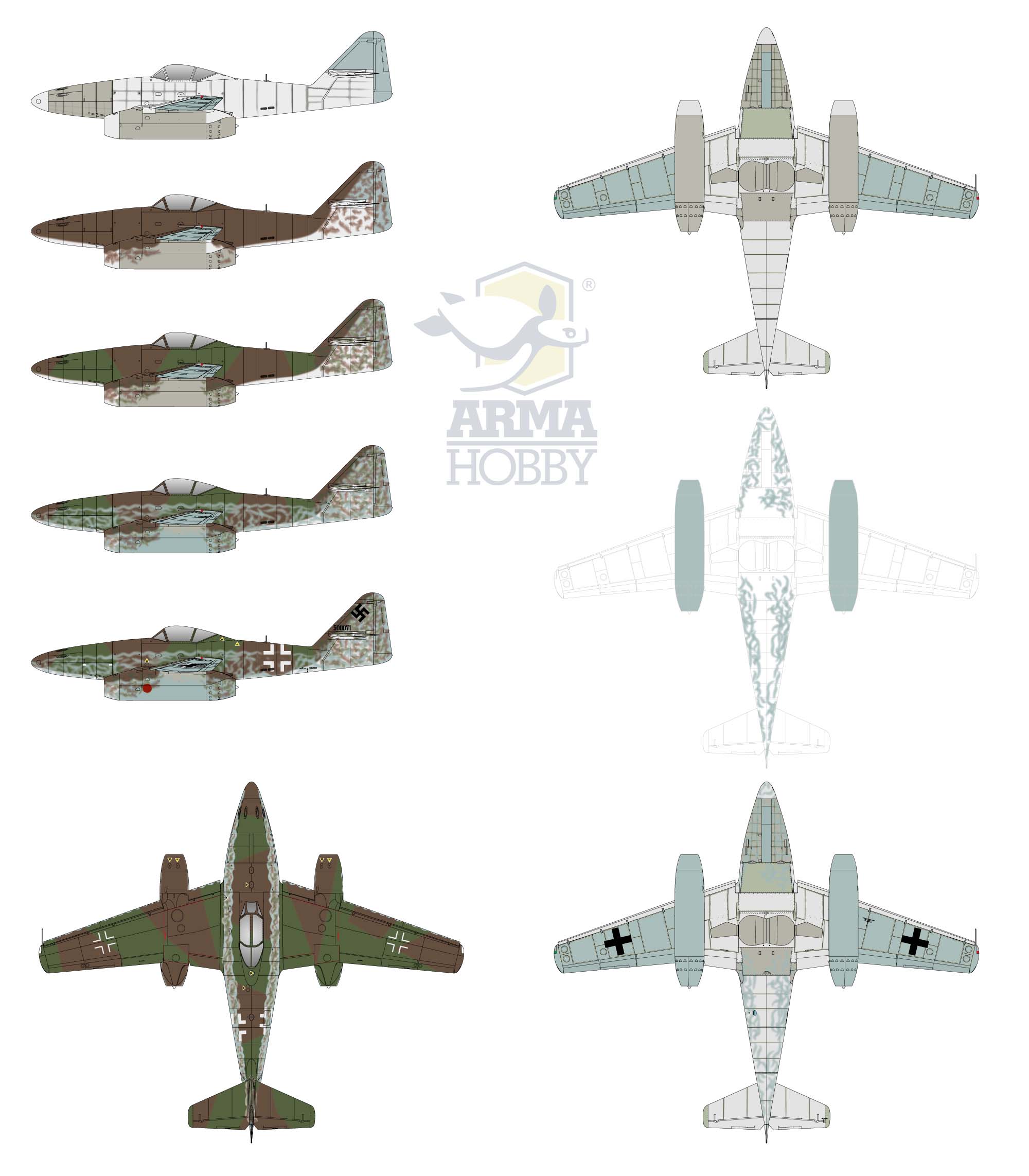


Two examples of Me 262 painting sequences. Click the image to enlarge.
- On the left: aircraft W.Nr. 500071 “White 3”, Oberfähnrich Hans Guido Mutke, 9./JG 7, München-Riem airfield, Germany, April 1945.
- On the right: aircraft from Jagdverband 44, flown by Generalleutnant Adolf Galland, München-Riem airfield, Germany, February–April 1945.
Artwork by Zbyszek Malicki © Arma Hobby.
Painting the Me 262 fuselage
The fuselage was painted after final assembly, although many of its subassemblies arrived already partially protected or even pre-painted by subcontractors. The fuselage was painted following the principle of applying colours from dark to light: first, a dark coat was applied over the entire fuselage (usually RLM 81), then contrasting patches of RLM 82 were added, extending down the fuselage sides to the wing line. Finally, RLM 76 was used to lighten the fuselage sides—initially over broader areas, later reduced to the characteristic wavy demarcation line. Below this wavy line, dark mottles and squiggles showed through the lighter paint. The tail area, fin, and engine nacelles were also covered with dark mottling in RLM 81 or 82 to reduce the contrast of lighter elements that might otherwise have been visible to the enemy from a distance.
Painting the Me 262 wings
The wings were delivered separately, already ready for installation and also painted. Depending on the period and the subcontractor, painting of the lower surfaces was first reduced, leaving them with a more “technological” appearance while maintaining a more or less regulation camouflage pattern on the upper surfaces. Eventually, wings were delivered without camouflage altogether, protected only where production technology required it.
Over time, as labour-intensive stages of production were eliminated, further simplification followed: the lightening of the fuselage sides was gradually abandoned, until fuselages were left covered only with thin coats of RLM 81 and 82. As a result, filler and protective coatings for steel or other materials often showed through.
Simplified painting at the end of the war
At the final stage, when protective painting had been almost entirely eliminated, aircraft were assembled from components protected only by subcontractors. Steel parts of the nose were painted in RLM 02 and filled, leaving grey patches or a chequered pattern of dried putty marks. The remaining fuselage and wing surfaces were left in duralumin. Panel joints were protected sparingly, using RLM 02 paint or grey filler, while steel wing components (slats, flaps), engine cowlings, and steel fuselage areas around the cockpit remained painted in colours generally described as RLM 02, applied by subcontractors.
A few words about final assembly
The joints between larger components—such as the main fuselage sections, wing tips, and tail unit—were additionally sealed with adhesive tapes, which were then protected by brushing over them with special preserving compounds in grey, green, and red. During production, external parts also carried a variety of signs, symbols, and markings applied for manufacturing, logistics, and assembly purposes. These temporary markings were often not removed and are visible on the latest aircraft; they can still be found today on surviving examples in partly original condition—for example on the undersides of the wings of aircraft 500071 in Munich, or on the fuselage and wings of aircraft 500200 in Canberra.
The aluminium sheets from which the skin panels were formed often also bear clear stamp marks showing the logo and code of the aluminium sheet manufacturer. These stamps are black or dark blue, though red ones can also be found. Once again, thanks to the exposed wings of the Munich aircraft, displayed without the removable lower covers, it is possible to look inside and see these markings for oneself.
Summary and a preview of the next parts
At this stage, it is worth pausing to consider the basic principles and realities of Me 262 painting. Understanding the evolution of late-war RLM colours and the effect of production simplifications on the appearance of these aircraft is essential before moving on to analyse specific examples.
In the following articles, I will discuss the individual aircraft from the first edition of the kit, looking at their distinctive camouflage features, tonal differences, and possible historical interpretations.
References
Merrick K., Hitchcock T., Official Monogram Painting Guide to German Aircraft 1935–1945, Monogram Aviation Publications, Boylston 1980.
Crandall J., Focke-Wulf Fw 190 Dora. Volume 2, Eagle Editions Ltd., Hamilton 2007.
Brown D. E., Janda A., Poruba T., Vladař J., Messerschmitt Me 262s of KG & KG(J) Units, JaPo Publishing, Praga 2010.
Brown D. E., Poruba T., Vladař J., Messerschmitt Me 262 Production & Arado Ar 234’s Final Operations, JaPo Publishing, Praga 2012.
Order the kit from our store
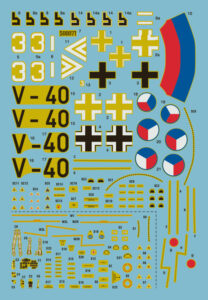
- Buy now here in the Arma Hobby model store.

This post is also available in:
 polski