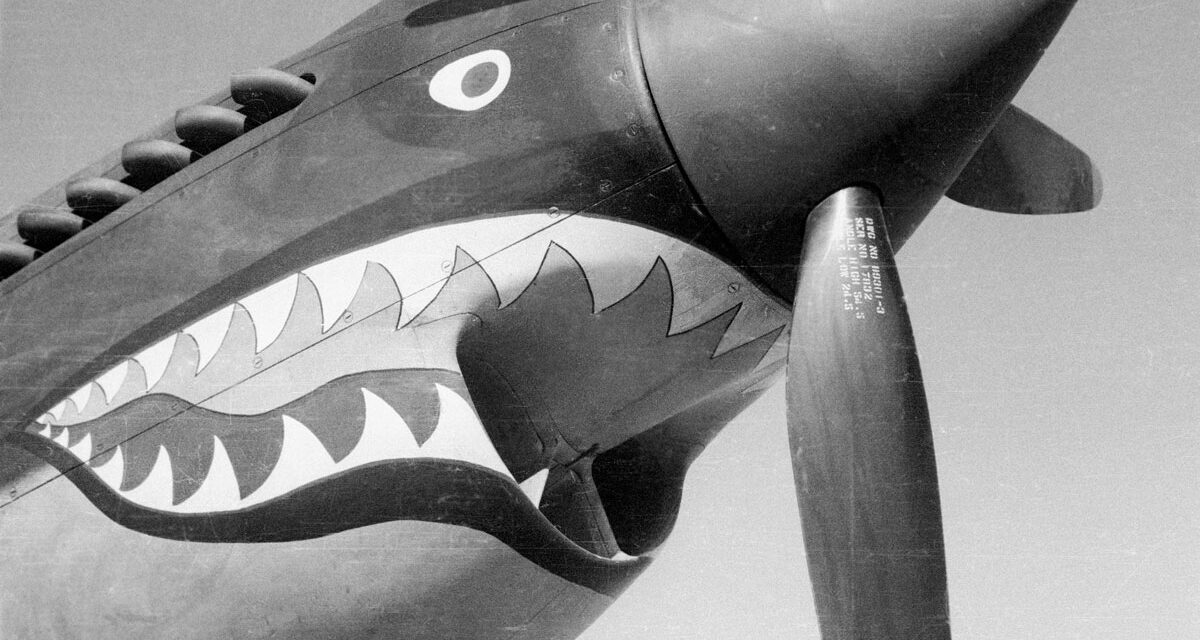
In the annals of military aviation history, few combinations of men and machines are more enduring than that of the American Volunteer Group and its shark-faced Curtiss Hawk 81-A2 fighters in action over Burma and China during 1941-42. The AVG’s exploits, amply reported by the American press to readers otherwise pummeled with bad news during the opening months of the U.S. involvement in World War II, earned the unit its immortal nickname, “The Flying Tigers.”
Cover photo: The iconic shark mouth markings were applied to Hawk 81-A2s of the American Volunteer Group beginning in November 1941, and this one appeared on aircraft No. 84, serial P-8195, of the 3rd Pursuit Squadron. Its assigned pilot was Wingman P.J. Greene.
The Origins of the American Volunteer Group
The underdog story of the AVG actually began in August 1937, when the Chinese Nationalist government hired a recently retired U.S. Army Air Corps captain, Claire Lee Chennault, to help build a modern air force for the war-torn country. Japan had instigated the conflict with China earlier that year and was making steady progress in eastern China with virtually no opposition in the air. Chennault set to work, and over the next three years he improved pilot training, built airfields and installed a crude but effective air raid warning system. But by 1940 it was clear to Chennault, a strong advocate for pursuit aviation during his USAAC career, that China could not defend itself in the sky without help from the United States.
Aggressive lobbying by Chennault, Chinese Nationalist leader Chiang Kai-shek, and Lauchlin Currie, a White House economist, eventually convinced U.S. President Franklin D. Roosevelt, and in April 1941 he authorized the creation of a clandestine “Special Air Unit” for service in China. The unit would be equipped with American aircraft and staffed by aviators and technicians recruited from the U.S. Army, Navy and Marine Corps. Recruiting started immediately, candidates being told their mission was to defend the Burma Road so that supplies could continue to flow from the great port at Rangoon overland to China. Meanwhile, Great Britain agreed to transfer delivery of 100 Hawk 81-A2s to the Chinese Air Force in exchange for a like number of more advanced U.S. fighters when they became available.
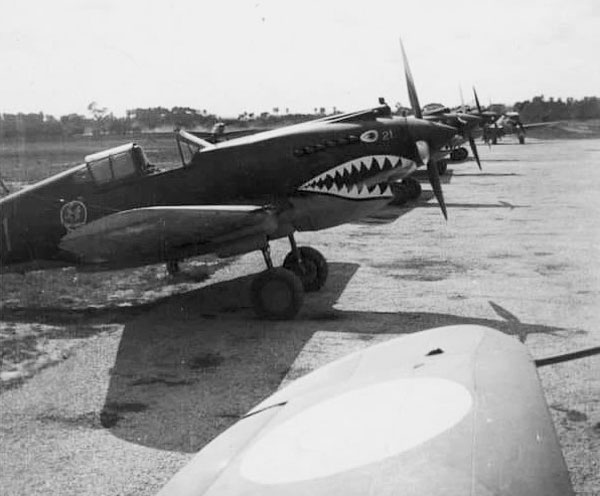
Flight Leader Gregory “Pappy” Boyington of the 1st Pursuit Squadron flew aircraft no. 21, serial P-8182, seen here on the flightline of an airbase in Burma or China.
Imperfect Pilots and Imperfect Aircraft
Neither of the two main elements of the AVG – the pilots and the aircraft – were ideal. Though Chennault envisioned recruiting 100 fully trained fighter pilots for the AVG, the reality fell somewhat short of that. Recruiters scouted military airbases across the U.S. but eventually had to resort to signing up pilots with experience in bombers, transports and even floatplanes to fill out the quota of pilots for the AVG. Obviously, those pilots lacking fighter time in their logbooks would require substantial training before they could even hope to succeed when they came up against Japan’s well-seasoned combat fliers. And even the AVG pilots who had flown fighters lacked any combat experience.
Meanwhile, the AVG’s Hawk 81-A2s had only been made available by the RAF because they were verging on obsolescence. Similarly, the U.S. Army wasn’t willing to give up any of its new Curtiss P-40Es or Bell P-39s, and the U.S. Navy was just beginning to acquire its new Grumman F4F-3 Wildcats, which might have been the best fit for the AVG. Though the F4F-3’s performance and robust construction were similar to the Hawk 81, the Wildcat was a simpler design. Its air-cooled engine did not require a radiator system, its landing gear was manually operated, and its armament of four .50-caliber machine guns would have simplified AVG logistics because the Hawk 81 carried guns of two different calibers. But the Hawk 81 was the best American fighter available at the time, and the AVG pilots would have to make the most of the situation. As time would tell, they did.
Training at Toungoo
In the summer 1941 the first personnel and Hawk 81s began arriving at a remote RAF airbase in Toungoo, Burma, for training. Chennault lectured his pilots on the tactics he had developed during four years of observing Japanese aerial operations. He instructed his pilots to use the Hawk’s strengths to make diving attacks on enemy formations, then zoom back up to regain an altitude advantage. And never try to engage in a turning fight with the more maneuverable Japanese fighters. Flight training took a serious toll on the AVG’s aircraft strength. Three pilots died in training accidents, and several more resigned to return home.
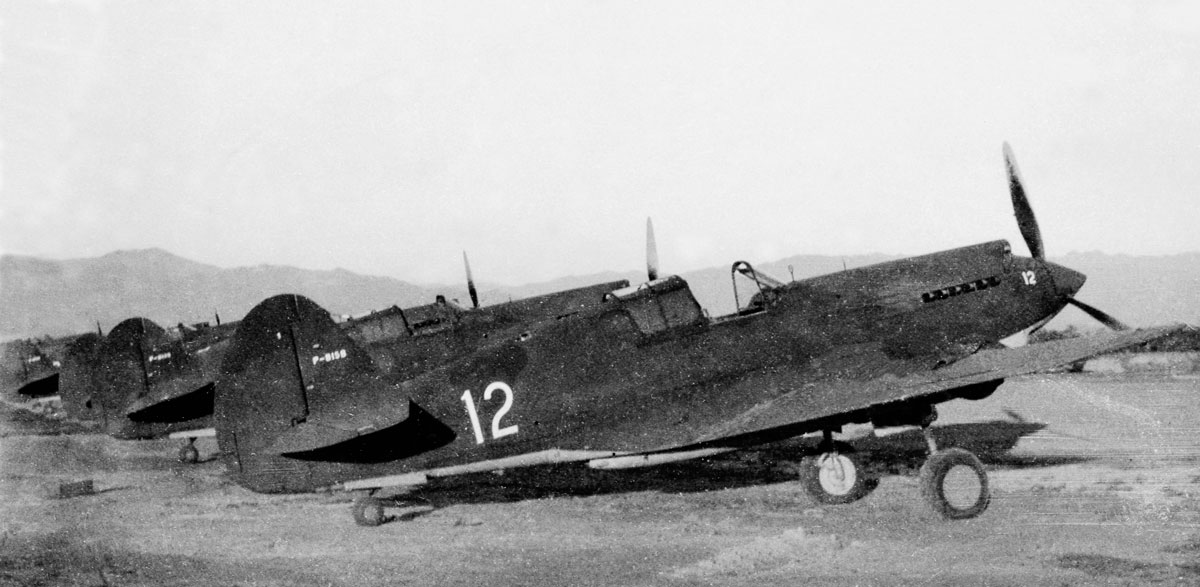
These 1st Pursuit Squadron Hawk 81s were fresh from the assembly shop in Rangoon, with neither Chinese wing insignias nor shark mouths yet applied, when they were photographed at Toungoo while the AVG was still in training. Aircraft no. 12 bore the serial P-8158 on its rudder.
The Shark Mouth
In mid-November 1941, several AVG pilots were in Toungoo town when a recent issue of the Illustrated Weekly of India caught their eyes, On the cover was a color photograph of some RAF Tomahawks in North Africa that had been decorated with a fearsome shark’s teeth design on their noses. Soon several AVG Hawks were sporting shark mouths, and when Chennault saw them, he decreed that all AVG fighters should be similarly painted. It was a light-hearted gesture intended to boost unit morale, but in the long run it added immeasurably to the AVG’s legend.
The AVG Enters the War
A popular misconception, fueled by media reports and a popular movie starring John Wayne, held that the AVG was engaged against the Japanese prior to America’s entry into the war. In truth, the AVG was still in training at Toungoo when word of the Pearl Harbor attack reached Burma. The remaining Hawks were divided among the three squadrons, and three pilots flew a photo recon mission to Bangkok, Thailand, on 10 December 1941, the AVG’s first combat operation.
The 3rd Pursuit Squadron, commanded by Arvid E. Olson Jr., was sent to Mingaladon Airdrome, outside Rangoon, on 11 December to bolster RAF Buffalo fighter squadrons assigned to protect the city. The 1st and 2nd AVG squadrons were ordered north to China, where they would protect Kunming, the terminus of the Burma Road. It was at Kunming, on 20 December, that the AVG had its first air battle. Unescorted Japanese bombers approached from Indo-China that day, intending to attack the city. Ample warning from Chennault’s air raid net gave the 2nd Squadron under Jack Newkirk time to attack the bombers about 30 miles south of the city, with Robert Sandell’s 1st Squadron joining the fight a few minutes later. Several bombers were shot down, though the exact number is a matter of dispute. But the P-40 attack forced the Japanese to jettison their bombs and turn for home without reaching the city. They did not attempt the bomb Kunming again for more than a year.
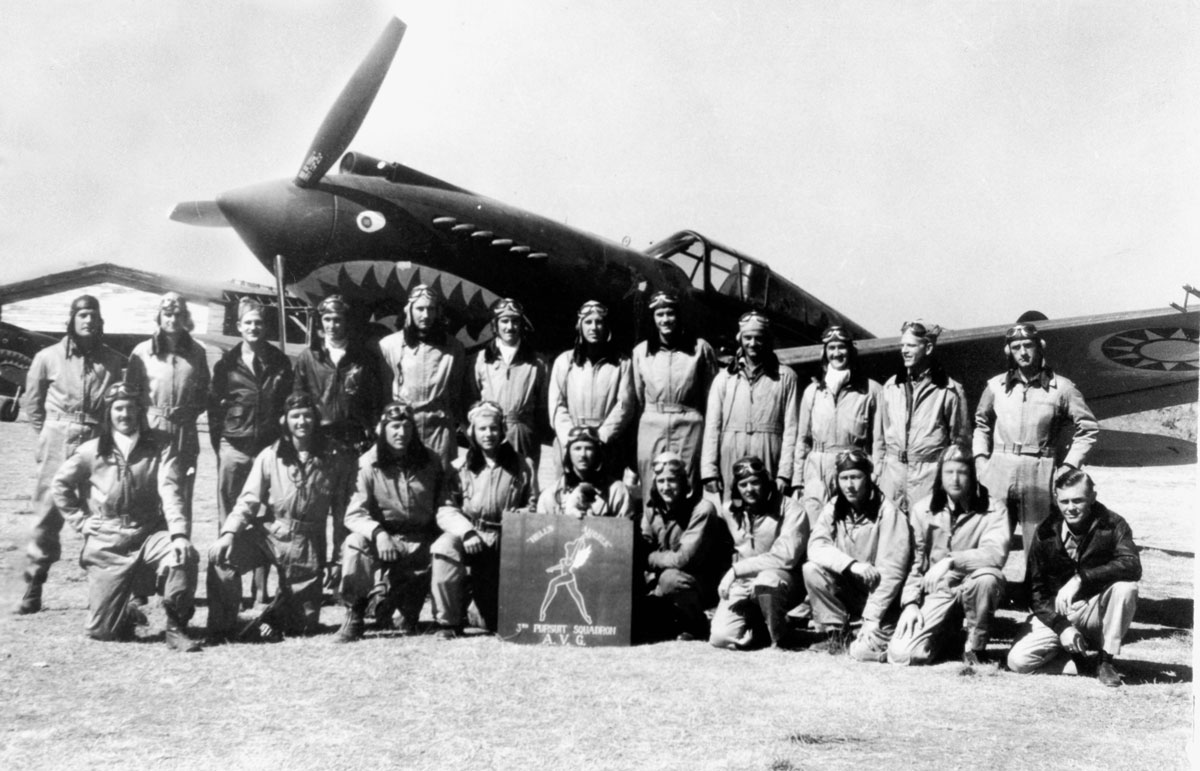
The pilots of the 3rd Pursuit Squadron pose in front of Squadron Leader Arvid Olson’s aircraft no. 99, serial P-8101, at Kunming, China, in early 1942. Olson is standing seventh from the left in the top row.
The Battle for Rangoon
The 3rd Squadron got its initial taste of combat on 23 December, when the Japanese raided Rangoon for the first time. The Hawks got off too late to intercept the first wave of 18 bombers, which attacked Mingaladon and caused 40 casualties, but they had a stiff battle with the second wave of 27 bombers plus escorting Ki-27 Nate fighters. Twelve pilots of the 3rd Squadron claimed 11 victories, plus 5 probables and 10 damaged. Three Hawks were shot down in the battle with two pilots killed, the first AVG combat fatalities. The following day was quiet, but the Japanese attacked Rangoon again shortly after midday on Christmas. This time, the Japanese formations included 25 new Type 1 (Ki-43) Hayabusa fighters, which had been flown up to Thailand from Malaya to counter the AVG/RAF interceptor force. The 3rd Squadron scrambled 13 P-40s, accompanied by a similar number of Buffalos. A ferocious 30-minute air battle ensued as bombs again rained down on Mingaladon before the Japanese withdrew over the Gulf of Martaban.
In all, the 3rd Squadron claimed another 24 victories that day for the loss of two Hawks but no pilots. Two pilots, Charles Older and Robert “Duke” Hedman, scored five victories each during the course of the two intercepts to become the AVG’s first aces. Two ground crewmen suffered minor injuries from the bombing at Mingaladon. The 3rd Squadron attempted to intercept high-flying recon aircraft several times without success over the next three days before transferring to Kunming on 29 December, while the 2nd Squadron took over at Rangoon. This was about the same time that a newspaper reporter tagged the AVG with a nickname that would grace the unit forever, “The Flying Tigers.”
The 2nd Squadron flew several successful offensive missions into Thailand early in January 1942 and then, reinforced by members of the 1st Squadron, fought a series of combats over Rangoon during the last week of the month. Victories continued to pile up in February, though it was becoming clear that Rangoon could not be held much longer. The AVG’s last interception over Rangoon took place on 26 February. Flight Leader Charlie Bond’s account of his experience that day, which appeared in his book, A Flying Tiger’s Diary, describes a classic example of Chennault’s combat tactics at work:
“We had barely reached 18,000 feet when we spotted a formation of 15 Jap bombers and some 20 or 30 fighters. I had joined Bob Little’s flight, and it appeared to me that he had not seen the bandits yet. I pulled up to him and waggled my wings pointing off to the left: Away we went. We had to get a little more altitude to come in from above the fighter escort. While climbing I found myself engaged by four fighters. I took a quick peek to my rear to see if anyone was with me. Hell, I was by myself!
“I attacked, and I was head-on with one of the fighters. We barely missed each other. I turned to see if he was on fire. He wasn’t, and he was easily turning inside of me. Immediately, two others were on my tail. I half-rolled and went into a vertical dive — everything forward. Pulling out and up again, I got into position to make another attack. He saw me coming and went into a left turn. I led him a lot and squeezed the trigger. His ship straightened up a little and then started off in a steep spiral with smoke trailing. I pulled up in a shallow climb to follow him.
“My speed had fallen off, and when I looked back, I saw two Jap fighters smack-dab on my tail. Their guns were spitting smoke. Again, quickly into a Split-S with full throttle. They followed. All I could do was hunch up behind my armor plate and wait for my acceleration to pull me out of their firing range. None of their bullets hit my fuselage, but I got a few in my left wingtip. When I got out of range they pulled away. Climbing back up, I could find no more enemy planes. John Blackburn joined on my wing, and we returned home.”
The defense of Rangoon continued through the end of February, when the advancing Japanese army forced the Allies to withdraw. Japanese ground forces entered the city on 8 March 1942. Tallies of the AVG’s total victories scored during two months of fighting over Rangoon vary widely. Newspaper accounts at that time, for instance, put the AVG’s score for 25 and 26 February alone at a staggering 104 victories. At the extreme other end of the spectrum, recent studies of surviving Japanese records of aircraft losses suggest drastically lower AVG scores during the defense of Rangoon. Modern historians estimate the AVG destroyed about 50 Japanese aircraft for the loss of 20 Hawks during the defense of Rangoon.
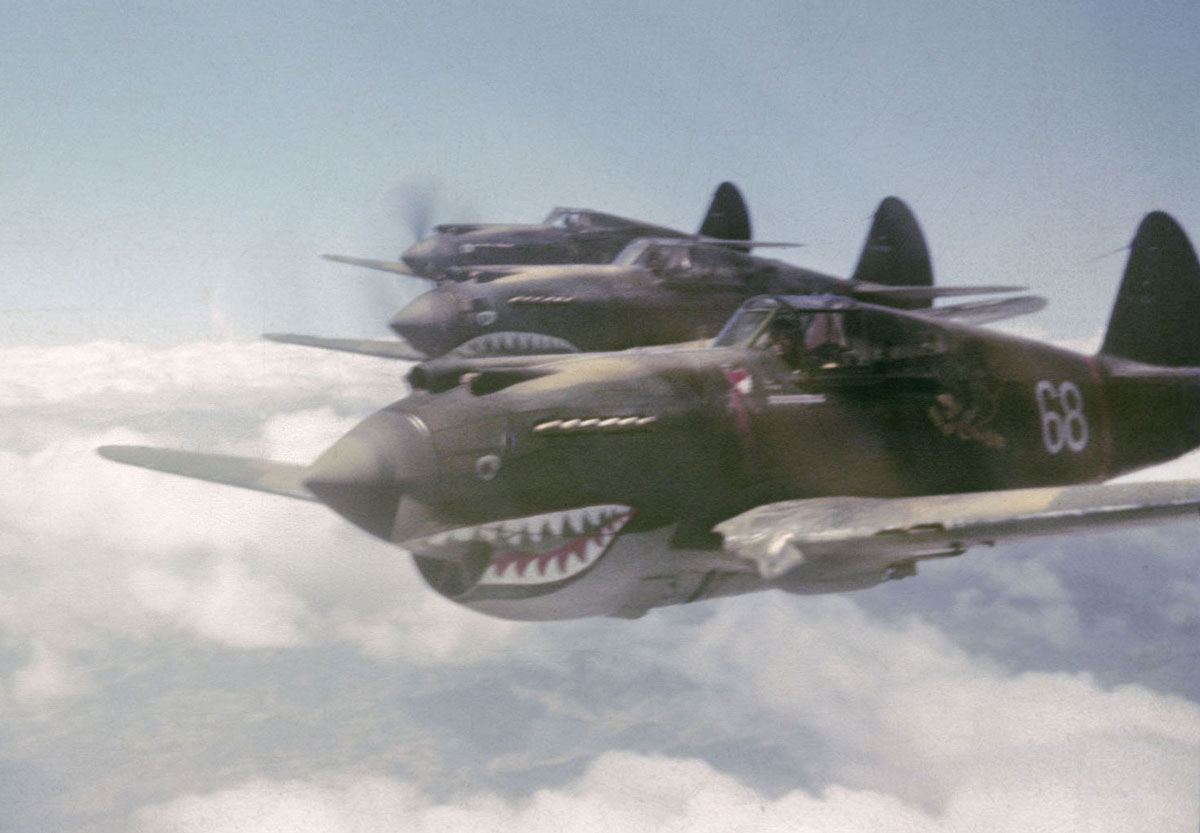
Flight Leader Charles “Chuck” Older leads a flight of 3rd Pursuit Squadron Hawk 81s in his no. 68, serial P-8109, near the China-Burma border in May 1942.
The Defense of China
China’s last overland supply route was cut when Rangoon fell. The Japanese already occupied all of China’s port cities, and Hong Kong had fallen on 25 December 1941. After a short period to regroup, Japanese invasion forces set out from Rangoon with the intention of pushing all the way through Burma and into India and China. The AVG’s new mission became the defense of China proper, though its planes continued to oppose the Japanese advance through Burma in March and April. Flying first from Magwe, about 200 miles north of Rangoon, and then Loiwing, just across the border in China, AVG pilots continued to hammer the JAAF. Replacement P-40Es, with heavier armament and the ability to carry bombs, began to arrive to offset losses of the original AVG Hawks. Eventually, the AVG would receive about 30 P-40Es.
A fight with Ki-43s over Lashio, Burma, on 28 April produced claims of 15 victories against no losses. But still the Japanese ground advance continued, and within a few days the AVG had to pull back to airbases closer to Kunming.
As the Japanese approached the Chinese border near the Salween River Gorge, the AVG inflicted heavy damage on enemy troops in a series of ground attack missions from 6 to 9 May. These missions, along with the onset of the monsoon season, allowed the Chinese Army to halt the Japanese advance short of its goal of entering China.
In June Chennault deployed aircraft to bases at Kweilin and Hengyang in the eastern part of Nationalist-controlled China, where several more successful intercepts took place before the AVG was disbanded on 4 July 1942.
The Legacy of the Flying Tigers
The AVG was officially credited with 297 enemy aircraft destroyed, including 229 in the air. Modern historians put the figure much lower, but the true figure — whatever it might be — is irrelevant. The AVG’s successes gave the American people something the cheer about during the dark days of 1942 when the war was going very poorly for the Allies. The Flying Tigers also proved that the P-40, when deployed skillfully and flown with proper tactics, was a tough and capable fighter with sufficient performance to hold its own against contemporary Japanese warplanes.
Curtiss Hawk 81-A2 „Flying Tigers” – The Beginning of a New Arma Hobby Family
Author’s Note
As a lifelong scale modeler and longtime aviation historian, I’ve noticed that most aircraft modelers choose a new project in one of two ways. Either they have affection for an aircraft type and choose a color scheme with one eye on its historical significance, or their interest in a pilot or a campaign drives their choice of aircraft to build. Sometimes it’s a combination of the two. The Curtiss Hawk 81-A2 of the American Volunteer Group is one of those rare aircraft that appeals equally through its history and its unmistakable appearance.
Material from two of the author’s books, Flying Tigers Colors and Curtiss P-40, Long-Nosed Tomahawks, was included in this article.
You may be interested:
See the Curtiss Hawk 81-A2 “Flying Tigers” 1/72 kit in the Arma Hobby shop

Carl Molesworth is the author 17 non-fiction books about the history of air combat during World War II, many of which cover aspects of the air war in the China-Burma-India Theater. Carl is considered an authority on the combat history of the Curtiss P-40 fighter aircraft.
Carl served in the U.S. Air Force from 1968 to 1972, and after that he earned a BA in English with a minor in history from the University of Maryland Baltimore County. Carl worked as journalist for newspapers and magazines for nearly 40 years before retiring in 2015. He now serves as a volunteer researcher at the Petaluma Historical Library and Museum. His web site is www.carlmolesworth.com.
He lives in Petaluma, CA, USA, with his wife, Kris, and their two dogs. His daughter, Claire, and her family, live in Bolinas, CA
This post is also available in:
 polski