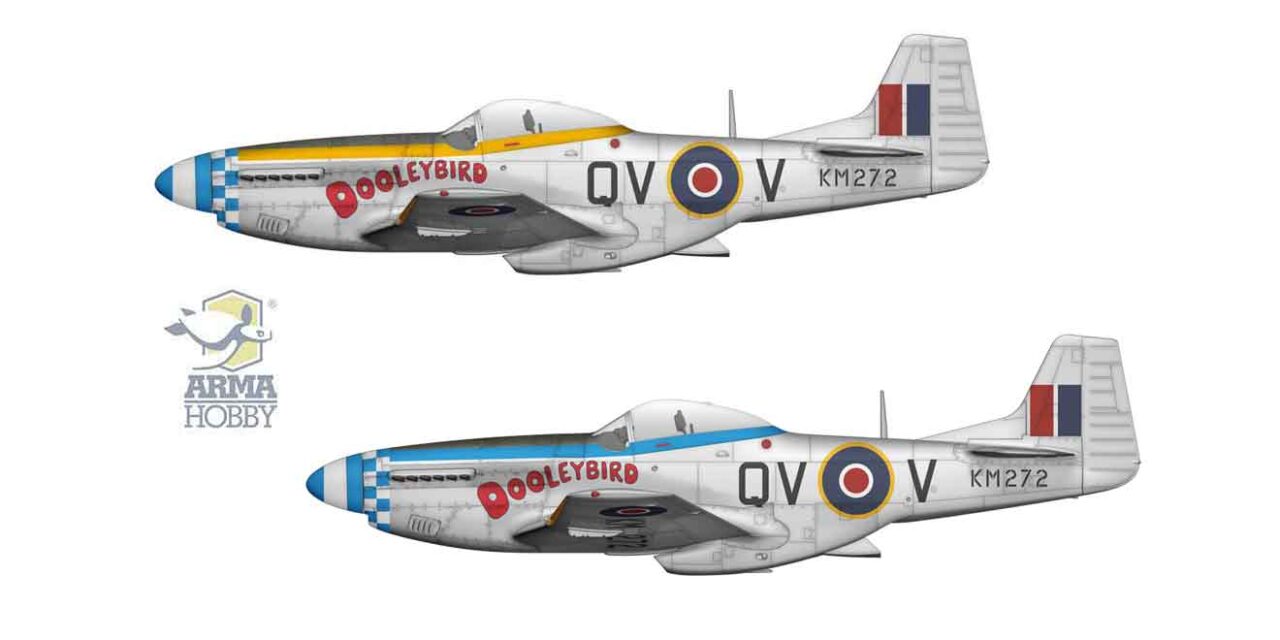
The dispute over the color of the fuselage band on Mustang KM272 “Dooleybird” of No.19 Squadron RAF has been ongoing for years. Was it yellow, or blue – or could both variants be correct, depending on the moment in the aircraft’s service? The text below analyzes available accounts, photographs, and publications in an attempt to answer this question.
Introduction
When the war was coming to an end, F/L Arthur Samuel Doley was a pilot with No.19 Squadron RAF. Long escort missions in Mustangs supporting Beaufighters and Mosquitos attacking shipping off the coasts of Norway and Denmark were undoubtedly exciting, but he likely welcomed the capitulation of Nazi Germany with relief. By wartime standards he was no longer a youngster — already 28 — and back in Wolverhampton his pregnant wife was waiting for him and a return to normal life. Nothing suggested that years later he would become one of the most recognizable RAF fighter pilots, and that his aircraft would be known to a large portion of the male population worldwide. His unexpected fame — long after the war — came thanks to Matchbox, which in 1973 released its P-51 Mustang kit featuring decals allowing modelers to build the aircraft of No.19 Squadron with the striking “Dooleybird” inscription on the left side of the fuselage.

Doley’s accounts and the first interpretation of the colors
In an interview given to the local newspaper *Wolverhampton Express and Star* on 8 January 1974, Doley stated that several years earlier he had lent his Log Book to someone writing a book, and that photographs of his Mustang were included there. The book he meant was almost certainly the booklet *Camouflage and Markings*, where the photos were published along with a description of the aircraft’s colors. The “Dooleybird” inscription was said to be red with a black outline, and the fuselage band around the cockpit blue, in the same shade as the checkerboard on the nose. Matchbox undoubtedly relied on this source when preparing its Mustang kit.[link 1]
Doley appeared again in the pages of the same newspaper on 13 September 1990, shown holding a model of KM272 painted according to the Matchbox instructions, featuring a dark blue fuselage band surrounding the canopy.[link 2]
For many years this was considered the only correct interpretation of KM272’s colors.
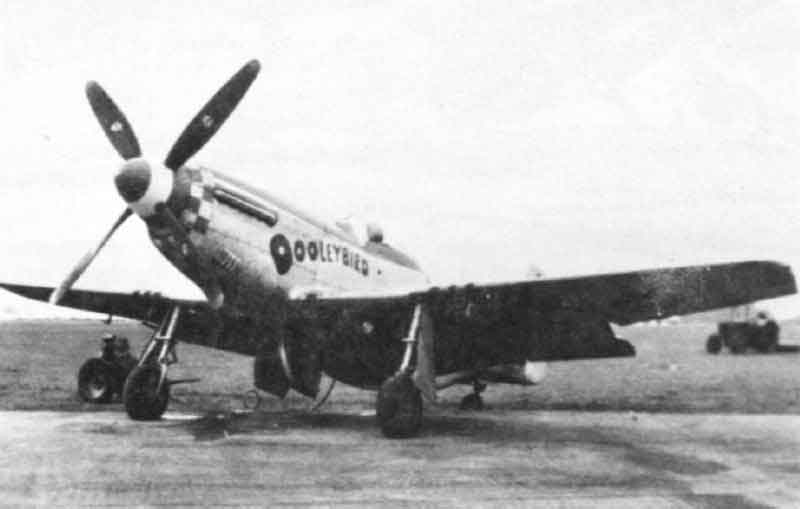
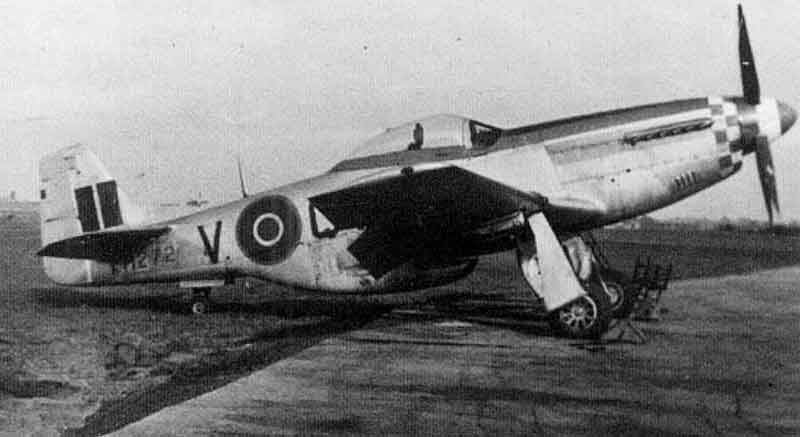
Two photographs of Mustang KM272/QV-V “Dooleybird” from the Log Book of F/L Arthur S. Doley.
Paul Lucas and the letter from Eric Taylor
In 2000, Paul Lucas published *RAF Fighters 1945–1950 UK Based*, in which he questioned the color of the “Dooleybird” inscription, suggesting it might have been blue. This interpretation, however, did not last long. In March 2001, *Scale Aircraft Modelling* published a letter by Eric Taylor of Newcastle who, after reading Lucas’s book and seeing the profile of KM272 printed there, decided to reveal his old notes made at the end of July 1945, when he saw No.19 Squadron’s aircraft at Acklington.
According to him, KM272 had a yellow fuselage band and red “Dooley Bird” inscription, KM193 QV-J had a blue band, and the Squadron Leader’s pennant appeared only on the right side with no personal name. Meanwhile KH742 QV-A had a red band and the name “Jeanne” on the left side. In his understanding, the colored fuselage bands marked the aircraft of the Squadron CO and the two Flight Commanders. The witness appears credible, although we do not know the circumstances of his visit nor his connection to the base. The details he recorded imply he must have been very close to the aircraft. Some of the information he provides cannot be verified, while some contradict available photographs — but these contradictions can be explained later.
Photos of KM193 and the issue of discrepancies
In both linked photographs below, KM193 looks significantly different. The photos are separated by roughly six months. The first is from April 1945, the second likely from October of the same year. Neither matches Taylor’s description from July 1945, but neither disproves it either.[link 3][link 4]
Taylor also described the code letters as dark blue. I believe this was an error. Some Mustangs of this unit were photographed on orthochromatic film, which lightens the appearance of blue, making it much lighter than the roundel blue. The code letters in reality were likely painted in Night Black, which was not a pure black but a mixture of black and ultramarine, appearing almost navy in strong sunlight.
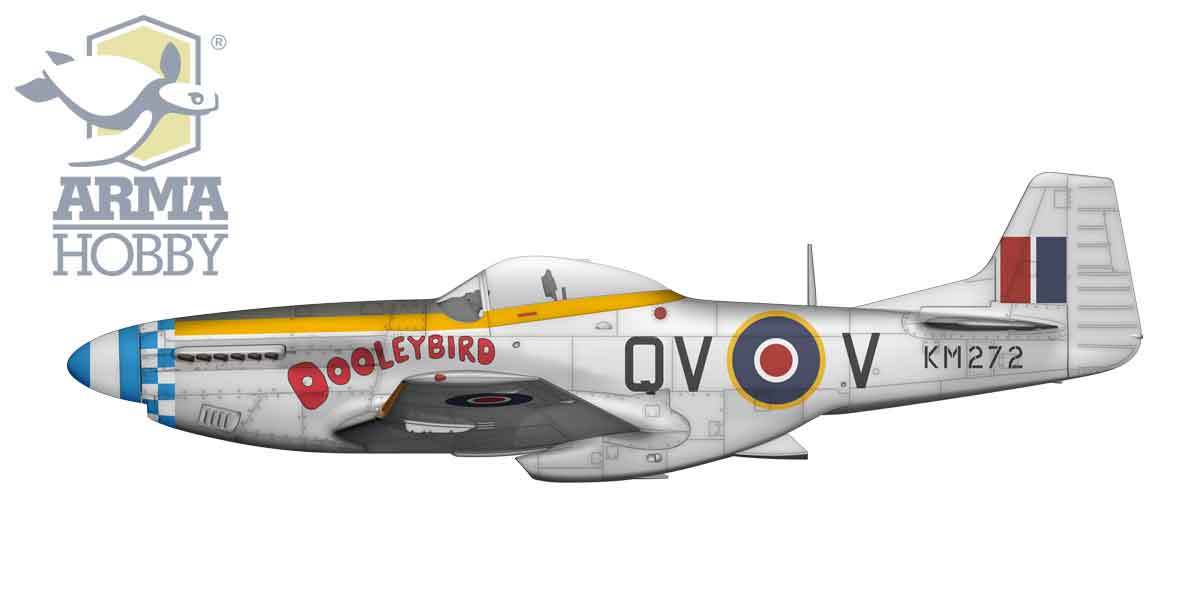
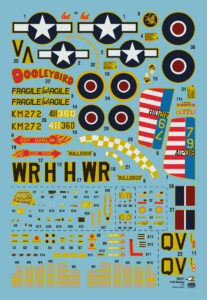
The appearance of Mustang KM272 “Dooleybird” after 3 July 1945, when the squadron introduced blue–white spinner and nose markings. Yellow fuselage band, no serials under the wing. Artwork by Zbyszek Malicki, Arma Hobby.
Why did the witnesses remain silent for so long?
Why did Eric Taylor, an aviation enthusiast and reader of modelling magazines, remain silent for so many years while the Matchbox Mustang dominated the market? Had he spoken earlier, perhaps the matter could have been verified with living witnesses — pilots and ground crew — who were still numerous in the 1970s and 80s.
Accepting Taylor’s version as the only truth would automatically imply that Doley was wrong. Yet Doley seems just as credible: he worked in commercial painting and decoration before the war (and may even have painted some of the decorative nose art in his squadron), he understood colors, and he never disputed the version later published in *Camouflage and Markings*. The Matchbox kit sold for nearly 20 years and hundreds of thousands of copies must have been seen by people familiar with No.19 Squadron’s Mustangs — and no corrections were reported before 2001.
RAF Flight colors and Doley’s role
Another strong argument in favor of Doley’s version is the RAF’s traditional color coding: blue marked “B” Flight, while yellow marked “C” Flight (if present). In 1945 No.19 Squadron did not have a C Flight. Doley belonged to — and commanded — B Flight in the final months of his service. Blue would therefore be the most logical choice for his aircraft.
Hypothesis: when yellow, when blue?
After reviewing available material, I believe the question is not “yellow or blue?” but rather “until when yellow, and from when blue?”. Until 3 July 1945 — before the reintroduction of the squadron’s pre-war blue–white colors — the unit used yellow and black markings on the spinner and the nose. At least one aircraft (KH818 QV-F, lost on 4 May 1945 in the last operational sortie of the war after colliding with KH674) also carried a yellow band in exactly the same location as the disputed band on KM272. It was not a Flight marking but a decorative element matching the unit’s wartime colors.
Could KM272 in late July — when Taylor saw it — still have had this yellow band as a leftover wartime marking, later repainted blue? In my view this is the best explanation for why two credible witnesses described the same aircraft with different colors. Taylor saw KM272 earlier, while the yellow band still existed; Doley remembered it later, after the repaint.[link 5]
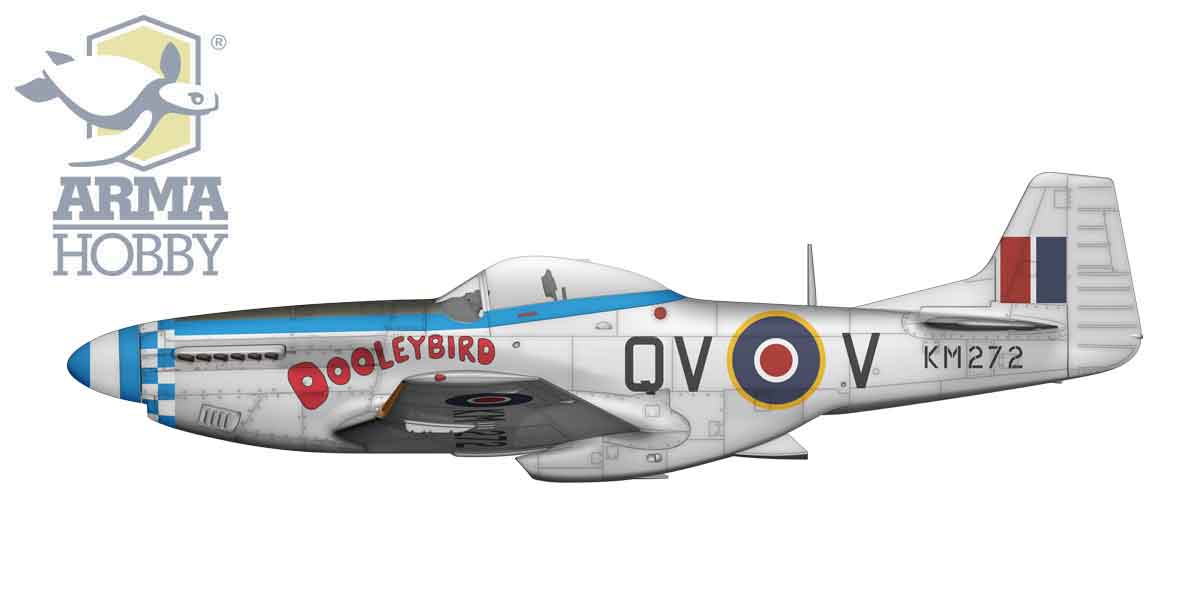
The appearance of Mustang KM272 “Dooleybird” in late 1945. Blue fuselage band, serial numbers under the wing. Artwork by Zbyszek Malicki, Arma Hobby.
 How to build the blue “Dooleybird”?
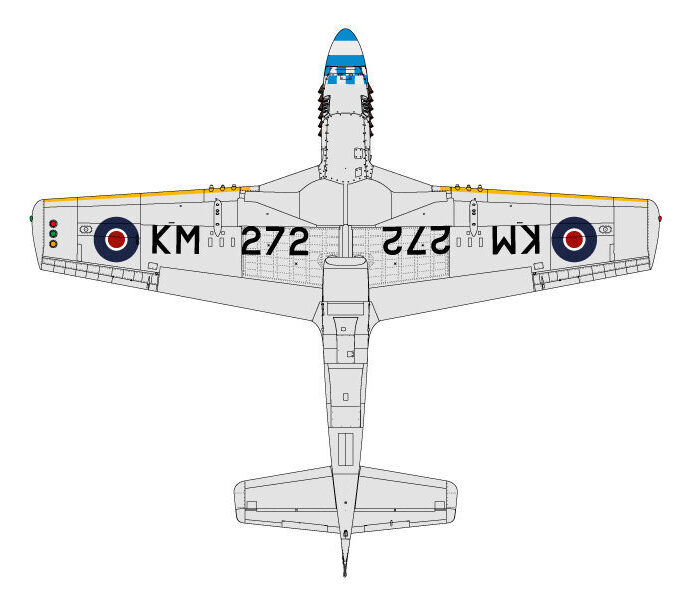
The serial number under the wings was not present when Taylor saw “Dooleybird” in late July 1945. It appeared shortly afterwards, in accordance with the marking regulations introduced that summer. Download the file to print these markings on transparent decal film if you wish to build the late-war version. Print with a laser printer and seal the decal with a layer of clear varnish.
Download link: click here to download.
Summary
The black-and-white photos from Doley’s Log Book, known from *Camouflage and Markings*, are the only surviving photos of KM272, but they do not support either color interpretation. Their date is unknown. The colors described there were likely agreed with Doley around 1970 and he never changed his account. Taylor’s testimony is also compelling, though not entirely free of inconsistencies.
Instead of trying to decide which witness was mistaken, it is more reasonable to assume that KM272 first carried a yellow band and yellow–black spinner — like KH818 — and was later repainted with the blue–white spinner and blue band. This would match both testimonies and the timeline of squadron marking changes. Doley continued to serve with No.19 Squadron until mid-February 1946.
Given the available evidence, modelers may safely choose either color version. Additional information may yet appear: the Suffolk Archives in Ipswich (reference HD4083) holds a photographic collection and a copy of S/L Peter Hearne’s Log Book, while the RAF Museum holds F/L Arthur Doley’s Log Book.
References (external links)
- *Wolverhampton Express and Star*, 8 January 1974 – link ↩
- *Wolverhampton Express and Star*, 13 September 1990 – link ↩
- Photo of KM193 (IWM) – link ↩
- Photo of KM193 (alternate angle) – link ↩
- Photo of KH818 QV-F – link ↩
Sources
- *Camouflage & Markings. RAF Fighter Command Northern Europe 1936–1945*, J. Goulding, R. Jones
- *RAF Fighters 1945–1950 UK Based*, Paul Lucas
- *On Target Profiles 2: RAF & Commonwealth P-51 Mustang*, Jon Freeman
- *Scale Aircraft Modelling*, March 2001
- *Model Aircraft Monthly*, May 2005
- *Wolverhampton Express and Star*, 8 January 1974 & 13 September 1990
See also:
- P-51K Mustang model kit at Arma Hobby store – link
Model maker for 45 years, now rather a theoretician, collector and conceptual modeller. Brought up on Matchbox kits and reading "303 Squadron" book. An admirer of the works of Roy Huxley and Sydney Camm.
This post is also available in:
 polski