There are aircraft that need an introduction, and there are aircraft we seem to have known all our lives.
The Hurricane belongs firmly to the second group. For anyone brought up on the story of the Battle of Britain, its shape is almost part of the landscape: the thick wing, the deep radiator beneath the fuselage, the hump-backed, workmanlike stance. It is so familiar that it can easily become simply the Hurricane — one of the hundreds in photographs, paintings and formation shots from the summer of 1940.
But no pilot flew ‘the Hurricane’.
He flew a particular aircraft, carrying particular squadron letters, from a particular airfield, on a particular day. Its paint was chipped in certain places, its engine had its own temperament, and its place in history was not yet history at all. It was simply the machine waiting outside when the telephone rang and the order came to scramble.
That is where the Hurricane comes into focus again: at the scale at which history was actually lived, one aircraft and one pilot at a time.
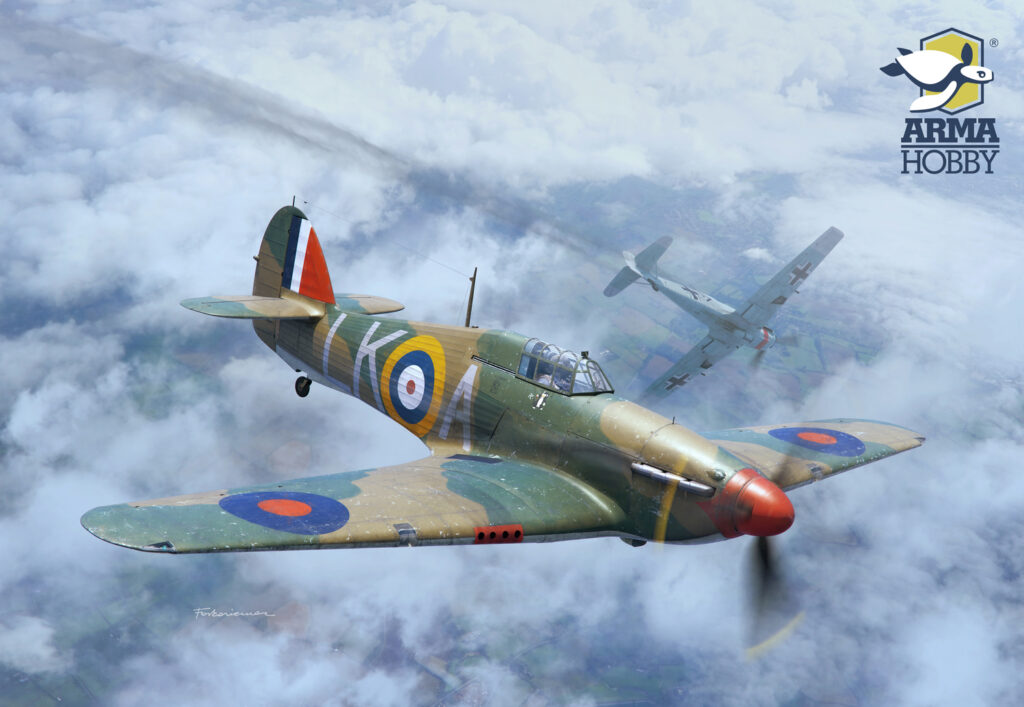
Battle of Britain Hurricane Mk I flown by I. R. Gleed, artwork by Piotr Forkasiewicz.
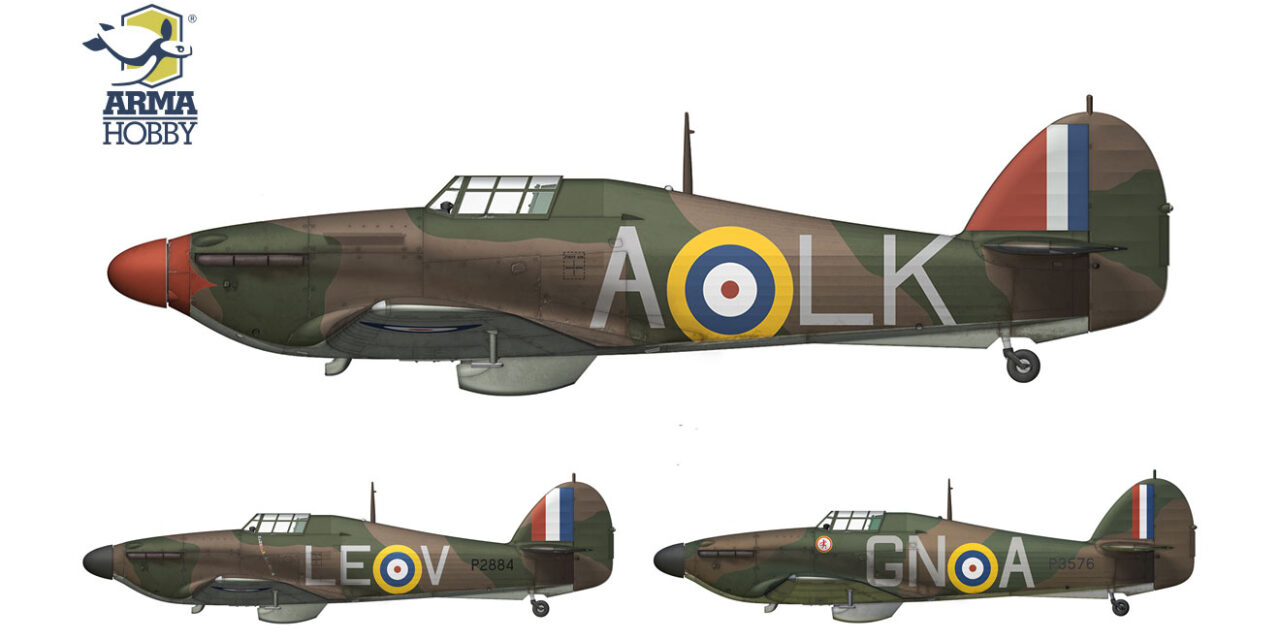
The three Hurricanes in this kit all come from the Battle of Britain, but each opens a rather different window onto those months. One was flown by an already successful and distinctive fighter pilot. Another belonged to a squadron in which a Fleet Air Arm pilot found himself fighting a very different kind of war from the one his uniform might suggest. The third is connected with one of the best-known individual actions of the entire battle — an action for which its pilot received the only Victoria Cross awarded to a pilot of Fighter Command during the Second World War.
P2798 LK-A, P2884 LE-V and P3576 GN-A are therefore more than three choices of markings. Each is a starting point for a story.
And that seems a good reason to build another Hurricane.
Hurricane Mk I P2798 / LK-A — No. 87 Squadron RAF, Exeter, August–September 1940
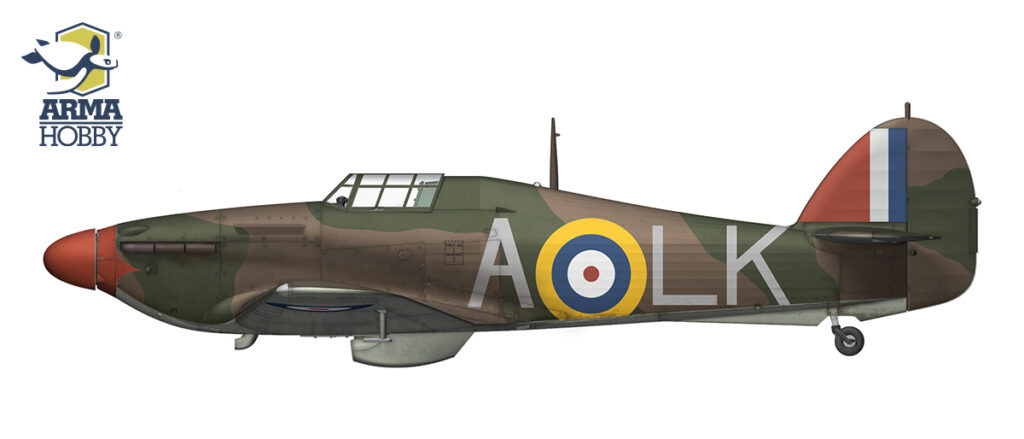
This Hurricane was flown by F/Lt Ian R. ‘Widge’ Gleed, one of the best-known British fighter pilots of the Battle of Britain. By the summer of 1940 Gleed was already an experienced fighter pilot and a flight commander in No. 87 Squadron, operating from Exeter during the fighting over southern England.
At this stage P2798 wore the standard Temperate Land Scheme of Dark Earth and Dark Green. It also carried Gleed’s personal emblem, the black-and-white cat Figaro, below the cockpit.
The aircraft remained closely associated with Gleed after the Battle of Britain. In the winter of 1940–41, when No. 87 Squadron was used in the night-fighter role, P2798 was repainted black while retaining its individual markings. By then Gleed had become Squadron Leader, and his rank pennant was carried on the fin and rudder. The aircraft was also fitted with unusual six-outlet exhaust stacks, visually similar to the type later familiar from Spitfire Mk IXs.
P2798 therefore had a remarkably long and visually varied operational life. The version shown here represents the aircraft during the Battle of Britain, before its later transformation into an all-black night fighter.
Read more:
Hurricane Mk I P2884 / LE-V — No. 242 Squadron RAF, Coltishall, August 1940
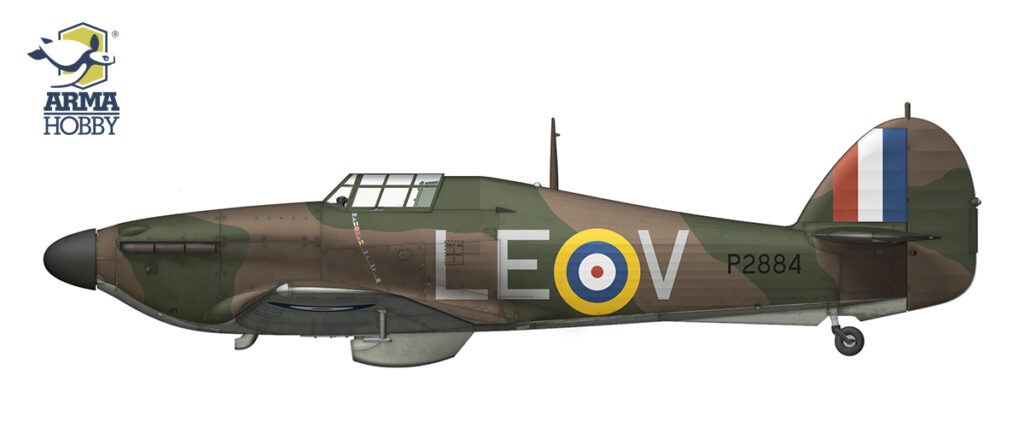
P2884 was flown by Sub-Lieutenant Richard E. ‘Jimmi’ Gardner of the Fleet Air Arm while serving with No. 242 Squadron RAF. His presence in a Hurricane squadron is a reminder that the Battle of Britain was not fought by Fighter Command personnel alone: Fleet Air Arm pilots were also sent to RAF fighter units at a time when trained pilots were urgently needed.
Gardner gave his Hurricane a distinctly naval touch. On the port side, a sequence of signal flags referred to Nelson’s famous message before the Battle of Trafalgar: England expects that every man will do his duty.
It is a small detail, but one that makes LE-V unusually personal. The aircraft is unmistakably a Fighter Command Hurricane of the summer of 1940, yet Gardner’s Fleet Air Arm background is literally written on its side.
Hurricane Mk I P3576 / GN-A — No. 249 Squadron RAF, Boscombe Down, August 1940
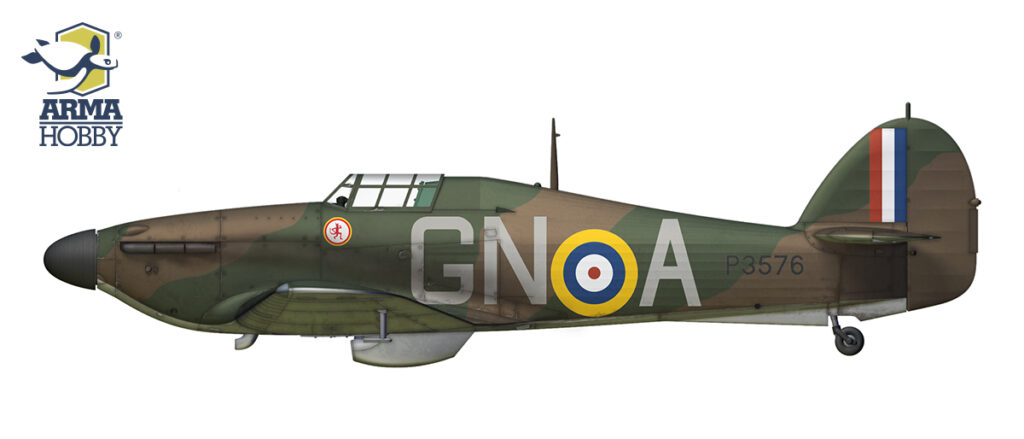
P3576 is associated with F/Lt James B. E. Nicolson and the action of 16 August 1940. His Hurricane was hit and set on fire during combat, and Nicolson himself was wounded and badly burned. Before leaving the aircraft, he continued the fight against an enemy fighter.
For that action Nicolson was awarded the Victoria Cross — the only VC awarded to a pilot of RAF Fighter Command during the Second World War. The story gives GN-A a significance that goes far beyond its camouflage and markings: this is a model connected directly with one of the most remarkable individual episodes of the Battle of Britain.
Read more:
With three such different stories in the box, choosing the first one to build may be the hardest part.
You may also be interested
40017 Hurricane Mk I 1/48 – Battle of Britain
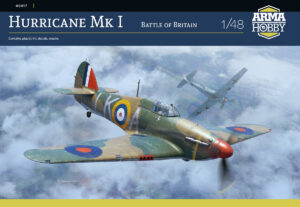
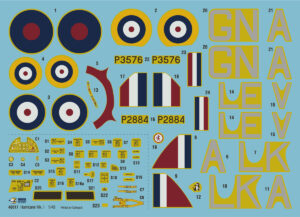
See the model in the Arma Hobby shop: link
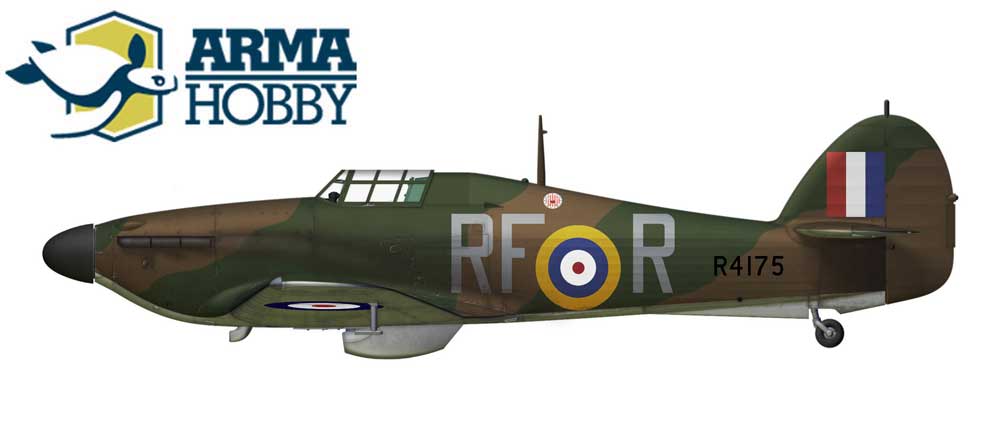
See another Hurricane Mk I 1/48 from the Battle of Britain — RF-R built by Marcin Ciepierski:

Modeller happy enough to work in his hobby. Seems to be a quiet Aspie but you were warned. Enjoys talking about modelling, conspiracy theories, Grand Duchy of Lithuania and internet marketing. Co-founder of Arma Hobby. Builds and paints figurines, aeroplane and armour kits, mostly Polish subject and naval aviation.
This post is also available in:
 polski