

Developing a historical model is very rarely a matter of simply “recreating what was there”. Much more often, it is a journey from low-resolution truth — an incomplete, blurred picture built from fragments of information — to a version that can be honestly defended on factual grounds.
At Arma Hobby, we regularly run into moments when something simply does not fit historically. A photo caption does not match the aircraft number. A popular interpretation has no strong source behind it. A well-known paint scheme turns out to be a reconstruction based more on repeated artwork than on a period photograph. And that is exactly when the real work begins — less spectacular, perhaps, but by far the most interesting part of developing a model.
The paradox is that knowledge about such details very often does exist — but it is scattered. Some of it is in publications, some on forums, some in local studies, and some simply in the memory of modellers and enthusiasts who have been immersed in the subject for years. So the problem is not only the lack of information, but rather how to extract from all this a picture that makes sense and does not fall apart when examined more closely.
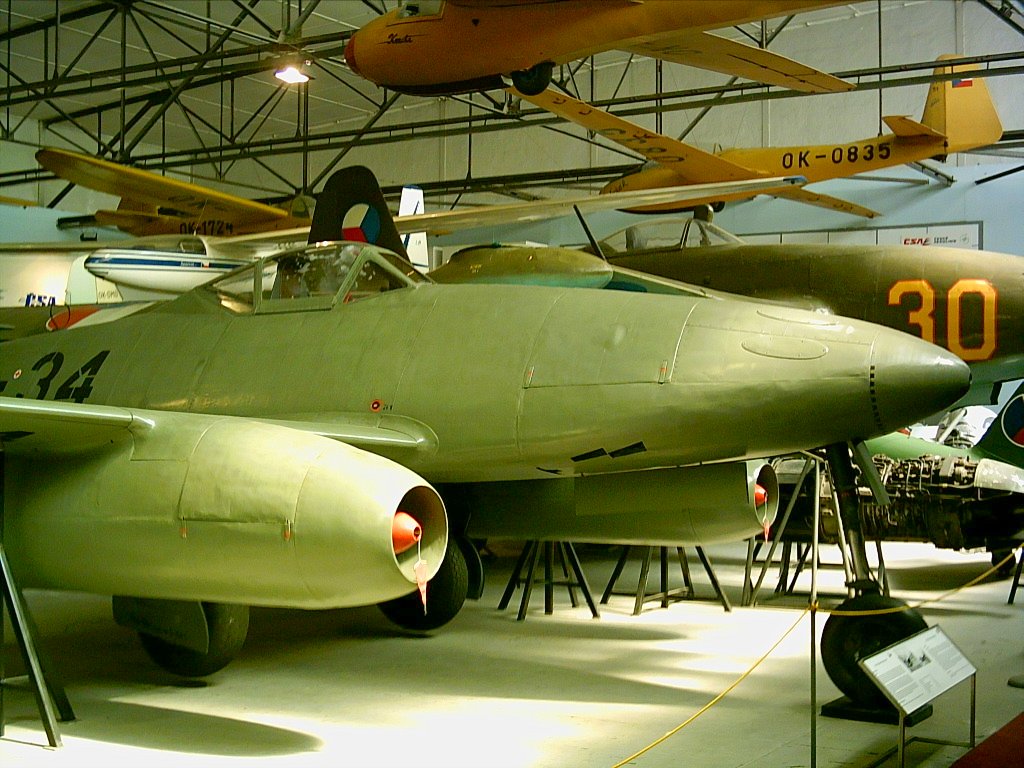
Avia S-92 Turbina, V-34, Praha-Kbely Museum. The gun barrel openings are clearly faired over. Photo: Wikimedia Commons.
That was exactly the case with the Czech Messerschmitt Me 262 — the Avia S-92 and CS-92. At first glance it seems like a niche subject, but once you look closer, it is full of traps: unclear designations, conflicting photo captions, legends repeated for decades, and sources that are not easy to reach — especially with the language barrier.
On this project, we were helped by two Czech aviation historians: František Šrédl and — in particular — Tomáš Dvořák. Thanks to their guidance and several key sources, we were able to narrow the field of uncertainty and arrive at an image of the aircraft that could be reconstructed in an honest way.
In the end, we chose not the most legendary option, but the one we considered the safest historically — an aircraft documented well enough that its appearance and markings could be reconstructed without adding more than the sources actually allow.
Trying to bring the Me 262 back to life
For most modellers, the Czech Avia S-92 and CS-92 are still a fairly exotic subject. The Me 262 itself is a very famous aircraft, but far fewer people know about its post-war Czechoslovak life. And that is a pity, because it is a very interesting chapter in aviation history.
During the Second World War, the well-industrialised parts of the German Protectorate of Bohemia and Moravia were fully drawn into the German war effort. Among other things, German tanks and self-propelled guns based on the Czech LT vz. 38 were produced here, along with Me 109 and Me 262 aircraft.
After the war, Czechoslovakia was left with parts, components, unfinished airframes and the entire industrial background needed to assemble several aircraft directly derived from the Me 262. That is how the Avia S-92 (single-seat) and CS-92 (two-seat) came into being. In much the same way, what remained of the Me 109 led to the Avia S-199 and CS-199. In the case of these jet Messerschmitts, this was not a normal serial production programme, but rather a post-war effort to assemble and put into service aircraft from whatever could be taken over and made airworthy.
The development of the Avia S-92 can now be placed in time reasonably well — although, as in many other aspects of this programme, the details are not always fully unambiguous.
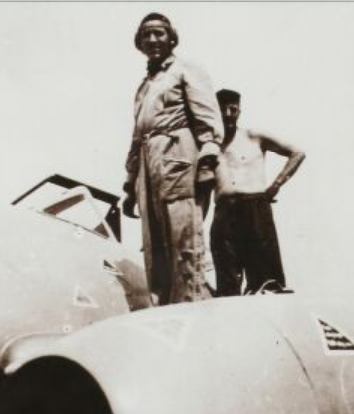
Antonín Kraus (1908–1951), Czech test pilot, with the Avia S-92 prototype in 1946. Photo: Wikimedia Commons.
The first attempts to assemble aircraft from available components began as early as late 1945, and work on the first example continued through the first half of 1946. On 27 August 1946, the first successful flight of the S-92 took place, and further aircraft followed soon afterwards. Later that same year, on 10 December 1946, the two-seat CS-92, intended for pilot training, made its first flight. In 1947, the aircraft began entering service, and in June of that year the designations S-92 and CS-92 were officially adopted. Production was short and limited — in practice it ended in early 1948, after only a small number of aircraft had been completed.
In the following years, these aircraft served mainly for training and for gaining experience with jet aviation. In 1950, they were assigned to the 5th Fighter Unit, but by 1951 they had already been withdrawn from front-line service.
There were only a few of these aircraft, but they played an important role as Czechoslovak aviation’s first practical contact with jet technology. They flew without installed armament, with the gun openings faired over. Their role was testing, introduction into service, training and building experience with an entirely new type of machine. That is why their story is so interesting today — because this is not just a “Czech Me 262”, but an aircraft from a very specific moment of transition: between war and peace, between the Luftwaffe and the new Czechoslovak air arm.
Who was who? A short guide to the S-92 and CS-92 numbers
With the S-92 and CS-92, it quickly becomes clear that the biggest problem is not the lack of interesting paint schemes, but the numbers.
There were only a handful of aircraft, yet they existed under several different designation systems at once. The same aircraft could first appear as V-36 during the trial and introduction stage, and later as KR-36 in service. On top of that, there are gaps in the documents, ambiguous photo captions, and several places where the sources simply do not agree.
That is why the table below is not meant to be the final revealed truth, but rather the most honest ordering of what can currently be said about the individual S-92 and CS-92 aircraft.
Table 1. Known Avia S-92 and CS-92 airframes and their designations in Czechoslovak service
| Airframe | LVÚ / VLÚ designation | Designation in SL 5 / 5. slt | Notes |
|---|---|---|---|
| S-92.2 | V-33 | – | According to the available information, S-92.2 = V-33. In 1949, a cockpit modification was carried out at Avia; by 1950, the aircraft was no longer intended for training. |
| CS-92.3 | V-31 | KR-31? | According to the available information, CS-92.3 = V-31. This was the first Czechoslovak two-seat jet aircraft; first flown on 10 December 1946. Preserved in a museum after service. |
| S-92.4 | V-34 | KR-34? | According to the available information, S-92.4 = V-34. An aircraft linked to a documented period of trials and later service. |
| CS-92.5 | V-35 | KR-35 | The KR-35 designation for the CS-92 is confirmed in the available material. |
| S-92.6 | V-36? | KR-36 | The KR-36 designation for the S-92 is confirmed. This is the aircraft later associated with the supposed “Mickey Mouse” story, but there is no certain photographic confirmation. |
| S-92.7 | V-37 | KR-37? | Taken over by the military administration on 11 October 1950 as S-92 V-37; later recorded in LVÚ documentation. |
| S-92.8 | V-38? | – | The V-38 designation seems logical, but the sources here are not as strong as in other cases. |
| S-92.9 | V-40? / V-39? | KR-40? / KR-39? | The most interesting aircraft for Arma Hobby. A photograph from Žatec in 1949 is interpreted as most likely showing V-40, although the documentation also contains ambiguity involving V-39. |
| S-92.10 | V-39? / V-40? | KR-39? / KR-40? | The airframe that breaks the pattern for us — the sources show overlapping possible identifications of V-39 / V-40. This is exactly why identifying V-40 requires caution and close work with the specific features of the aircraft. |
Prepared on the basis of: Irra, Miroslav, Avia S/CS-92…, see the bibliography at the end of the article.
In the case of the Czechoslovak Me 262s, the same aircraft may appear in sources under several different designations, depending on the stage of its career. S-92 denotes the single-seat version, while CS-92 denotes the two-seat one. The V-… series designations come from the period of trials, evaluation and introduction into service, and are connected with the institutions abbreviated VLÚ / LVÚ (Výzkumný letecký ústav / later Letecký výzkumný ústav), the Czechoslovak aviation research and test establishment. This is the context in which codes such as V-31, V-33, V-34 and V-40 appear.
Designations linked to later military service, in turn, appear in connection with SL 5 / 5. slt (5. stíhací letka, that is, the 5th fighter flight / unit). During this period, the later KR-… series designations also came into use. Importantly, after the aircraft were transferred to SL 5, the “V” codes were still used for some time before being replaced by the “KR” designations. This is why the same aircraft may appear in sources first as V-36 and later as KR-36.
For a modeller, this has a very practical meaning: the designation visible in a photo caption does not always tell you at what stage of service a particular aircraft is being shown. And that directly affects how its markings, configuration and overall appearance should be interpreted.
The best-known Avia S-92, used for ground training and later preserved as a museum exhibit. Photo: Destination’s Journey.
Which paint scheme should we choose?
Among the Czechoslovak S-92s, two options immediately catch a modeller’s eye.
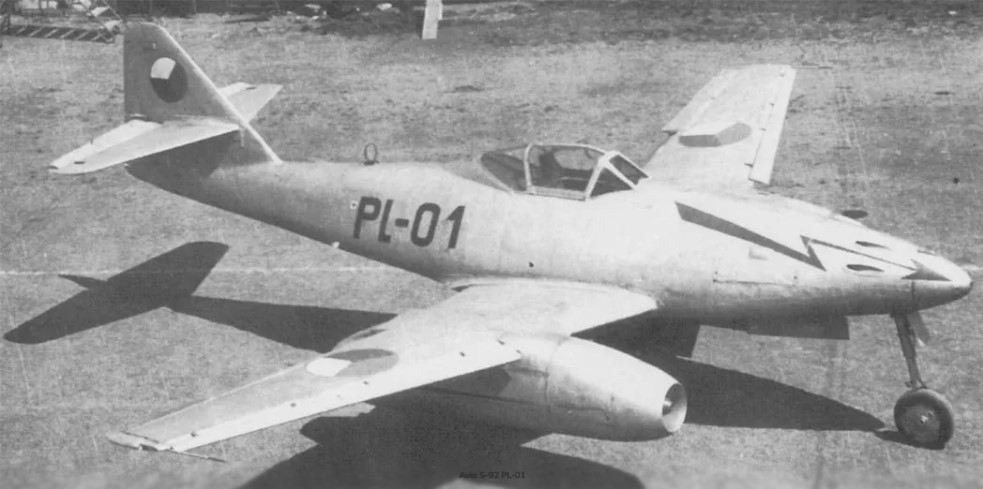
The first is PL-01 — visually very striking, with a colourful lightning flash on the nose and a large number of photos. The problem is that this designation is known from a museum / memorial aircraft, not from well-documented operational service. For that reason, from the start we treated it more as a curiosity than as a serious candidate for the box art option.
Why did we not choose V-36 with “Mickey Mouse”?
The second option was much more tempting: V-36 with the supposed Mickey Mouse emblem. And this turned out to be one of the most interesting traps in the whole project.
At first glance, everything looks perfect. There is a number, there is a legend, and there is even a “known” image of the aircraft. The problem began when we started looking for photographs and asking Czech specialists about this machine. The deeper we went into the subject, the clearer it became that the popular image of V-36 is, to a large extent, a reconstruction rather than a documented fact.
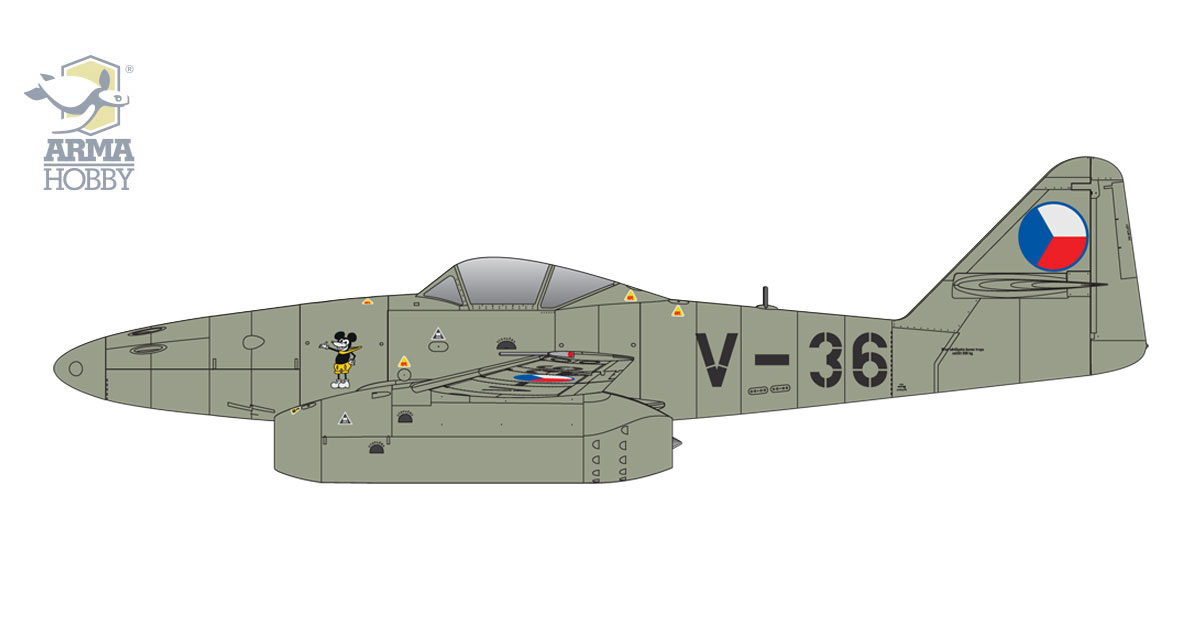
A popular but incorrect vision of Avia S-92 V-36 markings, after Miroslav Balous (1976 and 1995; see bibliography). Colour profile: Zbyszek Malicki.
What do we actually know?
Accounts quoted in Czech studies suggest that the S-92 V-36 really did carry a Mickey Mouse emblem. According to recollections, it was painted by Ladislav Matoulek, a technician associated first with LVÚ and later with 5. stíhací letka. The problem is that no known photograph survives showing this emblem painted on the aircraft. So we do not know exactly what this Mickey Mouse looked like, nor where exactly it was placed.
So where did the “known” Mickey come from?
The most widespread image of V-36 comes from artwork published by Miroslav Balous on the back cover of the magazine Letectví a kosmonautika, issue 19 from 1976. This is what shaped the later image of the aircraft among modellers.
But this illustration was not a faithful reconstruction based on a photograph. It was an attempt to “fill in” the emblem from recollections. Moreover, everything suggests that Balous based the Mickey Mouse figure on the well-known emblem from Horst Carganico’s Bf 109 of JG 5, later repeated in the modelling iconographic circuit. In practice, this means that the “Czech Mickey” known from publications is more a variation on an existing motif than the real, documented appearance of the emblem carried by V-36.
-
- Version 1.0.0
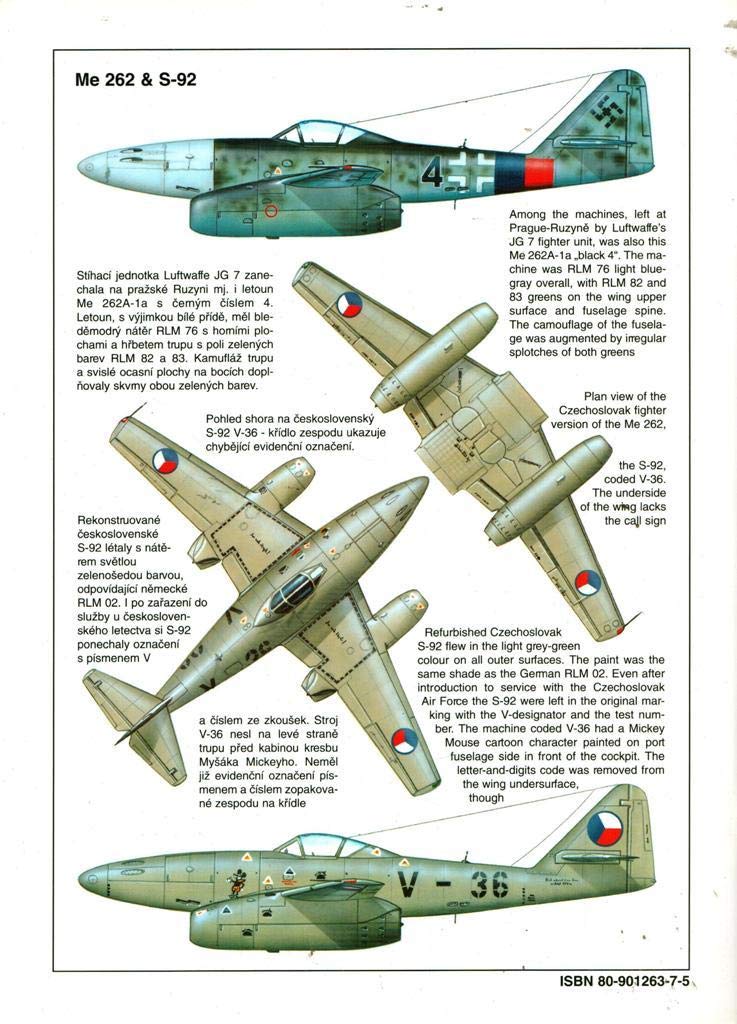
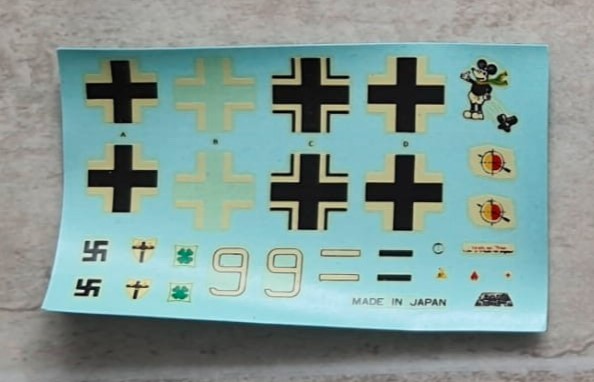
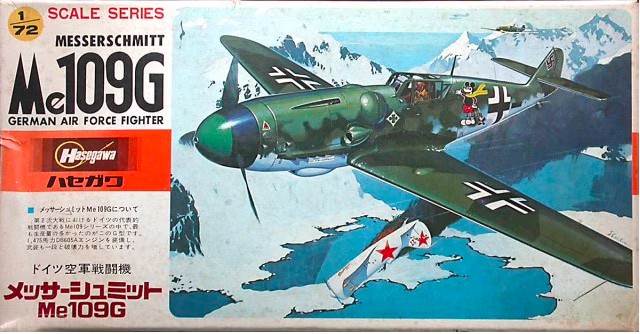
The source of the confusion: the Hasegawa A26 Me 109G 1/72 kit and its decal sheet, alongside Miroslav Balous’s artwork from the 1995 MBI book Messerschmitt Me 262. Images: Scalemates, MBI, adumaru.pl.
The version most often repeated in later publications resembles this figure — only simplified, without the shoes. From a modeller’s point of view, it is an extremely attractive scheme. From a historical point of view, it is simply too uncertain.
And that is why, with some regret, we gave up on this option.
Our choice: V-40
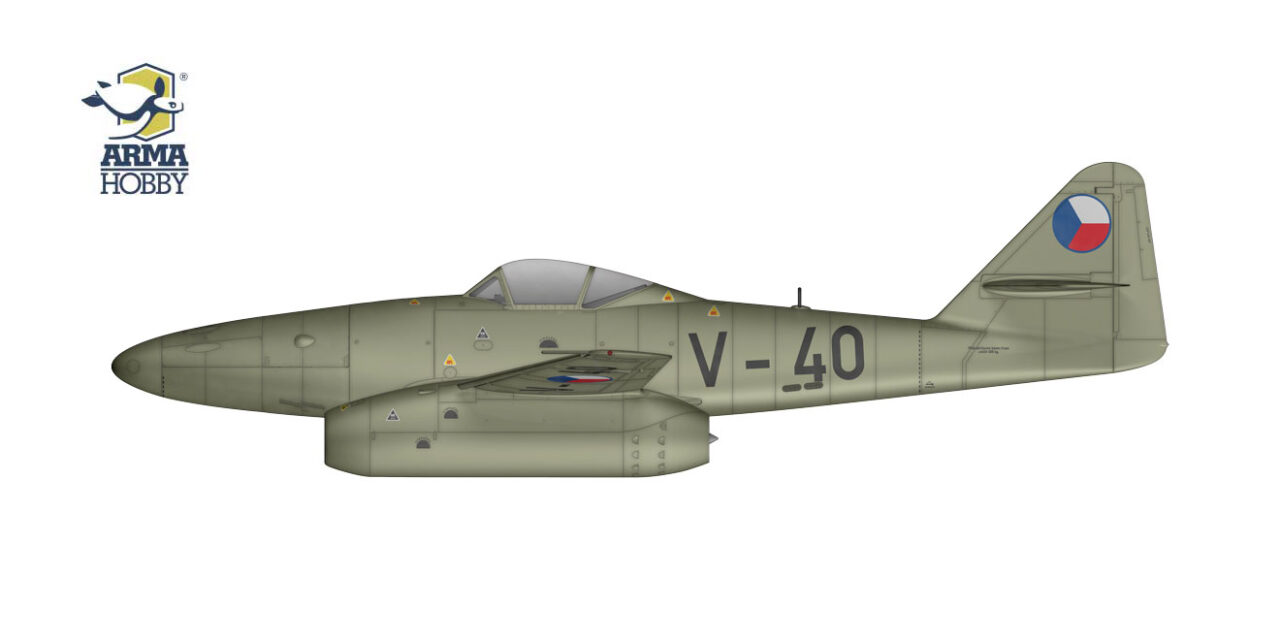
In the end, we chose V-40: perhaps a less legendary option, but one about which we had the fewest doubts.
This is one of those S-92s for which at least two archival photographs of the entire aircraft from its service period have survived, which in this subject is already a major advantage. That made it possible to reconstruct its markings and general configuration with much greater confidence. Just as importantly, it was a variant consistent with the Me 262 A-1a configuration — the one we could sensibly reproduce in plastic parts.
For the model, this was simply the more honest decision. We did not choose the loudest or most famous aircraft, but the one that could be grounded in sources rather than guesswork. And in practice, that kind of choice often turns out to be better — even if from the outside it may seem less spectacular.
The nature of the kit itself also mattered. From the beginning, we wanted to offer something more than just another classic German Me 262 paint scheme. The Czech option was far more interesting in that respect — both historically and visually — while at the same time offering a relatively simple, single-colour finish that works well in modelling practice.
In that sense, V-40 turned out to be a very rewarding choice: unusual, but not strange; interesting, but not overcomplicated; and attractive to the modeller because it offers the chance to build something less obvious without having to tackle a very complex late-war German camouflage scheme.
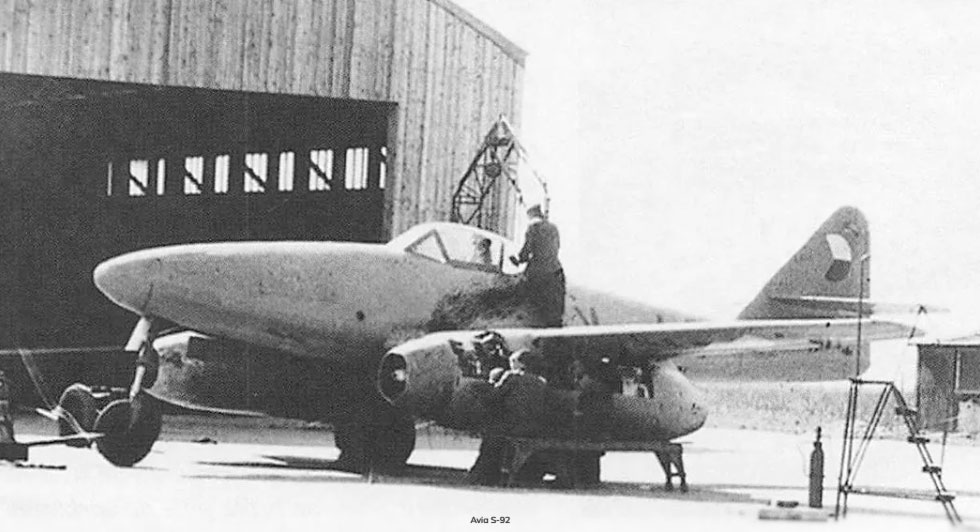
Avia S-92 V-40, Žatec airfield, 1949. Photo: Destination’s Journey.
What colour was V-40?
The colours of the S-92 and CS-92 are still open to debate. In the literature, the most common statement is that the aircraft were painted in a finish corresponding to the German RLM 02. But that does not solve the problem — RLM 02 was not one single fixed shade, but a type of coating that in practice could look quite different.

Czech studies also mention post-war production of this paint, referred to as Tebas 2036.02. This suggests continuity of technology rather than the exact use of wartime German paint. At the same time, the authors stress that there were many shades of this paint and that no single “correct” one can be identified today.
In practice, the safest assumption is that the S-92s were painted overall in a light grey-green colour. This is supported by written descriptions, surviving photographs and museum examples, although even they do not provide one fully conclusive answer about the exact shade.
For the modeller, this means one thing: instead of searching for one “perfect” RLM 02, it is better to think in terms of a range — from a cooler grey, through the classic grey-green, to warmer, slightly yellowish variants. That range is historically justified and reflects the character of these post-war machines well.
For our V-40, this is exactly the approach we adopted — a colour close to RLM 02, but treated as an interpretation, not as one strict paint-chip value.
Me 262 i późno wojenne kolory RLM – próba uporządkowania tematu
In the end, interpretation still remains
The story of the Avia S-92 shows very well what work on a historical model looks like in practice. It is not about recreating one certain image, but about gradually narrowing uncertainty — from scattered information, through conflicting interpretations, to a version that can honestly be put in the box.
And perhaps that is exactly why this subject turned out to be so interesting. Because instead of another “obvious” Me 262 version, we got an aircraft standing at the meeting point of eras, systems and interpretations — and that makes it exactly the kind of subject that shows how the story of a model begins long before the first cut from the sprue.
Bibliography
Printed sources
Balous, Miroslav, and Jiří Rajlich. Messerschmitt Me 262. Prague: MBI, 1995. ISBN 80-901263-7-5.
Irra, Miroslav. Avia S/CS-92 v československém letectvu. Aero series, no. 2/110. Prague: Jakab Publishing.
https://www.jakab.cz/110-avia-s/cs-95-v-cs-letectvu-m-irra#detail-anchor-description
Letectví a kosmonautika, issue 19, 1976.
(Back cover — Miroslav Balous’s illustration of S-92 V-36 with the “Mickey Mouse” motif)
Online sources
Třebíč Nuclear Model Club. S-92 / CS-92 Walkaround.
https://www.tnmc.cz/walkaround/s92_cs92.php
Model Forum.cz. Thread on Avia S-92 / CS-92 and their designations / markings.
https://www.modelforum.cz/viewtopic.php?f=52&t=80971&p=2684912&hilit=balous#p2684912
Destination’s Journey. Avia CS-92 – Historical Military Photographs.
https://www.destinationsjourney.com/historical-military-photographs/avia-cs-92/
Historeich Blog. Impressive Czech Messerschmitt Me 262 / Avia S-92.
https://historeich.blogspot.com/2025/02/impressive-czech-messerschmitt-me-262.html
Order the kit from our shop
- Buy now: link.
See also:
70083 Me 262 A-1a – Reviews, First Impressions and Video Coverage

Modeller happy enough to work in his hobby. Seems to be a quiet Aspie but you were warned. Enjoys talking about modelling, conspiracy theories, Grand Duchy of Lithuania and internet marketing. Co-founder of Arma Hobby. Builds and paints figurines, aeroplane and armour kits, mostly Polish subject and naval aviation.
This post is also available in:
 polski

.png)

A very detailed, comprehensive and engaging article.
Very well researched. You are now providing services that journalist (through their companies) should be providing, as the common man (and modeller) does not have the resources and time to engage in these deep dives. Although we immensely benefit from the results.
Thank you for this article and please keep it up.
i, in return will continue to provide my support by purchasing your (1/72 scale) kits.
Thank you
Guchi