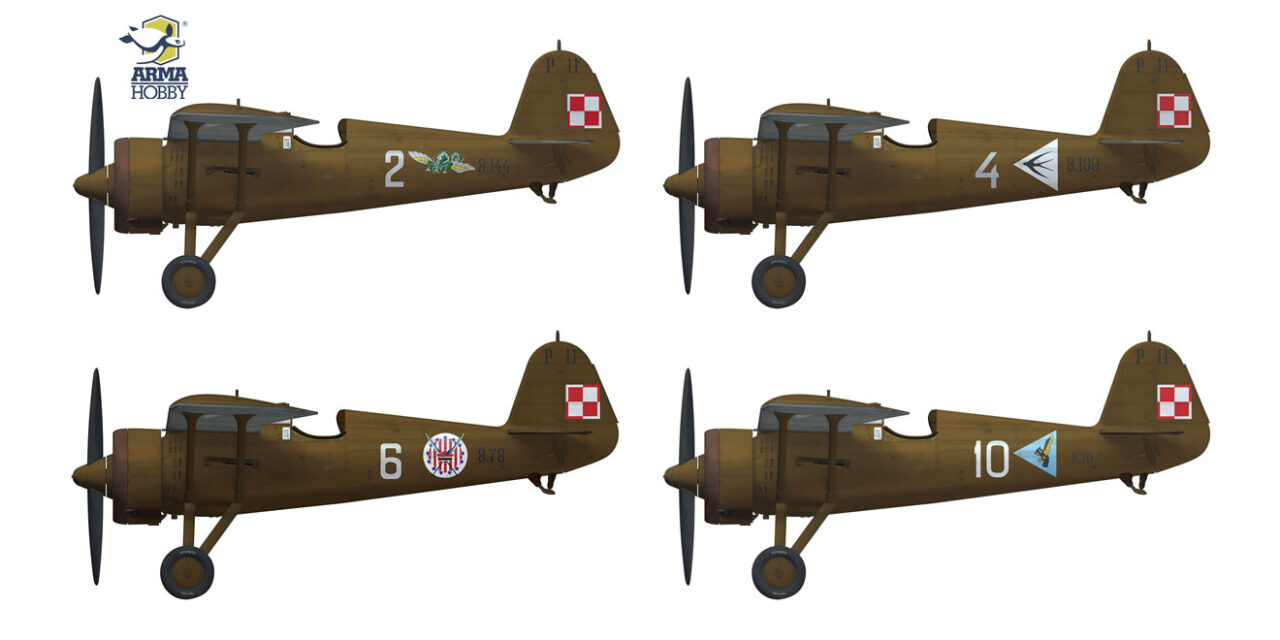
On 1 September 1939, the pilots of the Pursuit Brigade took off to intercept German aircraft heading for Warsaw. They flew PZL P.11c fighters – aircraft that only a few years earlier had ranked among the world’s most advanced, but by 1939 had to face much faster Luftwaffe machines.
Today we are presenting a new edition of our 1/72 scale PZL P.11c – 70018 PZL P.11c “Pursuit Brigade”. We chose four aircraft for the kit, one from each of the 111th, 112th, 113th and 114th Fighter Squadrons. Each is connected with a particular pilot and has a story of its own.
We are also adding new 3D-printed details, allowing the model to be considerably enhanced without making the basic kit any more complicated to build.
P.11c – different from the earlier Puławski fighters
The PZL P.11c was another stage in the development of the fighter family begun by Zygmunt Puławski. The P.1, P.6, P.7, P.11 and later P.24 were united above all by the characteristic gull wing that became one of the most recognisable features of Polish aircraft design in the 1930s.
The P.11c, however, also differed from the earlier P.7a and P.11a in the construction of its fuselage. The rear section retained a semi-monocoque structure, while the forward fuselage was built around a metal framework. Where the two structures meet, the fuselage line changes noticeably, with the forward section running at a slightly different angle.
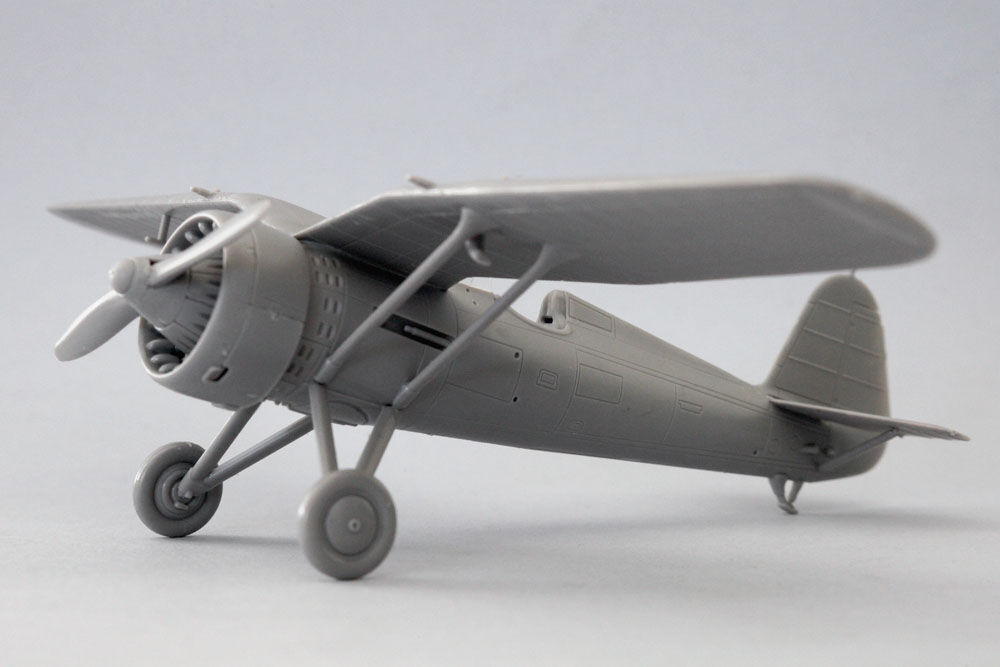
It is a small detail – until you start looking closely at photographs of the P.11c. After that, it becomes difficult not to notice.
We reproduced this geometry in our model. It is one of those features that may not immediately stand out on the sprues, but it makes a real difference to the characteristic silhouette of the finished P.11c.
At the same time, the model remains straightforward to build. The Arma Hobby PZL P.11c is the easiest 1/72 kit of the aircraft to assemble, while the new 3D-printed parts now offer much more scope for additional detail.
1 September
The aircraft of the Pursuit Brigade had already left Okęcie before the outbreak of war. The 113th “Owls” Squadron and the 114th “Swallows” Squadron moved to Poniatów, while the 111th and 112th Squadrons operated from field airstrips on the other side of Warsaw. The aircraft were dispersed and camouflaged – at Okęcie they would have been easy targets for the first German raid.
On the morning of 1 September, they did not have long to wait.
The first three fighters to leave Poniatów were led by Hieronim Dudwał, with Jerzy Radomski and Mieczysław Kaźmierczak flying alongside him. Dudwał later remembered the dust thrown up by the propellers, circling in cloud and being guided from the ground by radio. Before long he saw a German aircraft emerging from the clouds. The war they had been waiting for on the camouflaged airfield had suddenly become very real.
All four Warsaw fighter squadrons fought over the capital that day. The four P.11cs selected for this kit belonged to those very units.
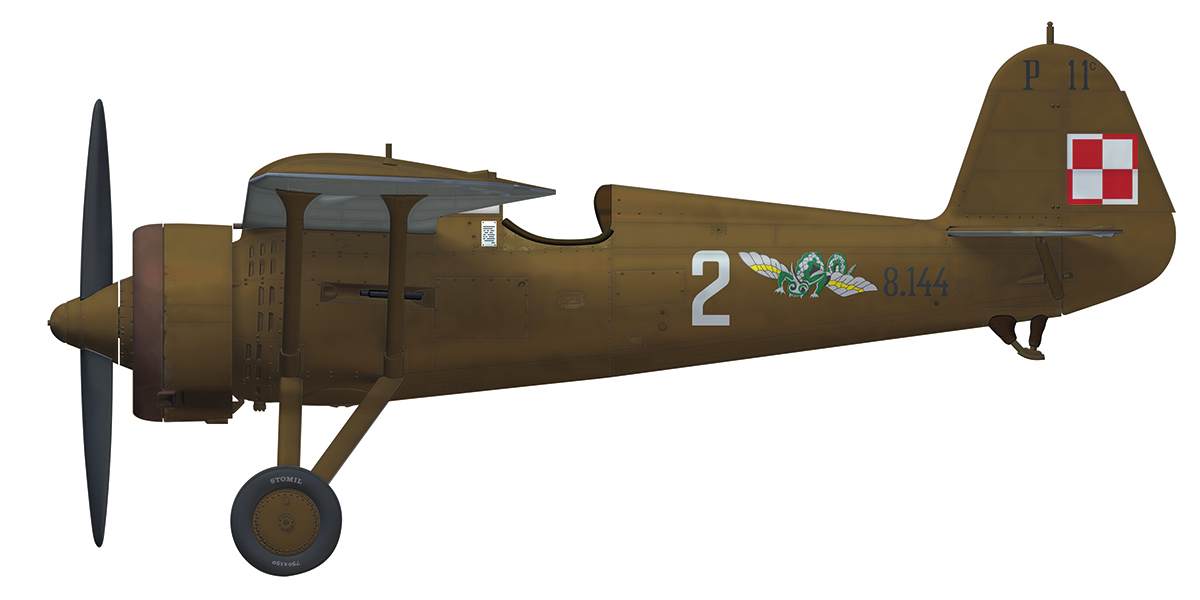
“2” with the Salamander – Wacław Łapkowski
PZL P.11c No. 8.144/666-N, tactical number 2, Lt Wacław Łapkowski, 112th Fighter Squadron, September 1939 – 1 and 1/3 aerial victories.
Wacław Łapkowski had served with the 112th Squadron since 1936 and by the outbreak of war was already an experienced pilot and leader. His “2” carried the squadron’s new emblem – the winged Salamander introduced on its aircraft during the summer of 1939.
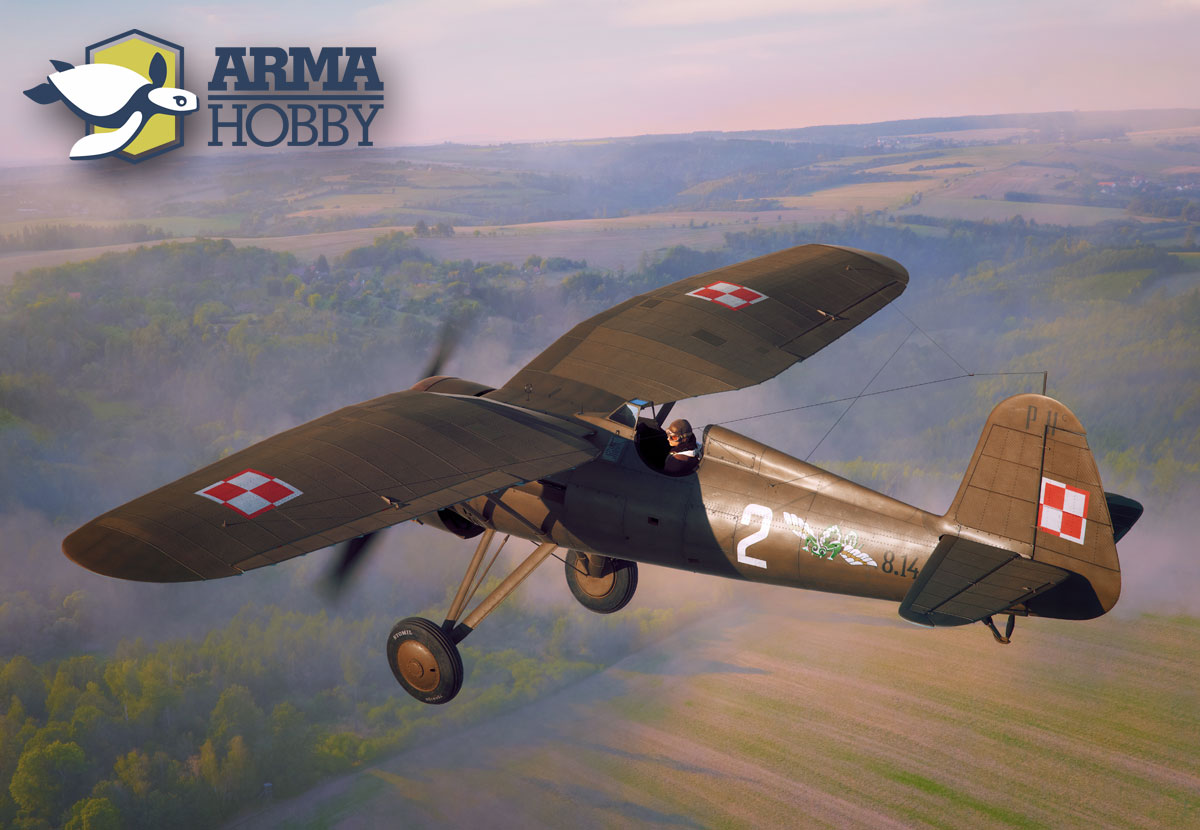
“2 with the Salamander” in flight, painted by Piotr Forkasiewicz.
On 1 September, Łapkowski and Jan Daszewski were assigned to the alert section. Paradoxically, this meant that during the Brigade’s first major engagement their section remained on the ground as a reserve. In the days that followed there was no shortage of opportunities to fight. Łapkowski was credited with 1 and 1/3 aerial victories during the September campaign.
He later fought in France and Britain and eventually became commander of No. 303 Squadron. Łapkowski was killed in action on 2 July 1941.
Read more about Wacław Łapkowski and his P.11c:
Uskrzydlone Salamandry cz. 4, Pilot „2” z salamandrą: mjr Wacław Łapkowski
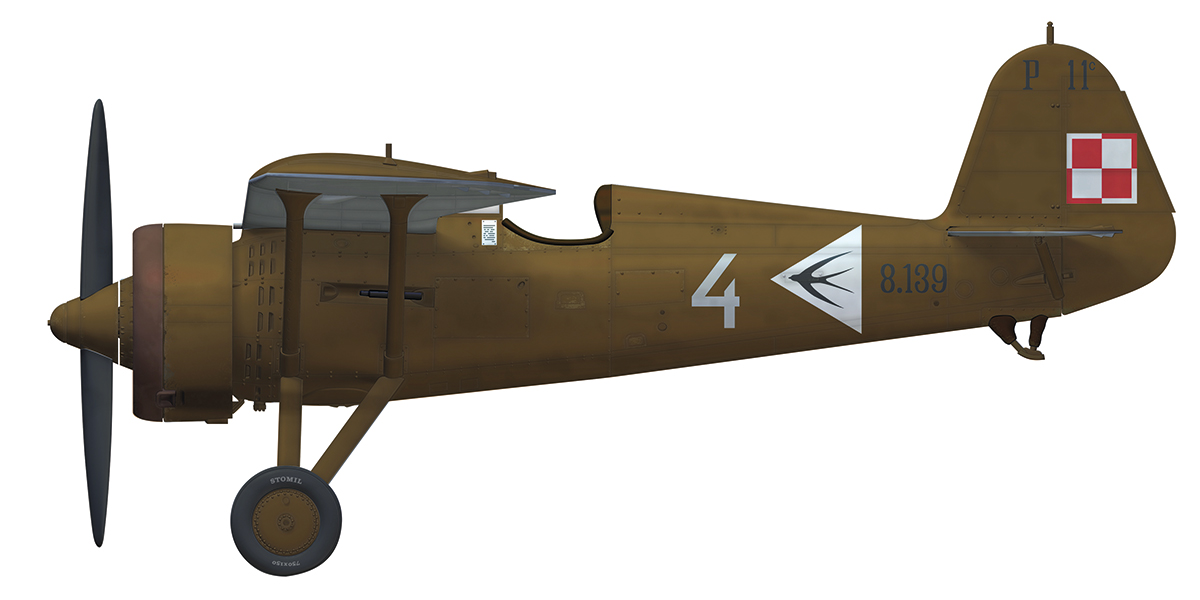
“4” with the Swallow – Tadeusz Sawicz
PZL P.11c No. 8.139/478-N, tactical number 4, 2nd Lt pilot Tadeusz Sawicz, 114th Fighter Squadron, September 1939 – 2 aerial victories.
This P.11c has a particularly interesting story from the first day of the war.
“4” with the Swallow was Tadeusz Sawicz’s aircraft. Sawicz was a section leader in the 114th Squadron, but on the morning of 1 September he was given another task – to bring the 123rd Fighter Squadron from Okęcie to its field airstrip.
His P.11c did not remain on the ground. Lt Aleksander Gabszewicz, tactical officer of IV/1 Fighter Squadron, climbed into it instead. Flying this aircraft, he took off from Poniatów and joined the Pursuit Brigade’s first engagement. Gabszewicz and Andrzej Niewiara attacked a Heinkel He 111. It became the first aerial victory scored in the defence of Warsaw.
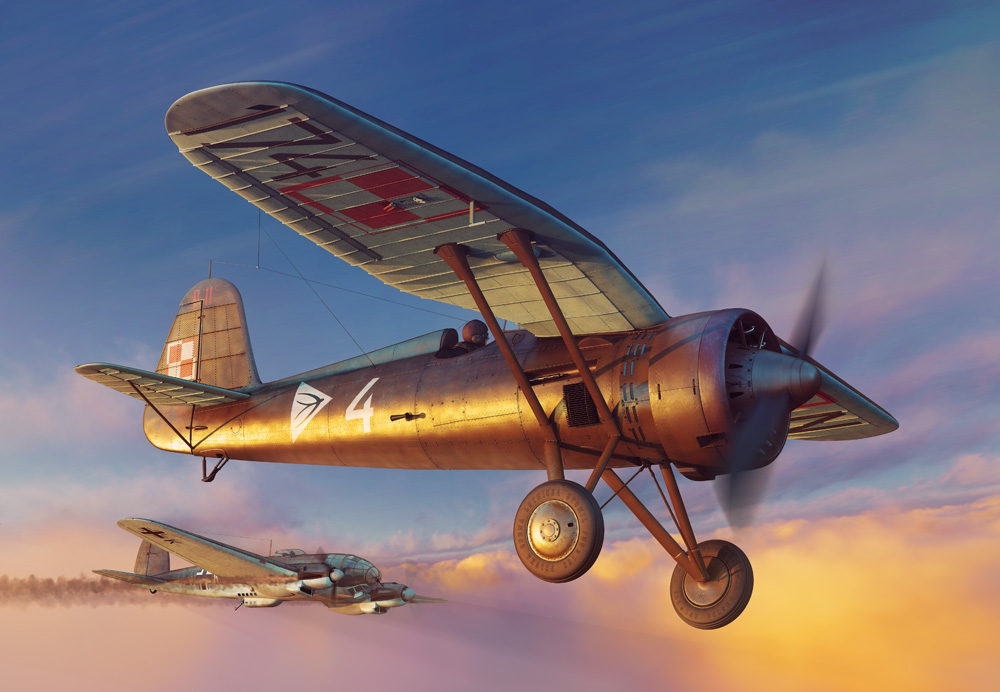
The first victory of “4 with the Swallow”, 1 September 1939, painted by Piotr Forkasiewicz.
Sawicz soon returned to combat flying and was credited with two victories during the September campaign. He survived the war, fighting later in France and Britain, and his flying career would continue for many years afterwards.
The story of Tadeusz Sawicz and “4” with the Swallow:
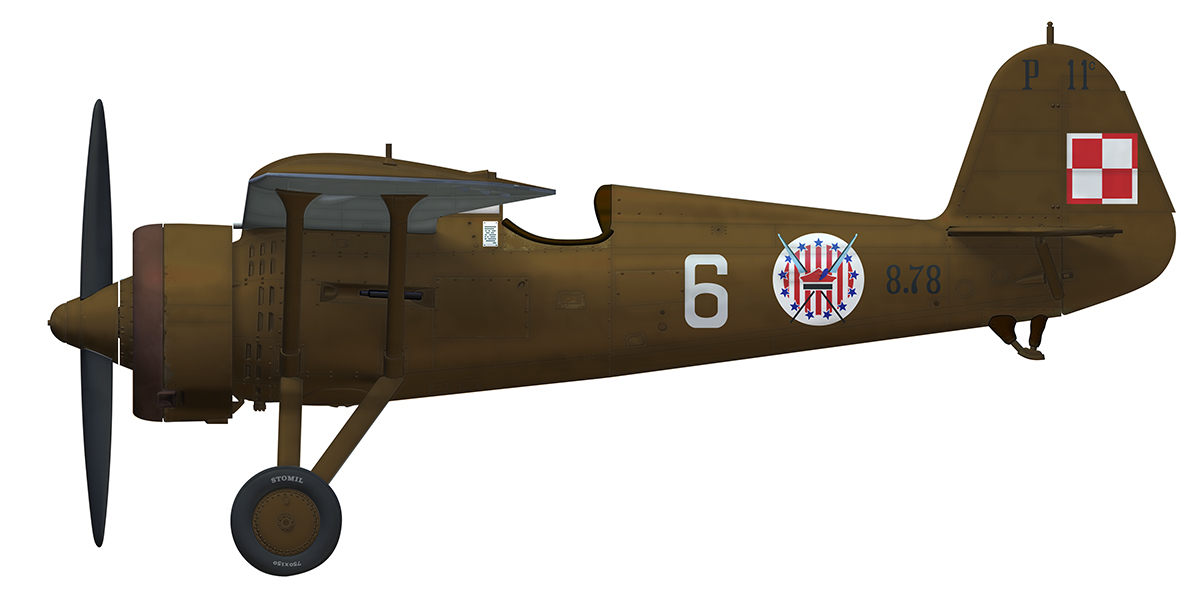
“6” – Janusz Maciński
PZL P.11c No. 8.78/46-N, tactical number 6, Officer Cadet Janusz Maciński, 111th Fighter Squadron, Sulejówek, September 1939.
“6” represents the 111th Fighter Squadron – the famous Kościuszko Squadron – in this kit. It is also an aircraft whose story deserves more space than a few paragraphs in a model presentation.
An article about Janusz Maciński and his PZL P.11c will be published soon on Arma Hobby News.
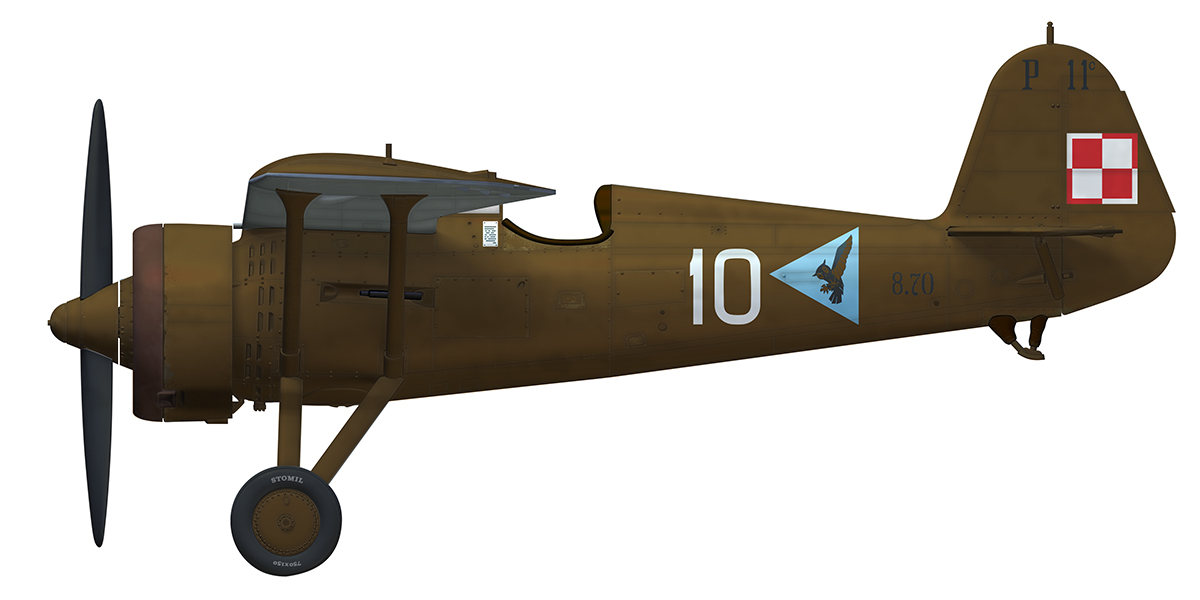
“10” with the Owl – Hieronim Dudwał
PZL P.11c No. 8.70/170-N, tactical number 10, Lt Hieronim Dudwał, 113th Fighter Squadron, Warsaw, September 1939 – 4 aerial victories.
Hieronim Dudwał – “Himek” to his friends – was 26 years old. Before becoming a military pilot he had been a Scout and a model maker.
It was Dudwał who led the first three P.11cs off Poniatów on the morning of 1 September. Before long he encountered a German aircraft emerging from the clouds and then Messerschmitt Bf 110s. He returned from the fight with his wing and propeller damaged by gunfire.
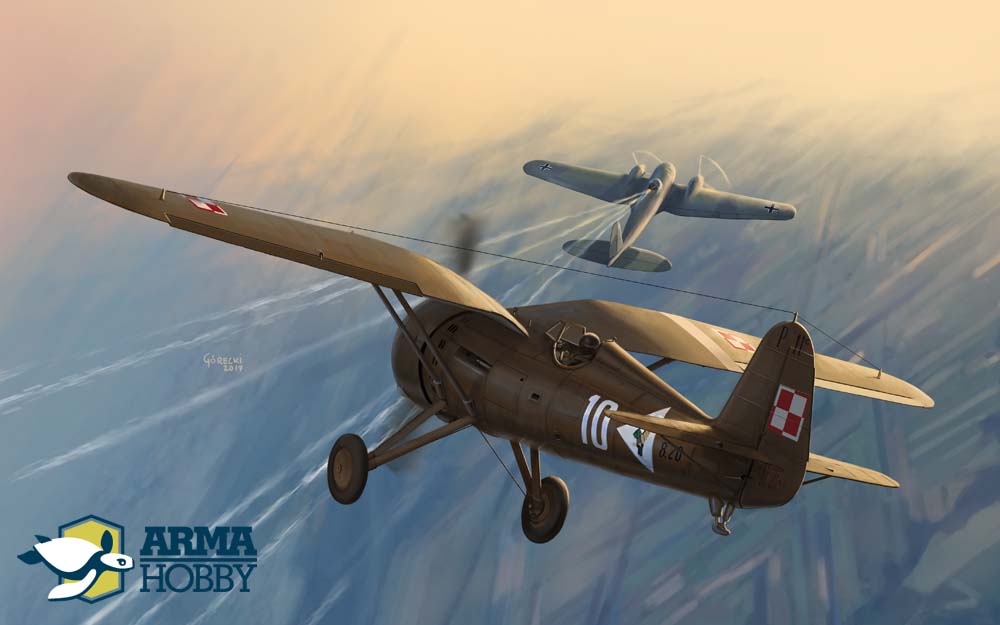
Hieronim Dudwał in combat, September 1939, painted by Marcin Górecki.
It was only the beginning. Dudwał was credited with four aerial victories during the September campaign, making him one of the Pursuit Brigade’s most successful pilots.
His “10” carried the distinctive Owl emblem of the 113th Squadron, as well as additional stripe markings on the starboard side of the aircraft.
Dudwał later made his way to France. In the spring of 1940, in Paris, he told the Polish poet Kazimierz Wierzyński about his fighting in September. Not long afterwards, on 7 June 1940, Dudwał was killed in combat with German fighters. He was 27 years old.
Read more about Himek Dudwał and his P.11c:
P.11c in new colours
Shortly before the war, the aircraft of the Warsaw squadrons were repainted in late Polish khaki, a distinctly darker and browner shade than the colours previously used on Polish fighters.
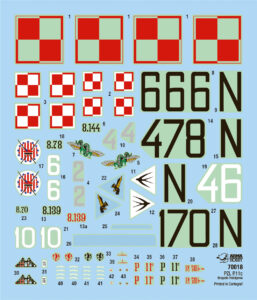
Not all of the earlier markings and stencilling were restored after repainting. The PZL logo disappeared, along with some of the servicing and weight stencils. Serial numbers and the “P.11c” designation were applied in black rather than the red used previously, while the tactical numbers were painted in aluminium silver. This is the appearance reproduced by the markings in kit 70018.
We have also included red serial numbers, the PZL logo and servicing stencils on the decal sheet, allowing modellers to portray these aircraft in their earlier finish.
The exact shade of late Polish khaki remains a fascinating subject for modellers. Paints for the Polish aviation industry came from several manufacturers, and surviving pre-war colour charts show broadly similar, distinctly brown shades of khaki. One of the most interesting surviving examples is a colour chart from the Radom-based PORSA company, which includes Khaki (earth brown) 413.
This does not, of course, prove exactly which paint was used on a particular P.11c during the 1939 repainting. Surviving samples, period colour charts and photographs do, however, give modellers enough evidence to compare the possibilities and make up their own minds.
See the surviving colour chart and an analysis of late Polish khaki at www.modelpaint.pl:
„Polskie khaki” cz. 2 – Odnaleziony wzornik kolorów radomskiej fabryki PORSA!
We discuss the repainting of the P.11c and the surviving photographs of Pursuit Brigade aircraft taken by Henryk Poddębski in more detail here:
Samoloty Brygady Pościgowej w obiektywie Henryka Poddębskiego
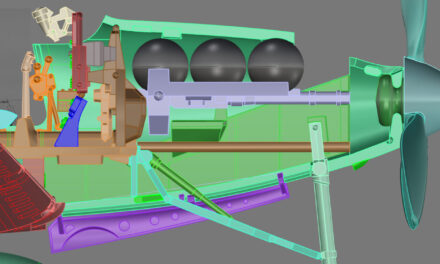
3D-printed details in kit 70018
The PZL P.11c is a straightforward model to build, and we wanted to keep it that way. At the same time, it offers plenty of scope for extra detail, so this edition includes a separate set of 3D-printed parts. They can be used where they genuinely add something to the finished model without complicating the basic assembly.
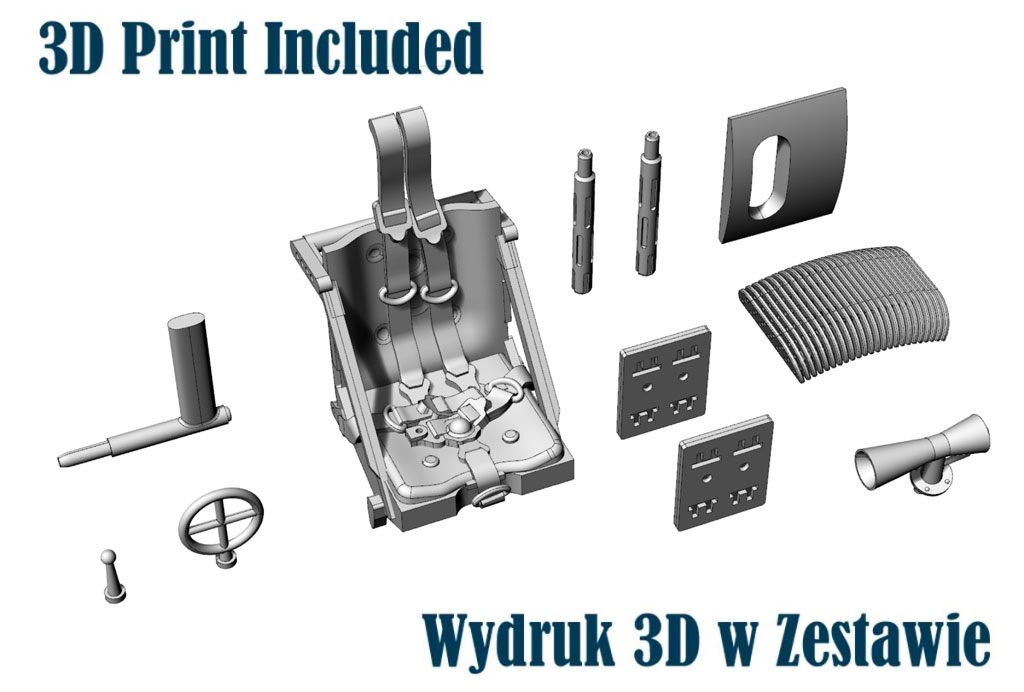
The kit will include:
- seat with harness
- radiator
- machine-gun barrels
- Venturi tube
- Pitot tube
- gunsights
- bomb racks
See the kit in our store:
By 1 September 1939, the PZL P.11c was no longer a modern fighter. But that morning, these were the aircraft in which the pilots of the Pursuit Brigade took off to defend Warsaw.

Modeller happy enough to work in his hobby. Seems to be a quiet Aspie but you were warned. Enjoys talking about modelling, conspiracy theories, Grand Duchy of Lithuania and internet marketing. Co-founder of Arma Hobby. Builds and paints figurines, aeroplane and armour kits, mostly Polish subject and naval aviation.
This post is also available in:
 polski