In 1986, Top Gun with Tom Cruise sparked worldwide interest in US Navy aviation. Forty-five years earlier, the film Dive Bomber, starring Errol Flynn and Fred MacMurray, played a similar role. Few people today remember its plot, but for enthusiasts of vintage aviation it is a real treat. The film was shot in Technicolor, with the participation of US Navy aircraft and personnel. On screen we see American naval aviation at the very moment when an era was coming to an end.
The film tells the story of a flight surgeon trying to find out why pilots black out during dives. It was directed by Michael Curtiz, and the screenplay was co-written by Frank “Spig” Wead, a former naval aviator. Filming took place, among other locations, at North Island in San Diego, and the aircraft carrier USS Enterprise was also placed at the filmmakers’ disposal. On screen we see Vindicators, Devastators, Dauntlesses, Buffaloes, Grumman F3Fs and whole rows of yellow trainers.
The most interesting thing, however, is something else. In some shots the aircraft have silver fuselages and yellow wings, in the next ones they are already all gray. Later the yellow ones appear again.
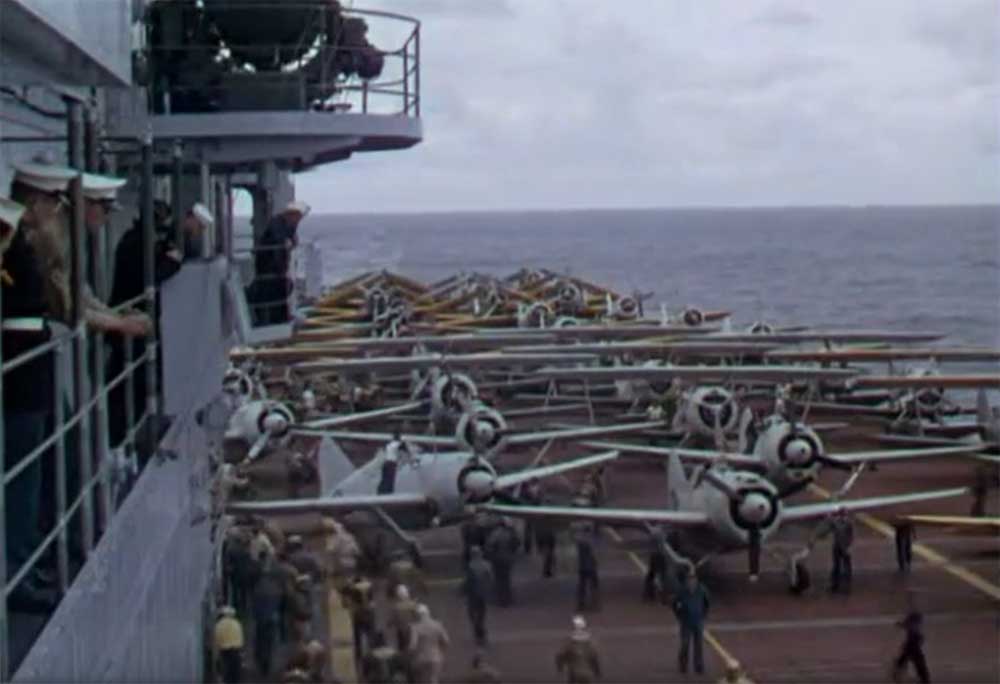
A still from Dive Bomber (1941). The Brewster F2A-3 Buffalo fighters already wear the gray scheme, while the Douglas TBD Devastator torpedo bombers and Curtiss SBC Helldiver dive bombers still have yellow wings. The film captured the moment of the US Navy’s transition from prewar colors to wartime camouflage. Dir. Michael Curtiz, Warner Bros., 1941.
This is not an editor’s mistake. The film was shot from March 1941 onwards, exactly when the US Navy was repainting its aircraft in wartime colors. Curtiz even had to ask for some of the aircraft to be left in the old scheme so that he could finish the scenes he had already started.
Quite by accident, the film became a color record of one of the greatest transformations in the history of American naval aviation.
And we can follow this transformation through the example of one particular Marine squadron – VMF-111.
One squadron, several names and three generations of aircraft
VMF-111 was one of the oldest aviation units of the US Marine Corps. It was formed on 1 September 1925 at Quantico as VF-2M. Over the following years it changed names and designations, serving among others as VF-9M and VMF-1.
It was one of the Marines’ showcase squadrons. In the 1930s it flew Boeing F4B and Grumman F3F biplanes. Its pilots performed at air shows and took part in fleet exercises, and in 1937 the squadron served aboard the carrier USS Saratoga, then commanded by William “Bull” Halsey.
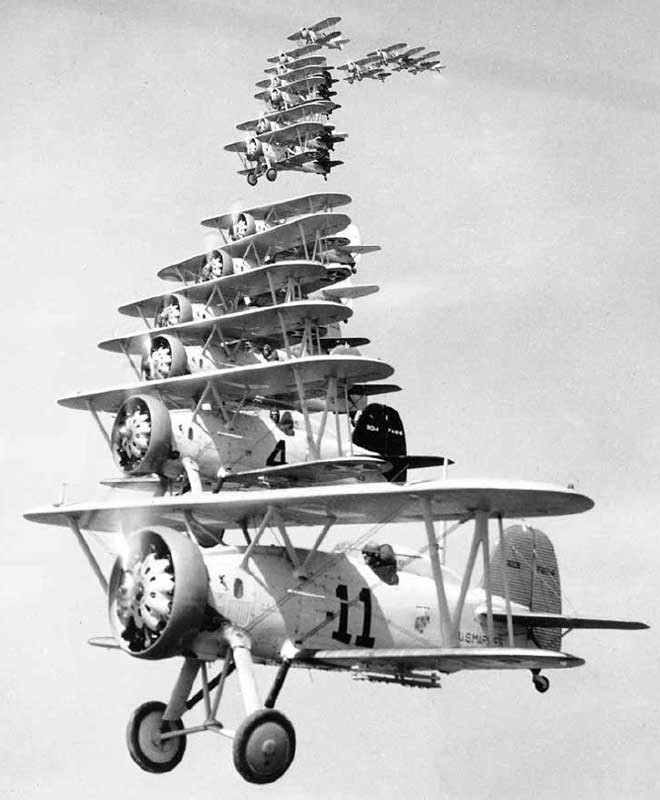
A formation of VF-9M Boeing F4B-4s, 1930s. Photo: Wikimedia Commons.
In 1941 the US Marine Corps was expanding at lightning speed. New aircraft wings and groups were formed, and the existing squadrons received three-digit designations. On 1 July 1941 VMF-1 was redesignated VMF-111. Shortly before, its sister squadron VMF-121 had also been formed.
It was not only the numbers that changed. VMF-111 pilots were moving from Grumman F3F-2 biplanes to modern F4F Wildcat fighters.
Interestingly, they received the rare F4F-3A variant, powered by a Pratt & Whitney R-1830-90 engine with a simpler supercharger. Only 95 of these aircraft were built. Thirty went to the British as the Martlet Mk III, and the remaining 65 to the US Navy and the Marines.
In December 1941 VMF-111 had fifteen F4F-3As on strength.
The end of the yellow wings
In the 1930s, US Navy aircraft were among the most colorful military machines in the world. Silver fuselages, chrome yellow upper wing surfaces, colored tails identifying the carrier, and colored bands identifying an aircraft’s place in the formation.
This was very practical during exercises. From a long distance you could recognize the unit and even the position of an aircraft within it. In wartime, however, such markings would be a gift to the enemy.
On 30 December 1940 the Bureau of Aeronautics ordered the introduction of an overall matt light gray finish – Non-Specular Light Gray. In March 1941 its use was confirmed for fleet aircraft, with the exception of patrol aircraft.
This is exactly the moment captured by the Dive Bomber camera.
But light gray was only a temporary solution. On 20 August 1941 a camouflage with Blue Gray upper surfaces was ordered, initially for Battle Force aircraft. On 13 October the new rules were extended to the rest of naval aviation.
Of course, this did not mean that all aircraft were repainted overnight. In the autumn of 1941 the VMF-111 Wildcats were still overall light gray.
The last great maneuvers before the war
In 1941 the US Army held two huge military exercises. In September maneuvers took place in Louisiana, and in November on the border of North and South Carolina.
Their scale is impressive even today. Nearly 300,000 soldiers took part in the Carolinas, and almost 700 aircraft were made available to the two sides.
What is most interesting, however, is how little the US Army still knew about cooperation between aviation and ground forces.
Army Air Corps aviators preferred to practise strategic bombing from high altitude. Supporting infantry and tanks, especially with dive attacks, was not among their favorite tasks. There was also a very practical problem: the Army had no suitable dive bombers. The first A-24s, land-based versions of the Dauntless, were only just being ordered.
General Henry “Hap” Arnold therefore turned to the Navy for help. Admiral Harold Stark sent more than originally requested: fighter, dive bomber and torpedo squadrons.
Among the units assigned to the maneuvers were VMF-111 and VMF-121.
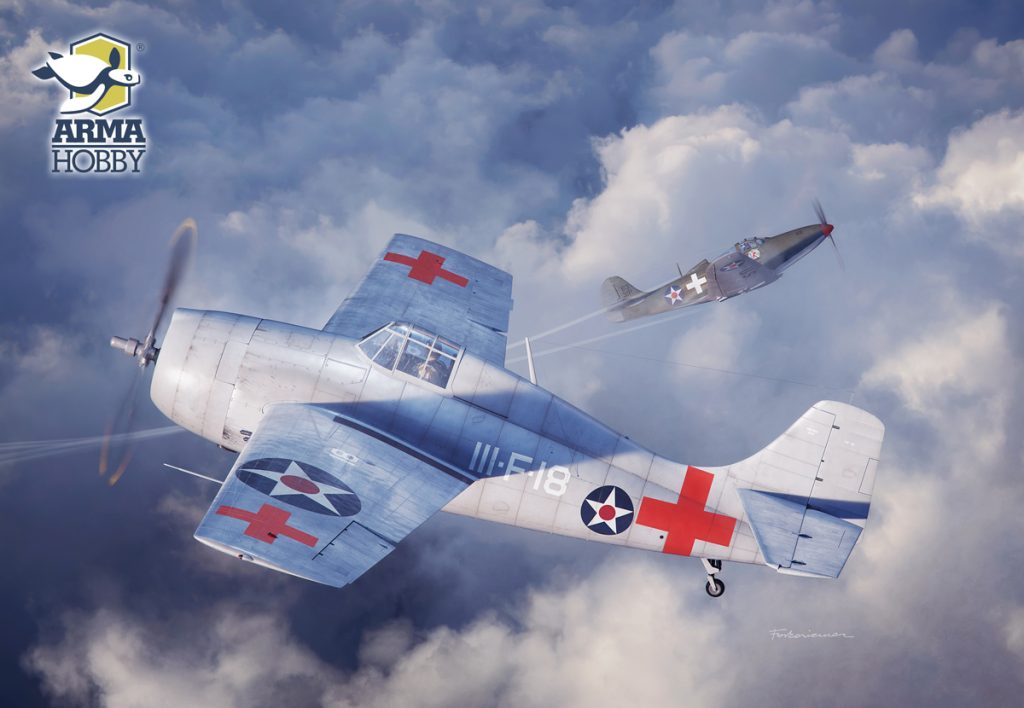
The Carolina Maneuvers, 1941. A Red Force F4F-3A Wildcat of VMF-111 and a Blue Force P-39D of the 40th Pursuit Squadron, 31st Pursuit Group. Box art painted by Piotr Forkasiewicz.
Red against Blue
In the Carolinas, two armies faced each other. The Blue side, under General Hugh Drum, had nearly twice as many ground troops. The Red side was commanded by General Oscar Griswold, whose IV Corps, however, had the advantage in the air.
VMF-111 was assigned to the Red force. VMF-121 found itself on the Blue side.
Special markings were prepared for the aircraft of both sides. Large crosses were painted on the fuselages and wings: red for the Red force and white for the Blue force. They did not replace the standard American stars, but they allowed aircrews and anti-aircraft gunners to tell the participants of the exercise apart.
On the light gray VMF-111 Wildcats, the red crosses looked particularly striking.
White crosses were applied, among others, to the VMF-121 Wildcats and to P-39 Airacobras belonging to Army aviation units. The latter can be seen in surviving photographs, in which the maneuver markings are painted next to the standard stars.
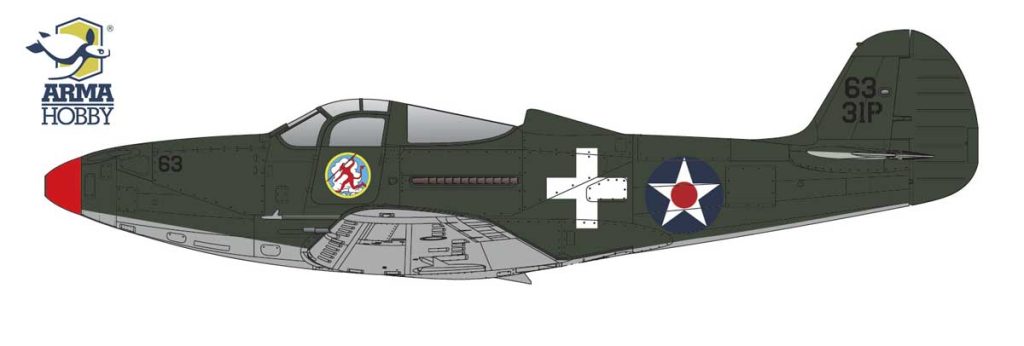
P-39D Airacobra of the 40th Pursuit Squadron, 31st Pursuit Group, Blue Force.
A pretend war, but real problems
In one phase of the maneuvers, the Blue force was to cross the Pee Dee River and establish bridgeheads on the other bank. The Red force was to stop them, using among others General George Patton’s armored units.
The umpires prohibited air attacks before eight in the morning, to allow the Blue force to begin the crossing.
At eight o’clock the Red air force struck the bridges.
On the first day 23 air raids were carried out, and the umpires ruled all six crossings destroyed or put out of action. At the same time, it turned out that aircraft attacking at low altitude would suffer enormous losses. On the first day of the exercise alone, the umpires ruled 66 Red aircraft shot down, and on the next day as many as 115.
These were, of course, not real losses but results simulated by the exercise directors. The numbers showed, however, how seriously the threat from anti-aircraft defenses was taken.
During these maneuvers there was also an episode worthy of a war comedy. Patton’s scouts got across the river and surprised the Blue commander himself, General Drum. They briefly took him “prisoner” and then let him return to command.
Over the whole exercise, the aviation flew 167 raids. More than half were directed against airfields, railway lines and bridges. Much less attention was paid to the direct support of fighting infantry and tanks.
This was one of the more important lessons of the maneuvers. There were plenty of aircraft, but no good system had yet been worked out for directing their operations in support of ground forces. The Americans were to learn this painfully during the fighting in North Africa in 1942.
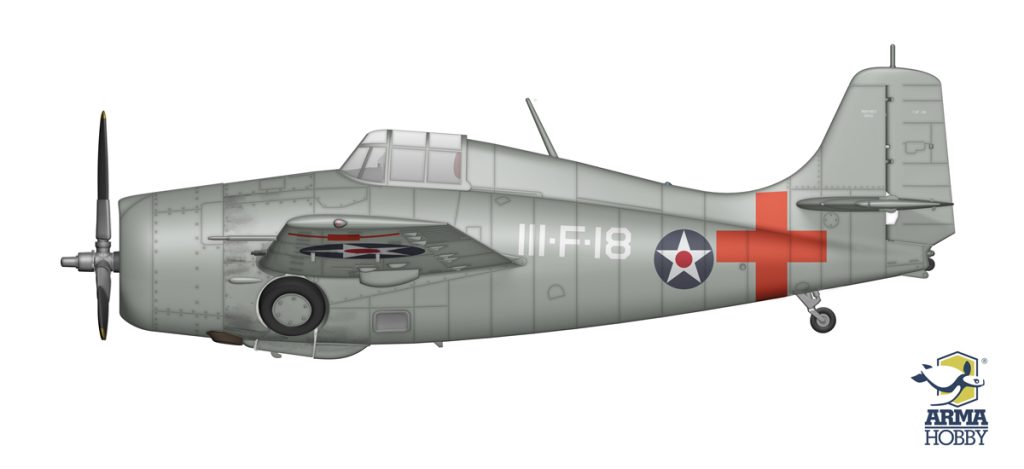
Grumman F4F-3A Wildcat of VMF-111, Red Force, Carolina Maneuvers, 1941.
Color photographs from the last days of peace
The maneuvers left behind some exceptionally interesting photographs.
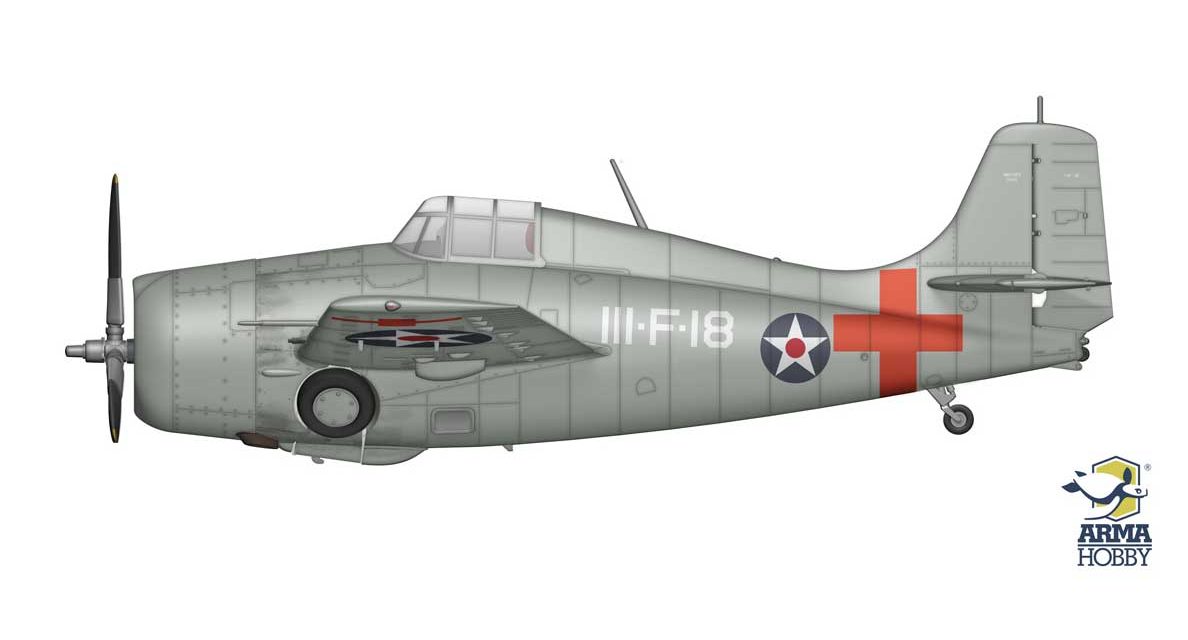
The VMF-111 Wildcats with red crosses were captured in color photographs by Hans Groenhoff. In one of the most interesting shots, a pilot climbs into the cockpit of F4F-3A III-F-18. The light gray fuselage, the unit code and part of the red cross are visible.
Another photograph shows three VMF-111 Wildcats in flight. This time the huge red crosses on the lower wing surfaces are clearly visible.
The Hans Groenhoff collection is held by the National Air and Space Museum in Washington and is available to researchers. Some of the photographs from this period have been published in books and in the online Asisbiz gallery.
These photographs have an additional value for us: they are in color, so they let us see the real appearance of the light gray Wildcats and their unusual maneuver markings.
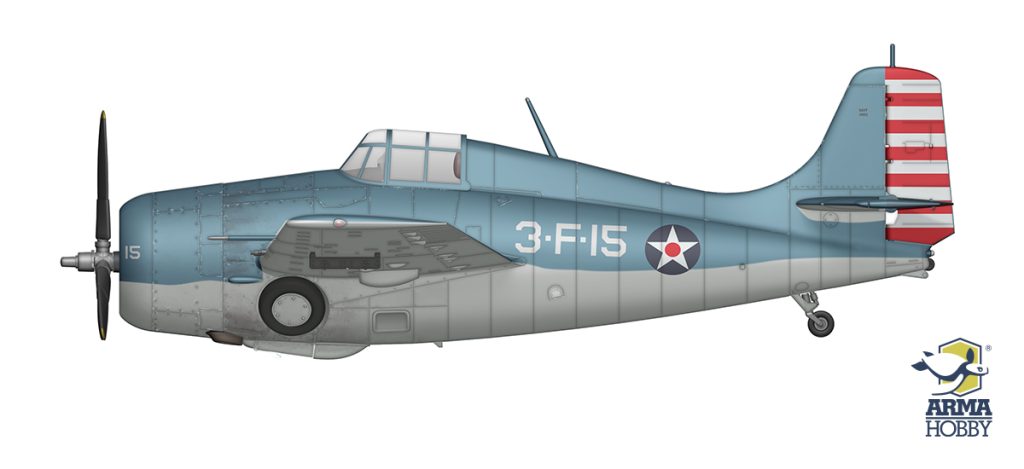
Just one week after the end of the maneuvers: Grumman F4F-3 Wildcat from USS Enterprise, VF-6, BuNo 3982, code 3-F-15, Ens. Gayle L. Hermann, Oahu, 7 December 1941.
7 December 1941
On 30 November, after the maneuvers had ended, General Lesley McNair summed up their results. He believed that American soldiers would be capable of fighting, but would suffer very heavy losses.
A week later, the Japanese attacked Pearl Harbor.
For VMF-111, the period of exercises and preparations was over. The unit was among the Marine squadrons sent to defend American positions in the Pacific.
On 10 March 1942 its aircraft arrived on Tutuila, becoming the first Marine fighter squadron stationed on Samoa. VMF-111 was later re-equipped with Corsairs. The squadron fought in the Pacific until the end of the war.
One of the unit’s pilots, Paul Fontana, recalled years later that when the war began, some of the young aviators had only 25–30 hours on Wildcats.
In November 1941 they flew with red crosses, chasing an enemy whose victories and losses were decided by the maneuver umpires. A few months later, a real war in the Pacific awaited them.
1941 Wildcats in Arma Hobby models
Two 1941 Wildcat paint schemes can be reproduced with our 1/72 scale kits.
The 70091 F4F-3 Wildcat “Yellow Wings” kit represents aircraft from the end of the colorful prewar era of US Navy aviation.
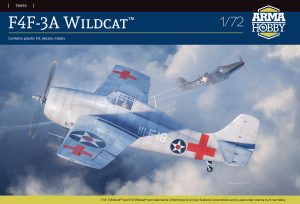
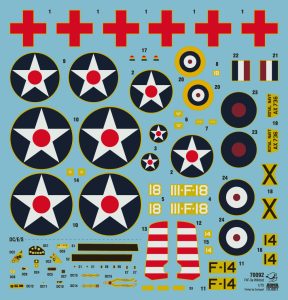
The 70092 F4F-3A Wildcat kit, on the other hand, includes the 111-F-18 scheme of VMF-111, with the huge red crosses from the 1941 maneuvers.
Two Wildcats, almost the same design, yet such different times.
Bibliography
- Christopher R. Gabel, The U.S. Army GHQ Maneuvers of 1941, CMH Pub 70-41-1, Center of Military History, Washington 1991.
- Henry I. Shaw Jr., Opening Moves: Marines Gear Up for War, Marines in World War II Commemorative Series, History and Museums Division, USMC, Washington 1991.
- Hans Groenhoff Photographic Collection (NASM.XXXX.0359), National Air and Space Museum Archives, Smithsonian Institution.
- Dive Bomber, dir. Michael Curtiz, Warner Bros., 1941
- Kinzey, Bert, F4F & FM Wildcat in Detail & Scale, Vol. 7, Detail & Scale, 2018, Kindle Edition. This publication includes several excellent photographs of the aircraft discussed in this article.

Modeller happy enough to work in his hobby. Seems to be a quiet Aspie but you were warned. Enjoys talking about modelling, conspiracy theories, Grand Duchy of Lithuania and internet marketing. Co-founder of Arma Hobby. Builds and paints figurines, aeroplane and armour kits, mostly Polish subject and naval aviation.
This post is also available in:
 polski