

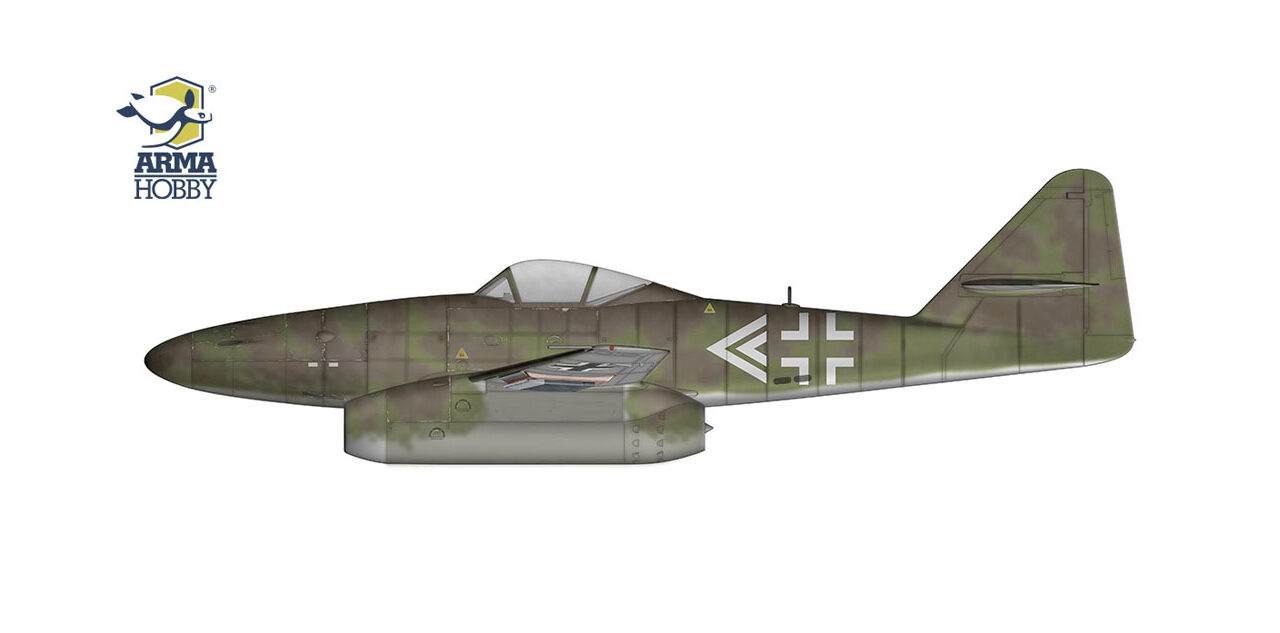
While the course of Adolf Galland’s final combat mission is relatively well documented, the aircraft he flew that day remains a mystery to this day. Available sources are fragmentary, and identifying the exact machine relies largely on indirect evidence and comparative analysis.
Title illustration: Messerschmitt Me 262 A-1a, JV 44, probable aircraft of Adolf Galland, München-Riem, April 1945. Likely WNr 1117xx, Kuno I production, EZ42 Adler gunsight, R4M rockets. Artwork by Zbyszek Malicki, Arma Hobby.
In 2009, Jerry Crandall published two photographs showing a Messerschmitt Me 262 A-1a, along with a fragment of the flight log of one of the pilots from JV 44. Based on this material, it was suggested that the aircraft seen in the photos may have been assigned to Galland — and that it was the machine in which he flew his last combat sortie.
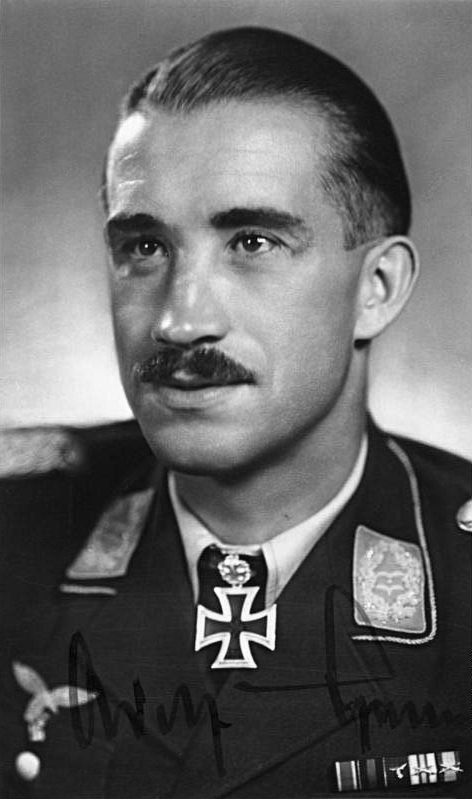
Adolf Galland – commander of JV 44, Luftwaffe fighter ace, and one of the best-known pilots of the Second World War. Photo: Bundesarchiv, Bild 146-2006-0123 / CC BY-SA 3.0
Galland and His “Jet War”
Adolf Galland was one of the most recognisable figures of the Luftwaffe — a fighter ace credited with 104 victories, a senior commander, and a man of strong personality. Associated with his trademark cigar and Mickey Mouse emblem, he stood out both in the air and on the ground.
He was a determined advocate of introducing jet fighters into combat service. In particular, he wanted the Me 262 to be used in its intended role as an interceptor fighter. He openly opposed Adolf Hitler’s decision to force the aircraft into use as a bomber.
The Me 262 itself made a tremendous impression on Galland. He is said to have remarked that it “flew as though pushed by angels.” Few phrases better capture the technological leap represented by the aircraft.
Toward the end of the war, Galland, now in conflict with the Luftwaffe leadership, formed the elite unit Jagdverband 44. It was with this formation that he flew his final combat mission on 26 April 1945 from München-Riem airfield, returning wounded in a damaged aircraft.
Messerschmitt Me 262 A-1a WNr 500071 – historia, malowanie i ostatni lot
Identifying the Aircraft
The aircraft in question is known only from two photographs most likely taken in late April 1945 at Riem airfield. They show the machine undergoing servicing work on its landing gear.
Its markings are partly obscured by camouflage netting, but the visible section suggests a double white chevron — the marking of a Geschwader commander. Unfortunately, the lack of tail photographs prevents identification of the serial number and full national insignia.
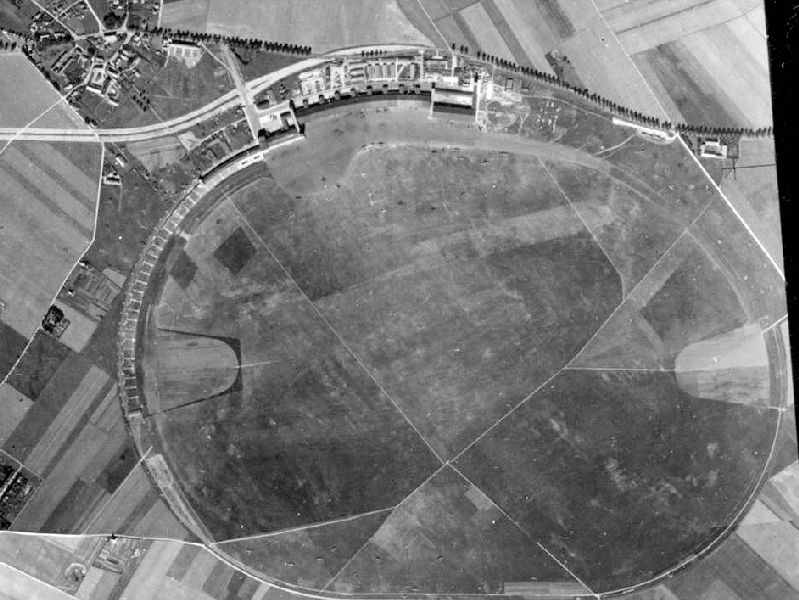
It was from München-Riem airfield that Galland took off on his final combat mission. Seen here through the lens of an American camera in 1942. Wikimedia Commons.
Production: Kuno AG Werk I
Analysis of construction details and camouflage strongly suggests that the aircraft was built at Kuno AG Werk I, codenamed “Kiesweg I”.
Located in the Scheppach forest near Leipheim, the plant operated in March and April 1945. Aircraft produced there took off from an improvised runway — a section of the A8 motorway approximately 1,700 metres long.
Based on known serial numbers, around 86 Me 262 aircraft are believed to have been completed there, within the range 1117xx–1123xx.
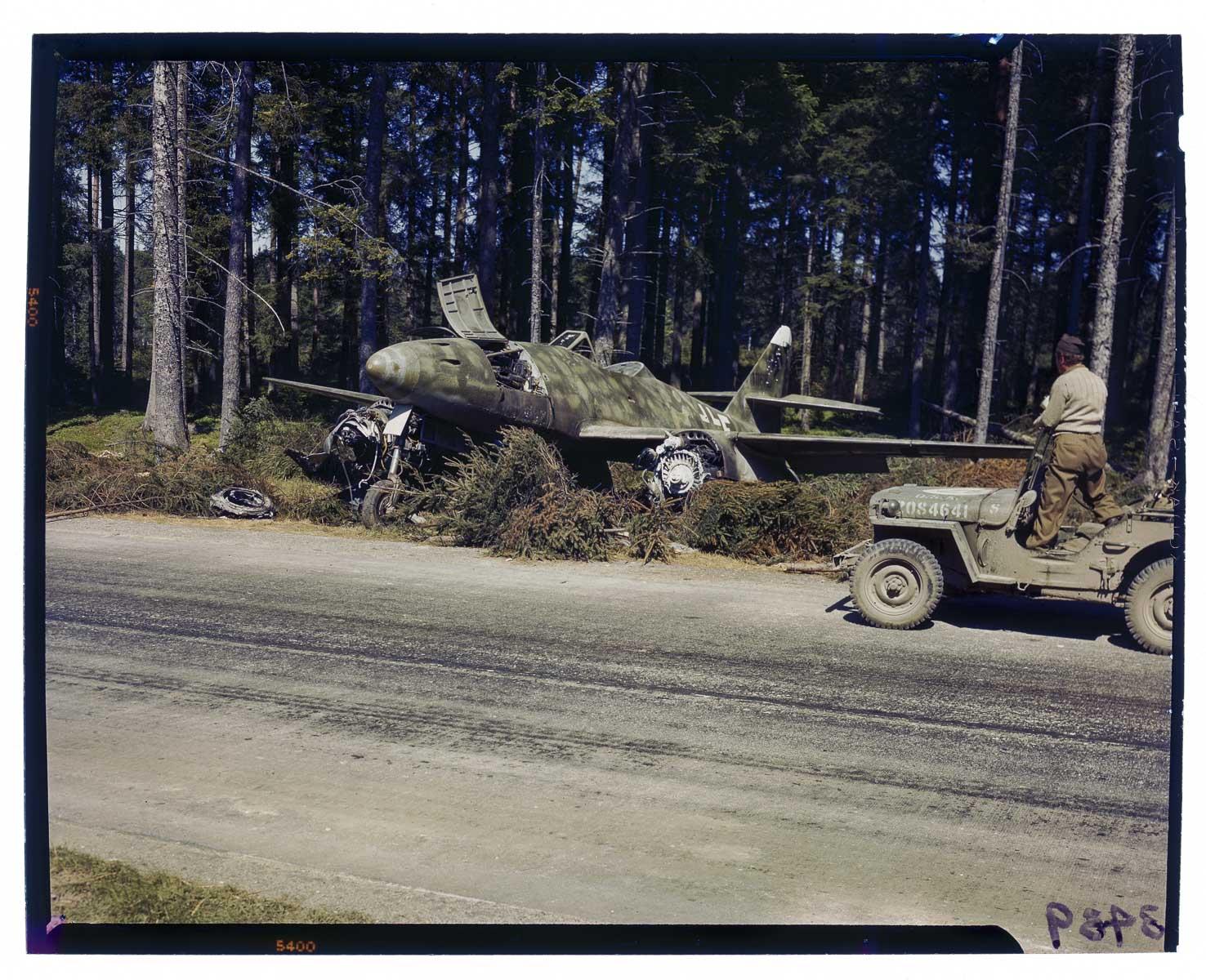
Messerschmitt Me 262 A-1a, 9K+FH, an aircraft from the earlier production batch WNr 111658, abandoned beside a road near Munich. Photo: US Army.
Identification Clues
Several details point to the aircraft belonging to the Kuno I production batch:
- distinctive ammunition loading stencil markings,
- two white rectangles beneath the gun bay,
- layout and style of other servicing markings,
- the type of national insignia visible,
- gun bay covers with teardrop-shaped bulges above the spent-case chutes,
- a low camouflage demarcation line descending to the lower edge of the fuselage,
- characteristic ammunition servicing markings beneath the gun compartment.
In addition, JV 44 is known to have operated aircraft with serial numbers 111740–111745 and higher, whose appearance corresponds with the machine under discussion. On that basis, it may be cautiously assumed that Galland’s aircraft belonged to the same series numbered within the 1117xx range.
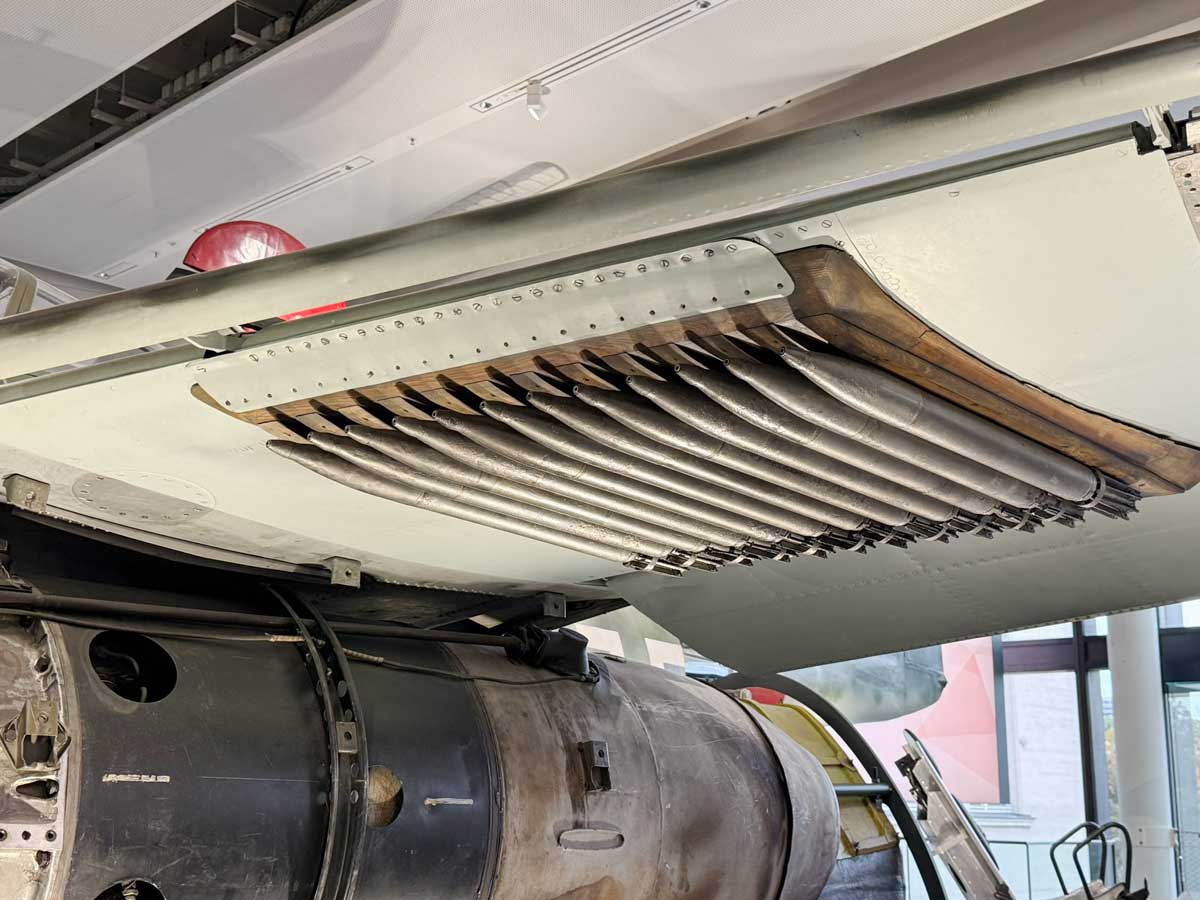
R4M Orkan rockets under the wing of a Me 262 A-1a. See the full aircraft walkaround here.
Equipment and Armament
One of the most interesting features of the aircraft was the EZ42 Adler, an experimental gyroscopic gunsight produced by Askania Werke.
The device automatically calculated lead angle corrections, taking into account speed, G-load and target movement. Because of limited availability, it was fitted only to selected aircraft.
According to Alfred Borchert, chief of the ground crew, Galland’s aircraft was also armed with unguided R4M Orkan rockets.
During his final combat mission, Galland was unable to use them because he could not release the rocket firing mechanism. He eventually attacked the bombers with cannon fire, destroying one B-26.
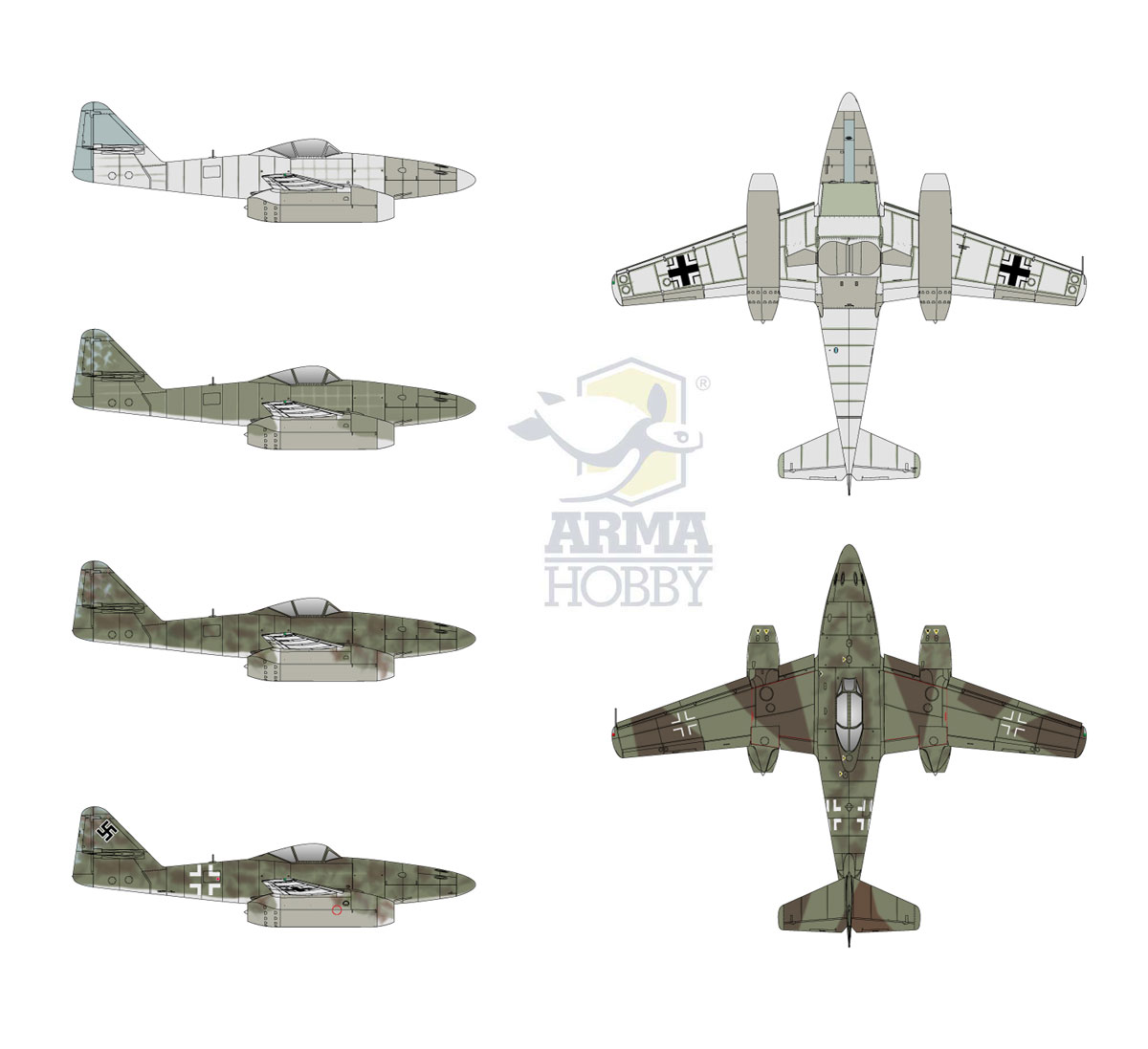





Reconstruction of the painting sequence of Galland’s aircraft. Artwork by Zbigniew Malicki, Arma Hobby.
Camouflage and Markings
The aircraft carried a simplified late-war camouflage scheme, representing one of the final forms used before protective painting of the Me 262 was abandoned entirely:
- upper surfaces: RLM 81 (brown variant) and RLM 82,
- fuselage: base coat of RLM 82 with irregular RLM 81 blotches,
- no sharp colour boundaries — the tones blended into each other.
The undersurfaces were largely left unpainted, except for components supplied by subcontractors, painted in colours approximating RLM 76 or RLM 02.
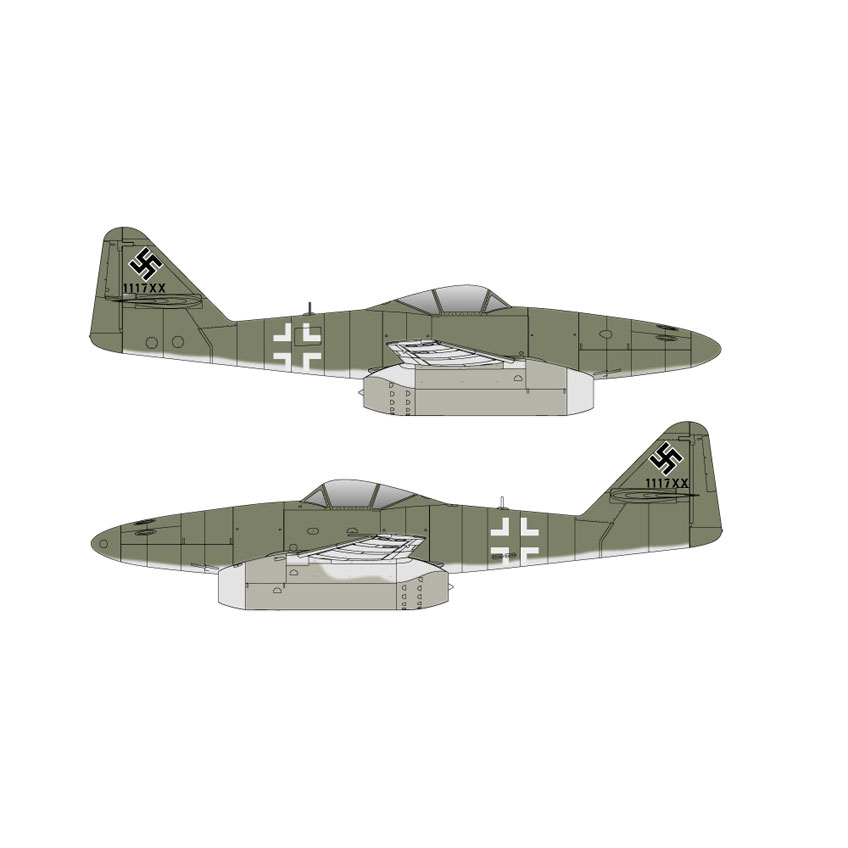
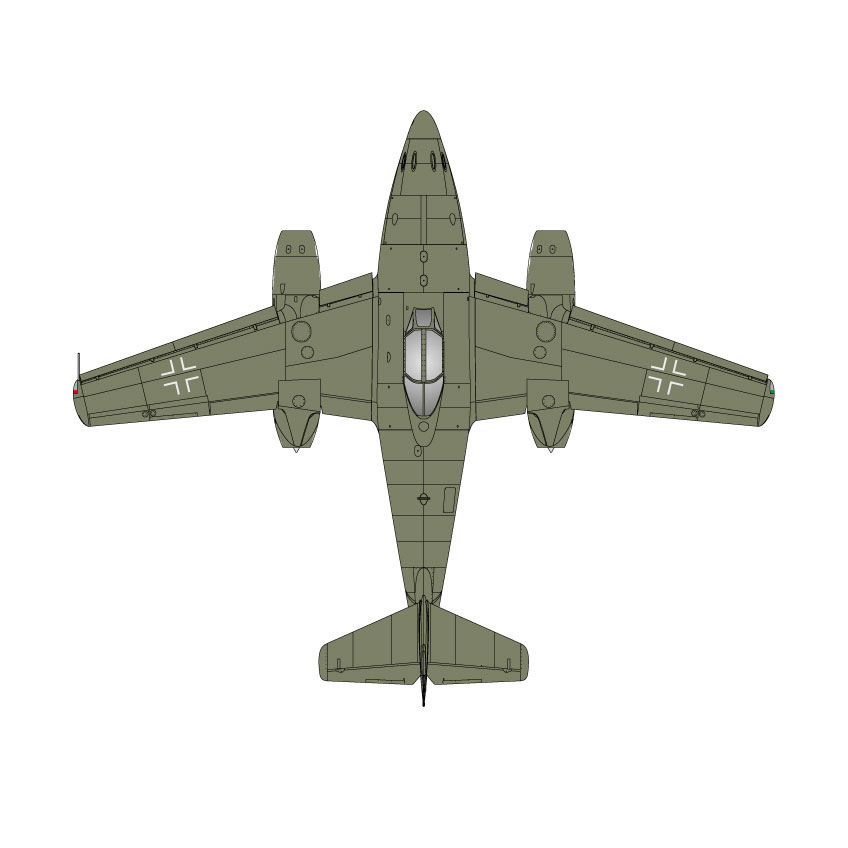
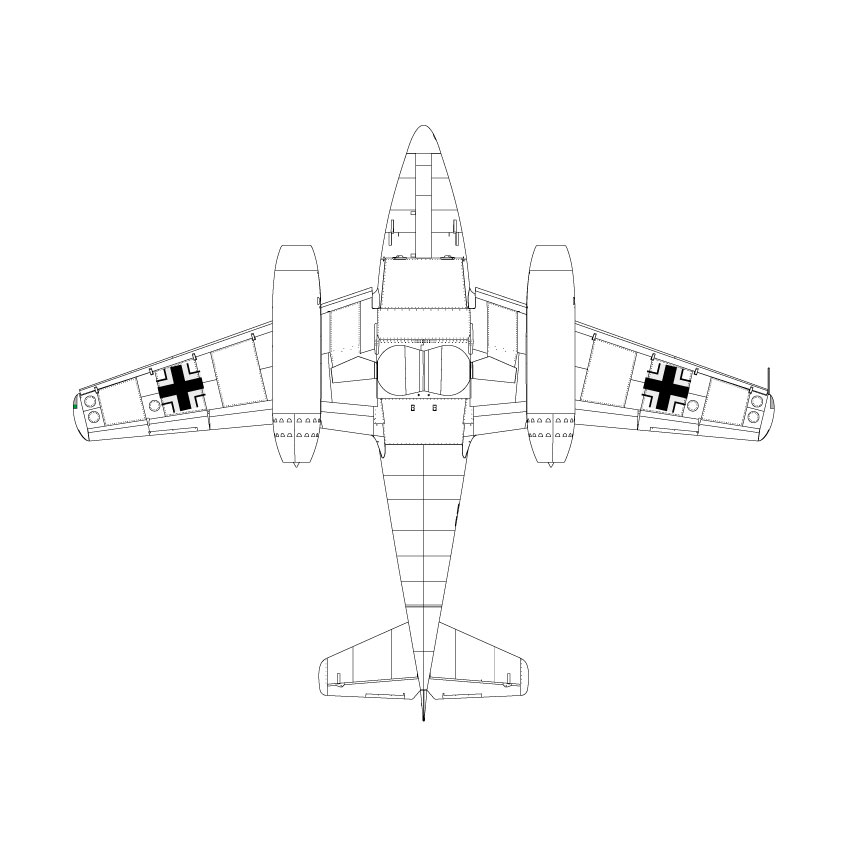
Positioning of national markings and serial number on Galland’s aircraft. Their style and layout are characteristic of aircraft produced under the Messerschmitt Augsburg network, including Kuno I. Note the slightly different orientation of the fuselage cross in relation to panel lines compared with aircraft built by Messerschmitt Regensburg. Artwork by Zbigniew Malicki, Arma Hobby.
Oznaczenia obejmowały:
- white Balkenkreuz corner markings on upper wings and fuselage sides,
- standard black-and-white crosses under the wings,
- a classic black swastika with white outline on the fin,
- serial number applied by stencil at the base of the fin,
- individual markings – a double white chevron, whose exact shape and placement remain approximate.
Me 262 i późno wojenne kolory RLM – próba uporządkowania tematu
The Final Mission and the Fate of the Aircraft
Galland’s most likely attacker during his final mission was 22-year-old James J. Finnegan of the 10th Fighter Squadron, 50th Fighter Group. Flying a P-47D, he fired on the jet fighter, hitting the starboard engine and the area around the cockpit. A photograph of the pilot and his P-47D-28 can be found in an obituary published by SFGATE.
It should also be remembered that the German aircraft had already come under fire from defensive gunners aboard the B-26 bombers they were attacking, who also reported hits on the jets.
Wounded in the knee, Galland managed to control the damaged aircraft, break away from his pursuers and return to the Munich area. Struggling with engine control problems, he made a hard landing at Riem airfield — the last of his combat career.
According to the flight log of Lt. Ernst Hasse, just three days later, on 29 April 1945, an aircraft carrying the commander’s markings was ferried to Innsbruck. There the documented story of the machine ends.
Was it the same aircraft Galland had flown, repaired in only three days?
To this day, the aircraft has not been conclusively identified in photographs taken after the capture of the airfields at Innsbruck or Salzburg, despite the fact that other JV 44 aircraft are relatively well documented. This is all the more surprising, as a clearly marked commander’s aircraft belonging to such a famous figure would normally be expected to attract considerable photographic attention.

Abandoned Messerschmitt Me 262 A-1a WNr 111857 of Jagdverband 44 photographed at Innsbruck-Hötting in May 1945. Part of JV 44 was relocated to Innsbruck during the final days of the war. Photo: U.S. Army Air Forces 342-FH-3A04899-57928AC.
Epilogue: The Places Today
- Kuno I (Scheppach/Burgau) – only traces of infrastructure remain in the forest.
- München-Riem – now the site of Messe München exhibition grounds.
- Innsbruck and Salzburg – functioning international airports.
One of the aircraft produced at Kuno I survives today — Me 262 A-2a WNr 112372, now in the collection of the Royal Air Force Museum.
In Salzburg, Hangar 7 is worth visiting — a unique aviation museum and display space for the Flying Bulls collection.
Conclusion
The aircraft in which Galland flew his final combat mission remains one of the more intriguing mysteries connected with the history of the Me 262. Available evidence allows a partial reconstruction of its appearance and equipment, but full identification still remains beyond reach.
Perhaps future archival discoveries will finally close the case. Until then, it remains a fascinating field for research, interpretation and modelling reconstruction.
Bibliography
- Crandall, Jerry. The Focke-Wulf Fw 190 Dora, Volume Two. Hamilton, MT: Eagle Editions, 2009. ISBN-13: 978-0979403514.
- Forsyth, Robert. Battle over Bavaria: The B-26 Marauder Versus the German Jets. Oxford: Classic Publications, 2000. ISBN-13: 978-0952686743.
- Kartschall, Alexander. Messerschmitt Me 262: Geheime Produktionsstätten. Stuttgart: Motorbuch Verlag, 2017. ISBN-13: 978-3613042582.
- Wenni-Auinger, Martina. Kuno AG Werk I. Die Endmontage der Messerschmitt Me 262 und die Rolle des KZ-Außenlagers Burgau. Eigenverlag, 2018. ISBN-13: 9783000726217.
You may also like:
- Buy now: link.

This post is also available in:
 polski



Very interesting and well-reasoned interpretation of Galland’s Me 262. I am finishing an article on Steinhoff’s last machine so your article is quite timely.
I believe Galland’s last Me 262 could equally have been ‘White 3’ WNr.110757. This machine was claimed by Franz Stigler as a machine favoured by himself and Galland, and was the one the latter was injured in on 26 April. It crashed immediately after take-off on 28 April 1945 at Oberweissenfeld north of München-Riem with its pilot, Lt. Walter Pirchan was fatally injured. (Information from a phone interview I did with Franz Stigler way back in June 1991.) Beyond two photos there are none taken post-crash.
Regarding “White Double Chevron’s ultimate fate, it is listed in Ofw. Ernst Haase’s Flugbuch as “<<” and being flown as an “Überfuhrung” from München-Riem to I”nnsbruch-West” (Höttng) on 29 April 1945 with take-off at 10:12 and landing at 10:32. Thus this machine must have ended up at the extreme western end of the airfield. So far there are no known photos of it.
I look forward to carefully reading this and your other articles.
Best,
David