

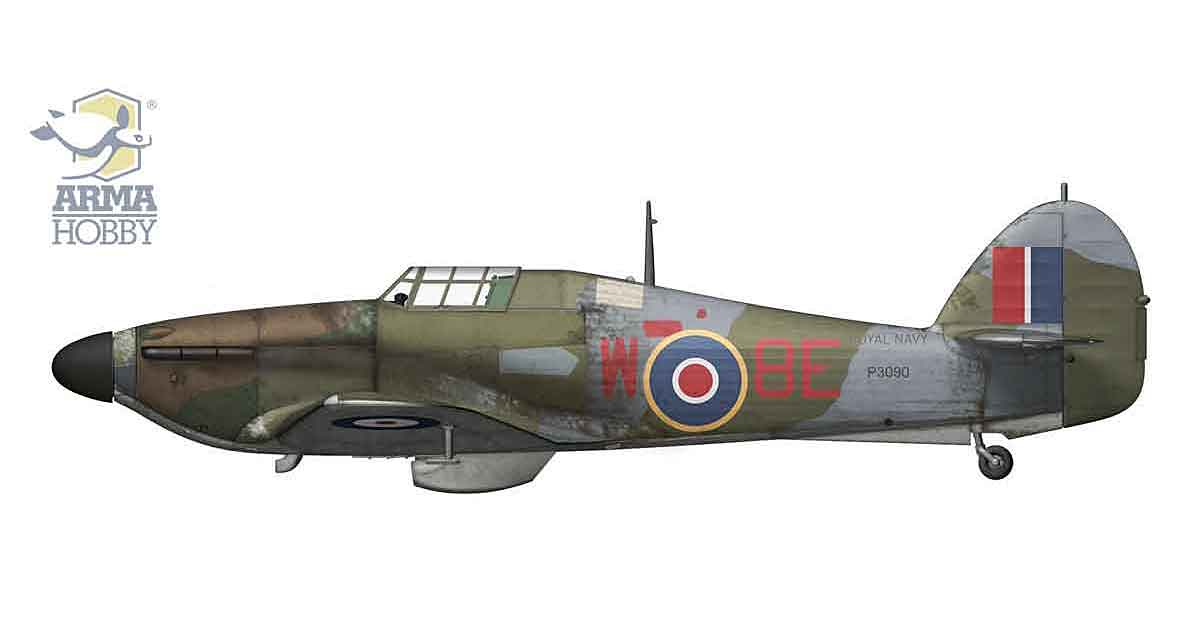
 Although it fought in the Battle of Britain in 1940, its greatest merit was quiet, everyday service. Hurricane Mk I serial P3090, later operated by the Fleet Air Arm, is an example of an aircraft that, after frontline service, moved to the Navy where it became a reliable “workhorse” of the Fleet Air Arm.
The Hawker Hurricane with serial number P3090 began its service in 1940 as a classic RAF fighter, built at the Gloster Aircraft Company. It was fitted with a Rotol propeller with a Spitfire spinner, a configuration typical, among others, for this production series.
Over two and a half years, it went from a frontline RAF unit to training Fleet Air Arm pilots.
From production to the front
The P3090 was delivered on 15 June 1940 to 19 Maintenance Unit (MU), and as early as 24 June it was assigned to 242 Squadron RAF, one of the units fighting in the Battle of Britain.
After several months of intensive use, it was transferred to 43 Group Delivery Aircraft (15 September 1940), and then to Austins (21 September) — most likely for inspection or repair. By the end of October it was with 46 Maintenance Unit (MU).
Two accidents – two fortunate endings
On 5 November 1940, during take-off from Tern Hill, Hurricane P3090 struck a stack of land drains while attempting an emergency landing. The pilot, First Officer J.K. Bodinnar, walked away unhurt, although the aircraft was seriously damaged (class CB — repair at contractor).
After repairs at de Havilland, the aircraft returned to service with 44 MU. Unfortunately, on 12 January 1941 it had to make another forced landing — this time near Ratcliffe. The pilot, First Officer A. Kirkby, also escaped without injury. The damage was classified as CA (repair at unit).
In naval service – Hurricane in Fleet Air Arm colours
In April 1941 P3090 was transferred to the Fleet Air Arm. In some sources (Hurricane Production List) it appears as a Sea Hurricane Ib, but in reality it had neither an arrestor hook nor catapult spools, nothing is known about her service on CAM-ship — so it was not a true “Sea Hurricane”. Most likely it was a standard Hurricane Mk I taken on FAA charge and repainted in the Temperate Sea Scheme, possibly with a few minor modifications typical of naval aviation (e.g., radio or onboard equipment changes).
After transfer it went first to 759 Squadron FAA, and then to 760 Squadron at RNAS Yeovilton. In this unit it carried the code W8-E, later changed to “S”.
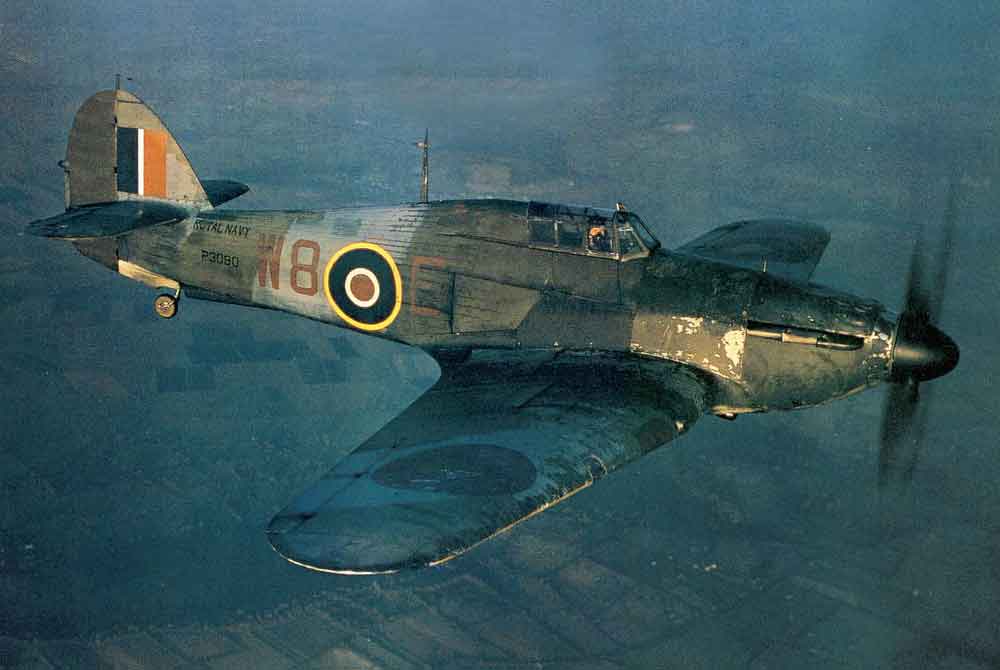
On three photos from the summer of 1942…
On three photos from the summer of 1942 you can clearly see the right and left sides as well as the underside of the fuselage of Hurricane P3090. In the colour photograph the aircraft clearly wears the Temperate Sea Scheme — Dark Slate Grey / Extra Dark Sea Grey / Sky.
What stands out are not only numerous touch-ups and patches, but also components taken from other airframes. The first is the right wing — in the underside view different sizes of Type A roundels are visible, indicating that a half-wing was replaced. The pattern of camouflage blotches on the upper surface also supports this conclusion.
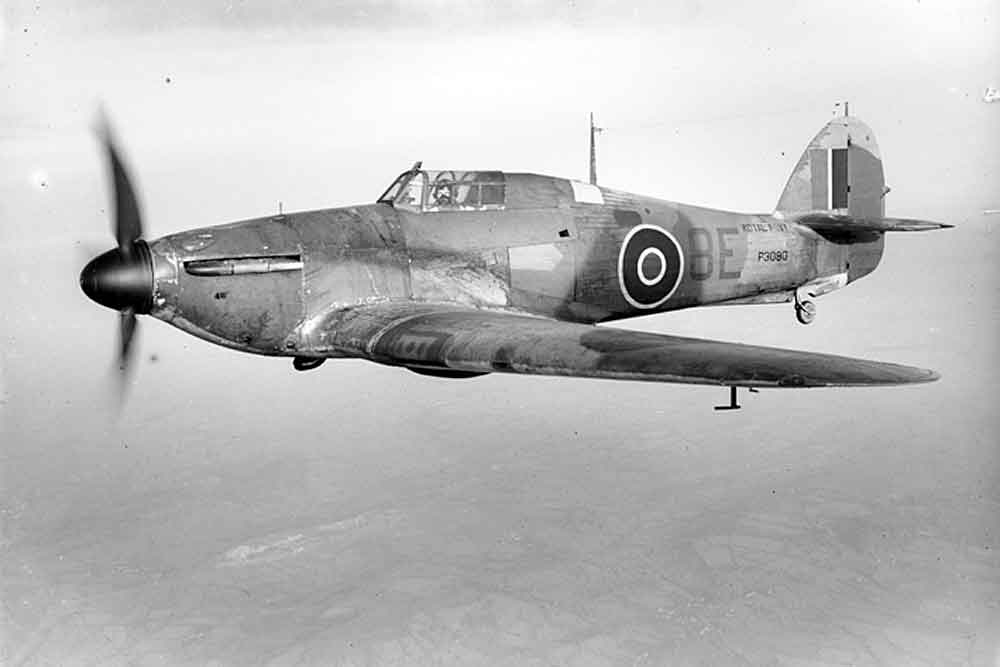
Touch-ups and signs of hard use
Equally interesting are the engine cowlings, which show the Temperate Land Scheme colours (Dark Green / Dark Earth) typical of earlier, land-based Hurricanes. These parts are heavily scuffed and worn, evidence of intensive use.
On the wings and fuselage there are also light-grey touch-ups, most likely applied with the temporary “Mixed Grey” paint (Sea Grey Medium 8 parts + Black 1 part), used at the time in various RAF Hurricane camouflage variants as a substitute for Ocean Grey. Touch-ups also appear in red primer, and in places even in Sky.
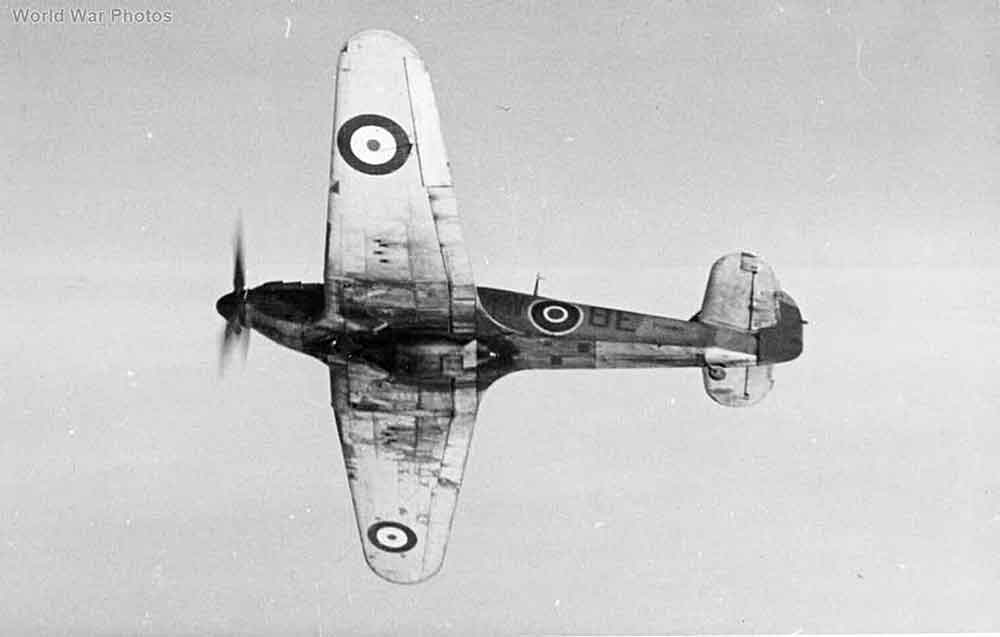
The underside is heavily weathered and dirty, which is clearly visible in the photos. For a modeller this means real freedom of interpretation — the appearance of this airframe surely changed from day to day with ongoing repairs and wear. Our interpretation is an attempt to bring order to this paint-scheme chaos, to best convey the character and story of a machine that went through a lot.
- The appearance of the aircraft could change from day to day, offering a wide field for the modeller’s creativity.

Heavy landing and final flight
On 25 February 1942 a heavy landing occurred. The pilot, Sub-Lt T.H. Hoare (RNZN), was uninjured, and the aircraft suffered CX-level damage.
The last entry in P3090’s history is dated 21 January 1943. During a training flight in fog, Sub-Lt C.J. Allen (RNZN) lost orientation and crashed near Charlton Mackrell (Somerset). The pilot was injured, and the aircraft was deemed destroyed (CZ) and struck off charge.
From frontline fighter to a naval workhorse
The story of Hurricane P3090 reflects the typical path of many RAF fighters. Aircraft that defended Britain’s skies in 1940 later, after a series of repairs and modifications, moved into naval aviation where they continued to serve — as training, catapult, or auxiliary machines.
P3090 was precisely such a wartime “workhorse” — reliable, rugged, and always ready for duty, whether fighting over the English Channel or training new Fleet Air Arm pilots.
Also see:
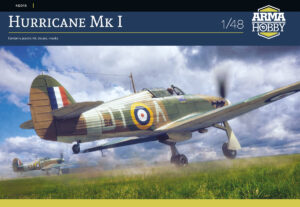
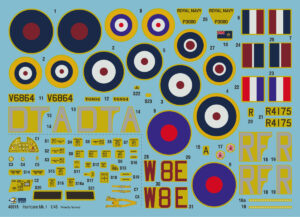
👉 See in the shop the Hurricane Mk I model: link

Modeller happy enough to work in his hobby. Seems to be a quiet Aspie but you were warned. Enjoys talking about modelling, conspiracy theories, Grand Duchy of Lithuania and internet marketing. Co-founder of Arma Hobby. Builds and paints figurines, aeroplane and armour kits, mostly Polish subject and naval aviation.
This post is also available in:
 polski

I suspect that colour photo is colourised. I believe that what happened in many cases is that a reel of b&w film was shot and then one photo was colourised for say the cover of a magazine. Colour film was pretty rare and would obviously never have been shot in a few frames and then printed. So the colourised photo was taken as part of the photo shoot of the others. One big clue is it appears to have 4 propellor blades! The wings are also very peculiar colours, and there are places where the colouriser appears to have assumed parts of the underside are black e.g. under the nose.
Yes, I suspected that too. We’ve discussed this among ourselves, and so far we haven’t come across any black-and-white photo that could have been the source for this colourised version. Thanks for your insightful comment!